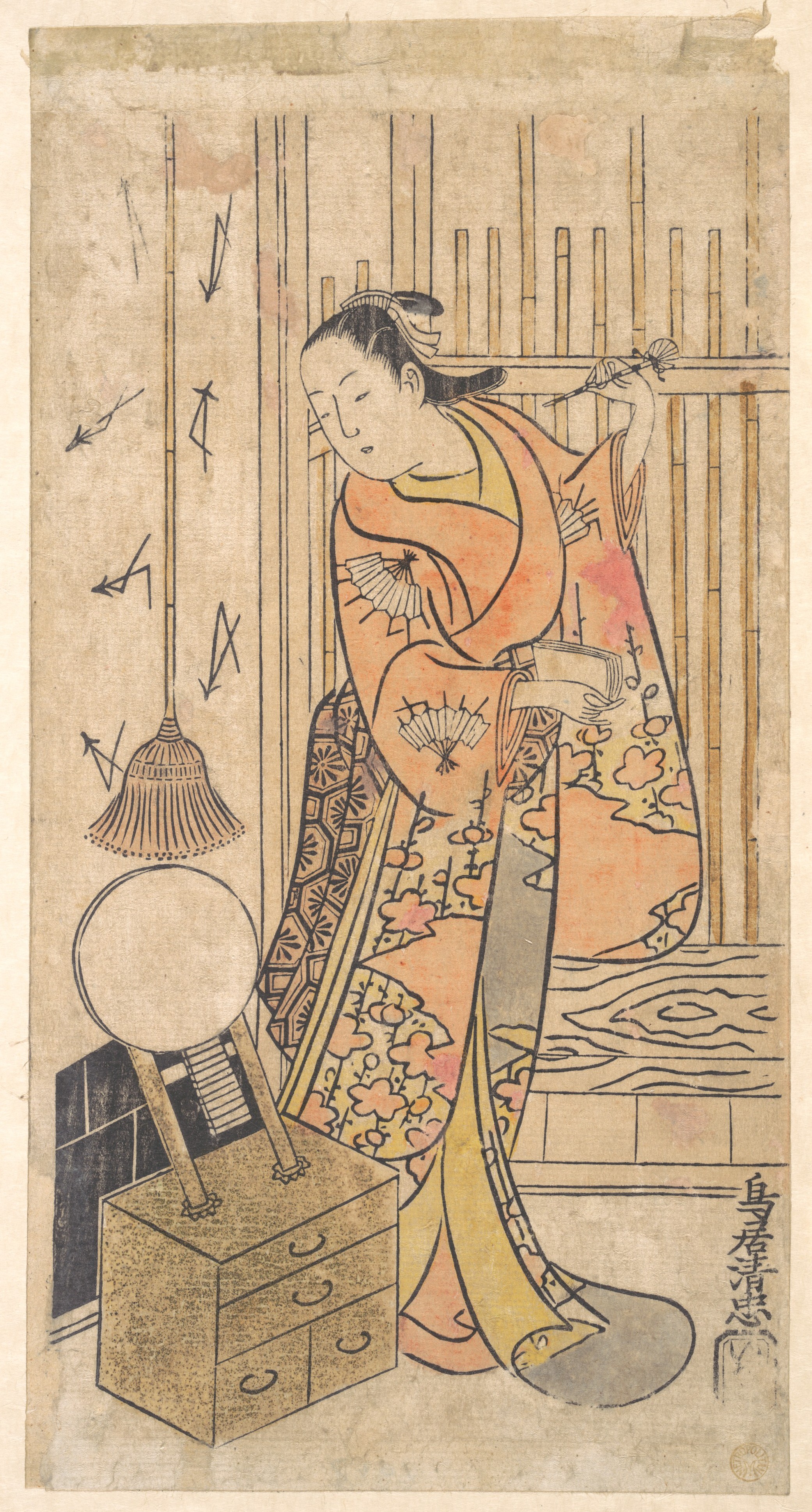
Actor as a Woman Standing by a Mirror Stand
- Date:
- ca. 1735
- Medium:
- Woodblock print; ink and color on paper (Urushi-e)
- Source:
- Metropolitan Museum of Art
Description
An urushi-e (lacquer print) by Torii Kiyotada portraying an onnagata - a male actor specialised in female roles - standing beside a mirror stand (kyodai), the freestanding wooden frame and bronze mirror that was a fixture of Edo women's dressing rooms. The intimate gesture of an onnagata before a mirror was one of the recurring conceits of early-eighteenth-century yakusha-e, allowing the print designer to depict the doubled fiction at the core of female-role performance: the male actor in female costume, contemplating his own constructed femininity in the reflective surface of the mirror. Onnagata performance had become one of the defining features of the Edo kabuki stage after the Tokugawa shogunate banned both women (in 1629) and adolescent male performers (in 1652) from the professional theatre, leaving adult male actors to play all female roles - a casting tradition that the Torii workshop's yakusha-e documented across more than a century. The urushi-e technique used a thick, glossy ink made by mixing standard sumi with animal-skin glue, often supplemented by sprinklings of brass or tin metal dust applied to selected passages of the composition; the resulting print imitated the lacquered surface of refined Japanese applied arts. Kiyotada was one of the leading designers of the urushi-e technique in the second quarter of the eighteenth century, working in the Torii school that monopolised actor-print production in Edo. The print belongs to circa 1735 and is held by the Metropolitan Museum of Art, which preserves the largest American holding of Kiyotada's signed urushi-e.
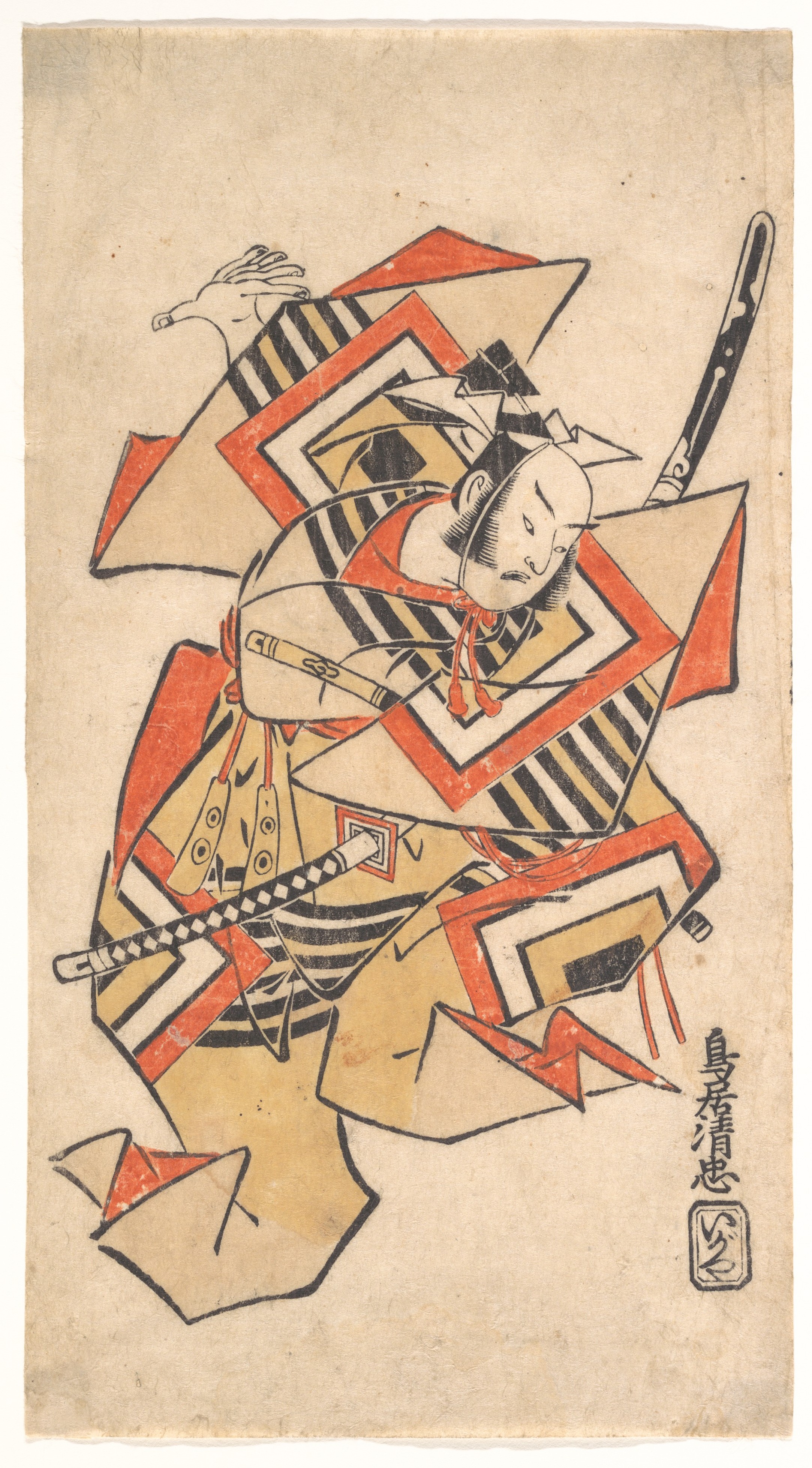
More Prints by Torii Kiyotada I
Frequently Asked Questions
Actor as a Woman Standing by a Mirror Stand was created by Torii Kiyotada I (鳥居清忠) in ca. 1735.