Biography
Tsukioka Settei (月岡雪鼎, 1710-1786) was an eighteenth-century painter and book illustrator who founded the Tsukioka line of artists in Osaka and stood as one of the most influential figures in the Kamigata-e tradition. Working at the western pole of Japanese visual culture rather than in the shogunal capital of Edo, Settei produced bijin paintings, illustrated books (ehon), and shunga albums that defined the Osaka and Kyoto inflection of ukiyo-e at the moment Suzuki Harunobu was launching the polychrome nishiki-e revolution far to the east. His work survives in major collections including the Art Institute of Chicago, the Metropolitan Museum of Art, and the British Museum, documenting an artist who carried Kanō-academy training into the popular print world of Kamigata.
Born in Ōmi Province (modern Shiga Prefecture) in 1710, Settei is also recorded under the name Masanobu and used several art names over his long career. His formal training came not from the ukiyo-e ateliers but from the Kanō school, the orthodox samurai-class painting academy that dominated official Japanese pictorial culture from the late sixteenth century through the Meiji Restoration. Settei studied under Takada Keiho, a leading Kanō master, absorbing the academy's rigorous training in brushwork, classical figural conventions, and Chinese-derived subjects. This pedigree distinguished Settei from most ukiyo-e artists, whose training came through workshop apprenticeship within the print trade, and marked his mature output with a refinement of line unusual in the ukiyo-e tradition.
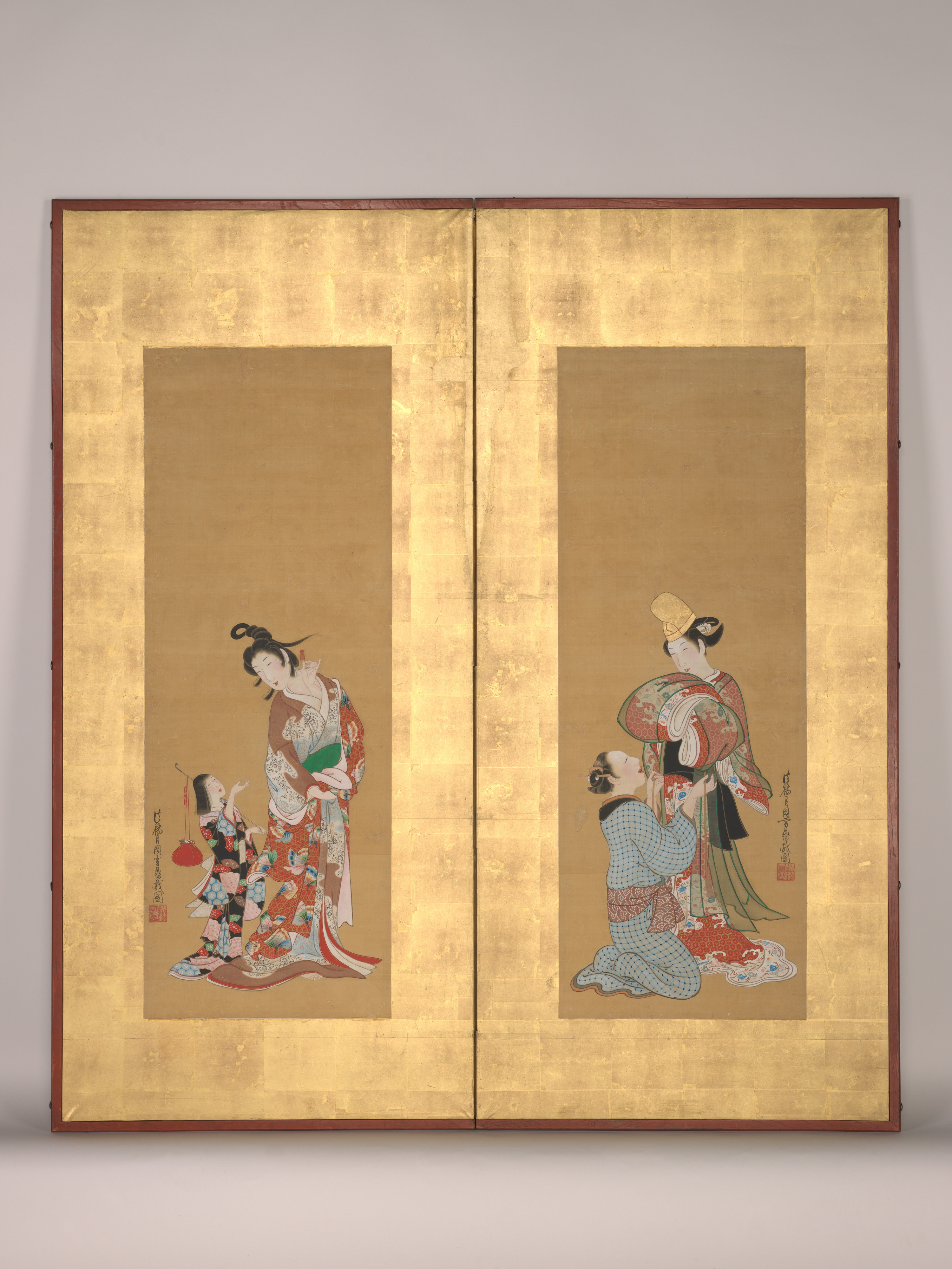
In mid-career Settei settled in Osaka and turned his practice toward ukiyo-e, applying his Kanō training to bijin-ga, historical figures, and illustrated literature for the Kamigata commercial market. The Kamigata-e tradition Settei helped define differed from the Edo ukiyo-e of contemporaries such as Suzuki Harunobu, Torii Kiyomitsu, and Katsukawa Shunshō: where Edo prints emphasized contemporary fashion, kabuki actor portraits, and the Yoshiwara pleasure quarter, Kamigata artists drew more heavily on classical literary subjects, courtly beauties, and the courtesan culture of the Shimabara and Shinmachi quarters in Kyoto and Osaka. Settei's bijin paintings, executed in the ink-color-and-gold-on-silk manner of his Kanō training, established a Kamigata model for elegant female portraiture.
From his Osaka studio Settei produced an enormous output of illustrated books, the principal commercial vehicle for his art. The Kamigata publishing industry specialized in ehon and gafu (painting manuals) combining refined Kanō-school draftsmanship with the subjects of urban Japanese life, and Settei was among its most prolific contributors. His Kingyoku gafu (1771), held in the Art Institute of Chicago in a six-volume set, is one of his most celebrated late painting manuals, gathering model compositions that Kamigata artists and amateurs consulted for figure drawing. His Ehon Misao gusa (Onna Buyū Kehai Kurabe), also at the Art Institute, addresses the eighteenth-century subject of female martial heroes drawn from classical literature.
Settei was also a substantial producer of shunga, the explicit erotic genre that constituted a major sector of the eighteenth-century Japanese print and book trade. His shunga albums, executed with the same refined Kanō-trained brushwork as his bijin paintings, are recognized today as among the most accomplished Kamigata productions of the genre and survive in public collections including the British Museum.
From his Osaka atelier Settei trained a school of pupils, most importantly his son Tsukioka Sessai (1761–1839), who succeeded to the Tsukioka name and continued the studio's painting and book-illustration practice. The Tsukioka surname was later borne by artists of the Meiji period — most famously the celebrated print designer Tsukioka Yoshitoshi (1839–1892) and his pupil Tsukioka Kōgyo (1869–1927), known for his nō-theatre prints — whose connection to Settei's Osaka line is not securely documented and who should not be confused with it.
Settei died in Osaka in 1786 at seventy-six. His paintings, books, and shunga remain foundational to the study of Kamigata visual culture and document an artist whose Kanō-trained refinement and prolific Osaka output helped define the western pole of eighteenth-century Japanese popular pictorial art.
Key Facts
Frequently Asked Questions
Tsukioka Settei (月岡雪鼎, 1710-1786) was an eighteenth-century painter and book illustrator who founded the Tsukioka line of artists in Osaka and stood as one of the most influential figures in the Kamigata-e tradition. Working at the western pole of Japanese visual culture rather than in the shogunal capital of Edo, Settei produced bijin paintings, illustrated books (ehon), and shunga albums that defined the Osaka and Kyoto inflection of ukiyo-e at the moment Suzuki Harunobu was launching the polychrome nishiki-e revolution far to the east. His work survives in major collections including the Art Institute of Chicago, the Metropolitan Museum of Art, and the British Museum, documenting an artist who carried Kanō-academy training into the popular print world of Kamigata.
Tsukioka Settei was active from 1710 to 1786. They were associated with the Ukiyo-e movement.
Tsukioka Settei's work was shaped by the Ukiyo-e tradition in Japanese woodblock printmaking. Ukiyo-e: ## What is ukiyo-e? Ukiyo-e ([浮世絵](/glossary/ukiyo-e)) — literally "pictures of the floating world" — is the Edo-period Japanese print and painting tradition that flourished from roughly 1660 to 1868, depicting the pleasures of urban life in Edo (modern Tokyo): courtesans, kabuki actors, sumo wrestlers, famous landscapes, and seasonal beauties.
Tsukioka Settei's prints frequently feature children.
Original prints by Tsukioka Settei can be found in collections including Metropolitan Museum of Art.