
Biography
Uehara Konen (上原古年, 1878–1940) was a Meiji–Shōwa shin-hanga designer whose atmospheric landscape and marine compositions occupy a quiet but distinctive place at the threshold between late Meiji nihonga and the mature shin-hanga movement that crystallized around Watanabe Shōzaburō. Born in Tokyo in 1878, Uehara studied under the nihonga painter Kajita Hanko (梶田半古, 1870–1917), from whom he absorbed an observational vocabulary — a restrained palette and a calligraphic shorthand for figures and architecture — that would remain the technical foundation of his print work for the next several decades. He is sometimes encountered in older Western literature as Konen Uehara, following the inverted Japanese-name order common in early twentieth-century European catalogues.
Uehara's most celebrated early prints belong to the years around 1900–1910, when he produced a small but technically remarkable group of marine compositions — the Hatō zu (Waves) sheets now preserved in the Library of Congress's collection of Japanese fine prints — that reduced the great Hokusai-derived wave subject to its essential structural geometry. Catalogued at the Library of Congress in several variant sizes, they share a single project: the systematic study of a breaking wave under different vantages, lighting conditions, and tonal registers. The compositions are pared down almost to abstraction, with the wave occupying nearly the entire sheet, no boats or Fuji or Edo-period decorative apparatus, and a palette restricted to a few carefully modulated blues and greens — among the earliest serious attempts by a Japanese printmaker to reinterpret the Hokusai wave subject in a recognizably twentieth-century visual idiom.
Alongside the wave studies, Uehara produced a substantial body of landscape compositions in the same first decade of the twentieth century, also preserved in significant numbers at the Library of Congress. These prints share a quiet, atmospheric vocabulary — restrained palettes, careful bokashi gradations, calligraphic shorthand for figures and architecture, and a strong preference for evening, moonlit, and winter subjects — that aligns them with the broader Meiji–Taishō transition and prefigures the mature shin-hanga sensibility.
Uehara's prints were issued in Tokyo by the ukiyo-e dealer and publisher Kobayashi Bunshichi, whose shop and celebrated collection were lost in the fires following the 1923 Great Kantō Earthquake, leaving impressions of his pre-earthquake work scarce. Watanabe Shōzaburō, whose print house had become the central institution of the shin-hanga movement, also published a limited number of his designs. Uehara's authentic prints bear a red artist's seal reading "Konen."
He died in Tokyo in 1940, leaving behind a body of atmospheric landscape and marine prints that occupy a quiet but technically distinguished position at the threshold between late Meiji nihonga and the mature shin-hanga movement of the 1920s and 1930s. His work is held today by the Library of Congress, which preserves a significant collection of his early landscape and wave compositions, as well as private collections in Europe and North America.
Key Facts
- Active Period
- 1878–1940
- Nationality
- 🇯🇵Japan
- Movement
- Shin-hanga
- Works Indexed
- 10
Frequently Asked Questions
Uehara Konen (上原古年, 1878–1940) was a Meiji–Shōwa shin-hanga designer whose atmospheric landscape and marine compositions occupy a quiet but distinctive place at the threshold between late Meiji nihonga and the mature shin-hanga movement that crystallized around Watanabe Shōzaburō. Born in Tokyo in 1878, Uehara studied under the nihonga painter Kajita Hanko (梶田半古, 1870–1917), from whom he absorbed an observational vocabulary — a restrained palette and a calligraphic shorthand for figures and architecture — that would remain the technical foundation of his print work for the next several decades. He is sometimes encountered in older Western literature as Konen Uehara, following the inverted Japanese-name order common in early twentieth-century European catalogues.
Uehara Konen was active from 1878 to 1940. They were associated with the Shin-hanga movement.
Uehara Konen's work was shaped by the Shin-hanga tradition in Japanese woodblock printmaking. Shin-hanga: ## What is Shin-hanga? Shin-hanga (新版画), literally "new prints," is the early twentieth-century revival of the collaborative Japanese woodblock workshop, organized between roughly 1915 and 1960 by the Tokyo publisher Watanabe Shōzaburō (1885–1962) and a handful of competing houses.
Uehara Konen's prints frequently feature bridges, pagodas, winter.
Original prints by Uehara Konen can be found in collections including Wikimedia Commons (public domain), Wikimedia Commons (Japanese public domain), Library of Congress, Prints and Photographs Division.
Woodblock Prints by Uehara Konen (10)
Belief of the Universe (Uchū no shinkyō), variant I
宇宙の信仰
c. 1900-1910
Color woodblock print

Belief of the Universe (Uchū no shinkyō), variant II
宇宙の信仰
c. 1900-1910
Color woodblock print

Waves (Hatō zu), variant II
波濤図
c. 1900-1910
Color woodblock print

Ferry Landing in Snow (Yuki no watashiba)
雪の渡し場
c. 1900-1910
Color woodblock print

Five-Storied Pagoda at Nikkō (Nikkō no gojū no tō)
日光の五重の塔
c. 1900-1910
Color woodblock print

Teahouse by the Pond (Ike no chaya)
池の茶屋
c. 1900-1910
Color woodblock print
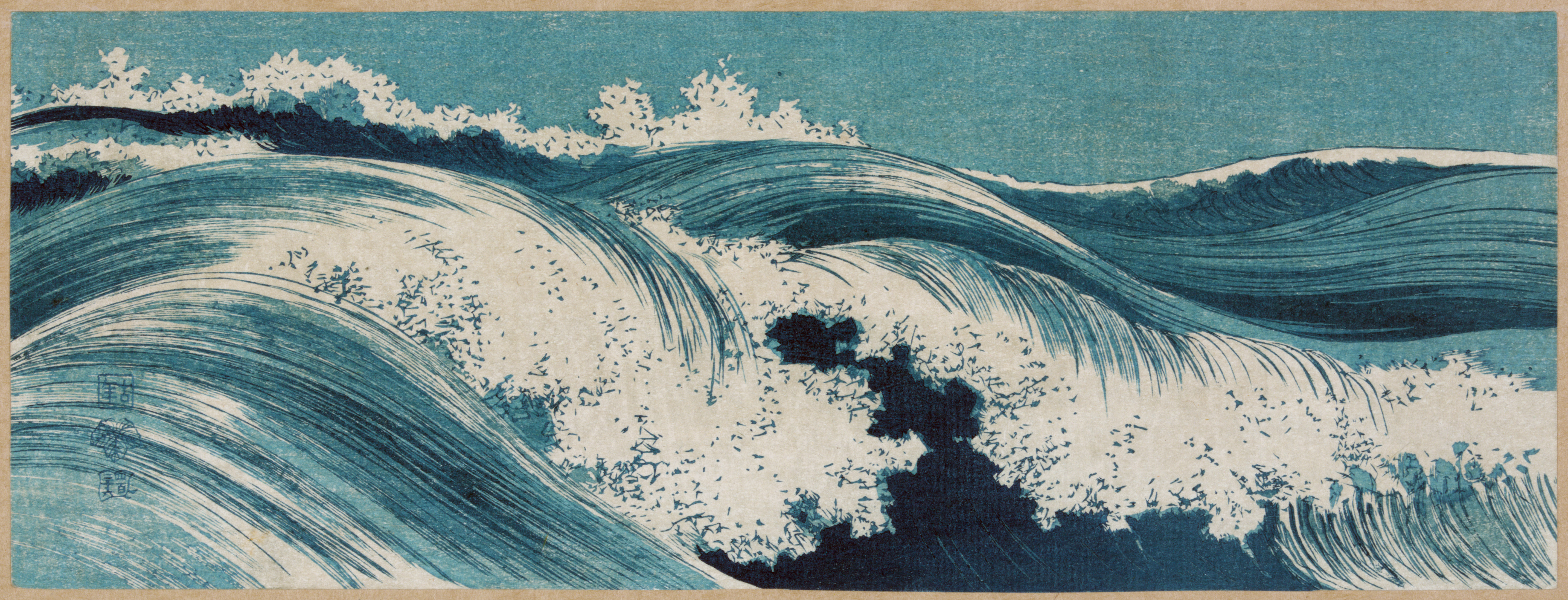
Waves
波
c. 1910
Color woodblock print (woodcut)

Boats and Houses
舟と家
before 1940
Color woodblock print

Bridge over the Sumida River
隅田川の橋
before 1940
Color woodblock print

Winter Landscape
冬景色
before 1940
Color woodblock print