
Biography
Utagawa Hiroshige III (三代目歌川広重, 1842-1894), born Gotō Torakichi (後藤寅吉), was the third artist to inherit the celebrated Hiroshige name and the principal designer who carried the Utagawa school's landscape and topographical tradition into the modernizing world of Meiji Tokyo. His career documents the abrupt transformation of the Japanese print industry between the late Edo (Bakumatsu) period and the new industrial Japan of the 1870s and 1880s, and his prints constitute one of the most extensive visual records of the city's metamorphosis from samurai capital into modern metropolis.
Torakichi entered the studio of Utagawa Hiroshige (Hiroshige I, 1797-1858) as a young teenager in the 1850s and worked there alongside the older pupil Suzuki Chinpei, who would become Hiroshige II. After the master's death in 1858, Chinpei married Hiroshige I's adopted daughter, took the name Hiroshige II, and inherited the studio. Torakichi continued under Hiroshige II, signing his early independent work as Shigemasa (重政) and then as Ichiryūsai Hiroshige. When Hiroshige II's marriage to the master's daughter dissolved in the mid-1860s and he relocated to Yokohama, Torakichi married Hiroshige I's daughter himself, assumed the studio in Edo, and in 1869 formally adopted the name Hiroshige III. The episode is among the more contested name inheritances in ukiyo-e, and the confusion between Hiroshige II and III was not fully resolved in Western scholarship until the twentieth century.
Hiroshige III's mature career coincided almost exactly with the early Meiji project of urban transformation. The samurai-administered Edo of his apprenticeship was abolished in 1868 and renamed Tokyo ("Eastern Capital"); the imperial court moved from Kyoto to the new capital; foreign concessions opened at Yokohama, Tsukiji, and other treaty ports; railways, telegraphs, brick and stone Western buildings, gas lamps, jinrikisha, horse-drawn omnibuses, and Western dress appeared in rapid succession. Hiroshige III committed himself to depicting these novelties more comprehensively than any other Utagawa designer of the period. His prints of the 1870s and 1880s are saturated with the iconography of modernization: the steam locomotive of the new Yokohama-Shinbashi railway (Japan's first, opened 1872); the brick-and-stone Ginza district rebuilt after the 1872 fire; the foreign settlements at Yokohama with their churches, consulates, and merchant houses; telegraph lines crossing newly widened avenues; and the great Industrial Exhibitions staged in Ueno Park as showcases for the Meiji state's drive toward industrial parity with the West.
The two great print series of his Meiji career are the "Famous Places in Tokyo" (Tōkyō meisho) and the closely related "Famous Places of the Nation" (Shokoku meisho zukai), which together extend the meisho-e (famous-place picture) tradition of Hiroshige I into a visual encyclopedia of the new Japan. The Tokyo views document the bridges, parks, railway stations, hotels, banks, and government buildings of the reformed capital, while the national series adds celebrated provincial sites under the new administrative geography. Together they form the visual counterpart to the Meiji guidebook literature of the 1870s and 1880s. Hiroshige III also worked extensively in Yokohama-e, the genre of prints depicting foreigners and foreign settings that had emerged at Yokohama after the port opened to foreign trade in 1859. His Yokohama-e include detailed views of merchant houses, ships, foreign residences, and the Catholic church (Tenshudō) built by French Catholic missionaries.
Unlike Hiroshige I's poetic landscapes and Hiroshige II's continuation of that tradition, Hiroshige III's prints are documentary and journalistic in character. They serve as much as records of the new Tokyo for distant readers and later generations as they do as decorative ukiyo-e. Their compositions tend toward broad horizontal triptychs that allowed him to fit panoramic urban scenes into the standard oban format, and they use the new aniline pigments imported from Germany alongside traditional vegetable colors, producing the strong reds, magentas, and purples characteristic of Meiji-era prints. He continued to produce designs into the late 1880s and died in Tokyo in 1894. The Hiroshige name was subsequently carried on by Kikuchi Kiichirō (菊池貴一郎), who worked as Hiroshige IV, and the line in fact continued into the twentieth century.
Major holdings of Hiroshige III prints are preserved at the Metropolitan Museum of Art, the Art Institute of Chicago (Clarence Buckingham Collection), the Library of Congress (Chadbourne Collection), the Museum of Fine Arts Boston (Sharf Collection of Meiji prints), and the British Museum. For historians of Meiji visual culture, Hiroshige III is the indispensable designer whose work bridges the Edo print tradition and the journalistic documentation that would supplant ukiyo-e by the end of the century.
Key Facts
- Active Period
- 1842–1894
- Nationality
- 🇯🇵Japan
- Movements
- Meiji/Taishō PrintsUkiyo-e
- Subjects
- Landscapes
- Works Indexed
- 3
Frequently Asked Questions
Utagawa Hiroshige III (三代目歌川広重, 1842-1894), born Gotō Torakichi (後藤寅吉), was the third artist to inherit the celebrated Hiroshige name and the principal designer who carried the Utagawa school's landscape and topographical tradition into the modernizing world of Meiji Tokyo. His career documents the abrupt transformation of the Japanese print industry between the late Edo (Bakumatsu) period and the new industrial Japan of the 1870s and 1880s, and his prints constitute one of the most extensive visual records of the city's metamorphosis from samurai capital into modern metropolis.
Utagawa Hiroshige III was active from 1842 to 1894. They were associated with the Meiji/Taishō Prints and Ukiyo-e movements.
Utagawa Hiroshige III's work was shaped by the Meiji/Taishō Prints and Ukiyo-e traditions in Japanese woodblock printmaking. Meiji/Taishō Prints: Meiji and Taishō era prints (1868–1926) bridge the transition from traditional ukiyo-e to the modern shin-hanga and sosaku-hanga movements. Ukiyo-e: ## What is ukiyo-e? Ukiyo-e ([浮世絵](/glossary/ukiyo-e)) — literally "pictures of the floating world" — is the Edo-period Japanese print and painting tradition that flourished from roughly 1660 to 1868, depicting the pleasures of urban life in Edo (modern Tokyo): courtesans, kabuki actors, sumo wrestlers, famous landscapes, and seasonal beauties.
Utagawa Hiroshige III's prints frequently feature landscapes.
Original prints by Utagawa Hiroshige III can be found in collections including Art Institute of Chicago, Metropolitan Museum of Art.
Woodblock Prints by Utagawa Hiroshige III (3)
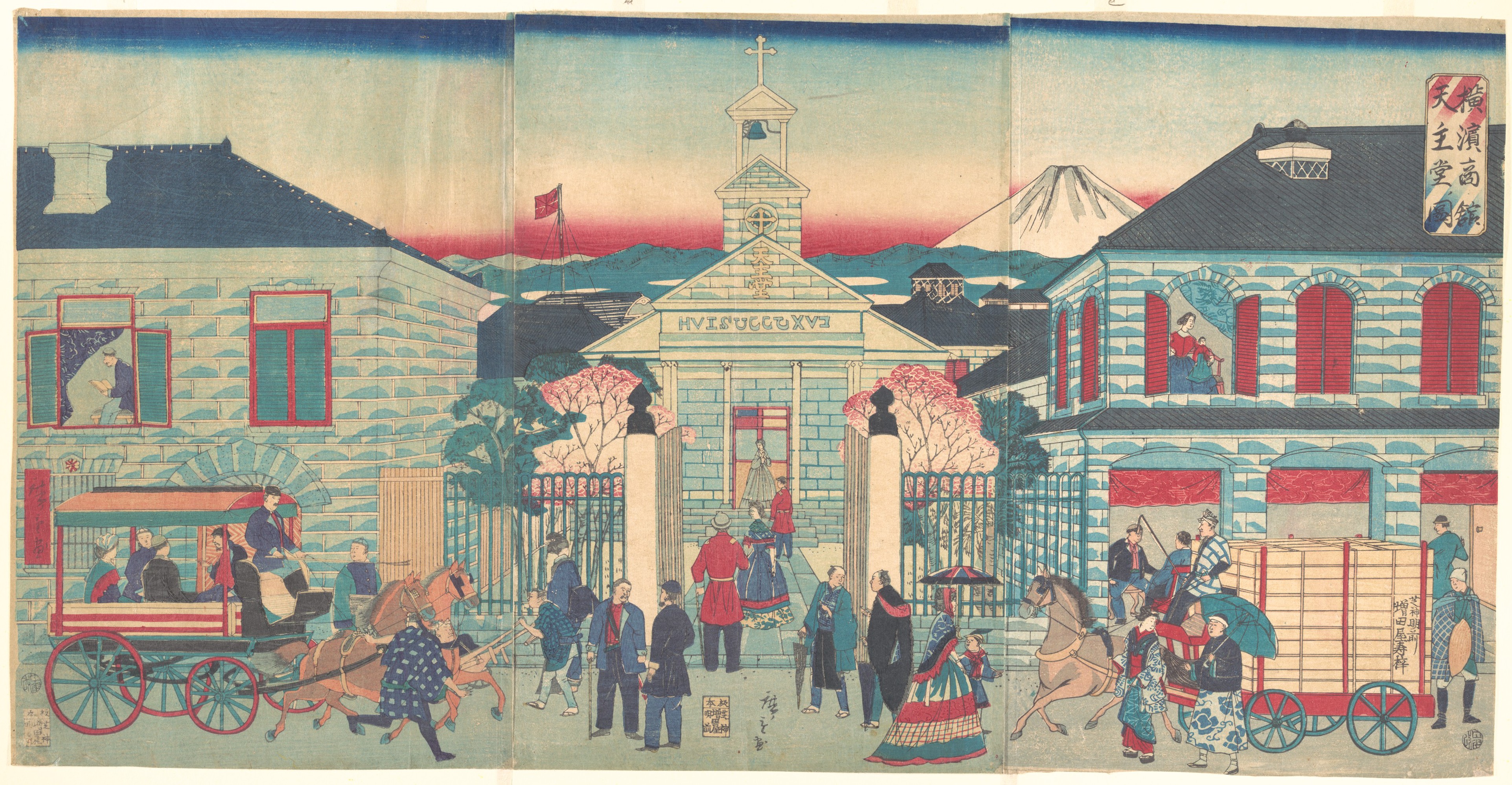
Illustration of Foreign Residences and the Catholic Church in Yokohama (Yokohama shōkan tenshudō no zu)
横浜商館天主堂之図
10th month, 1870
Triptych of woodblock prints (nishiki-e); ink and color on paper
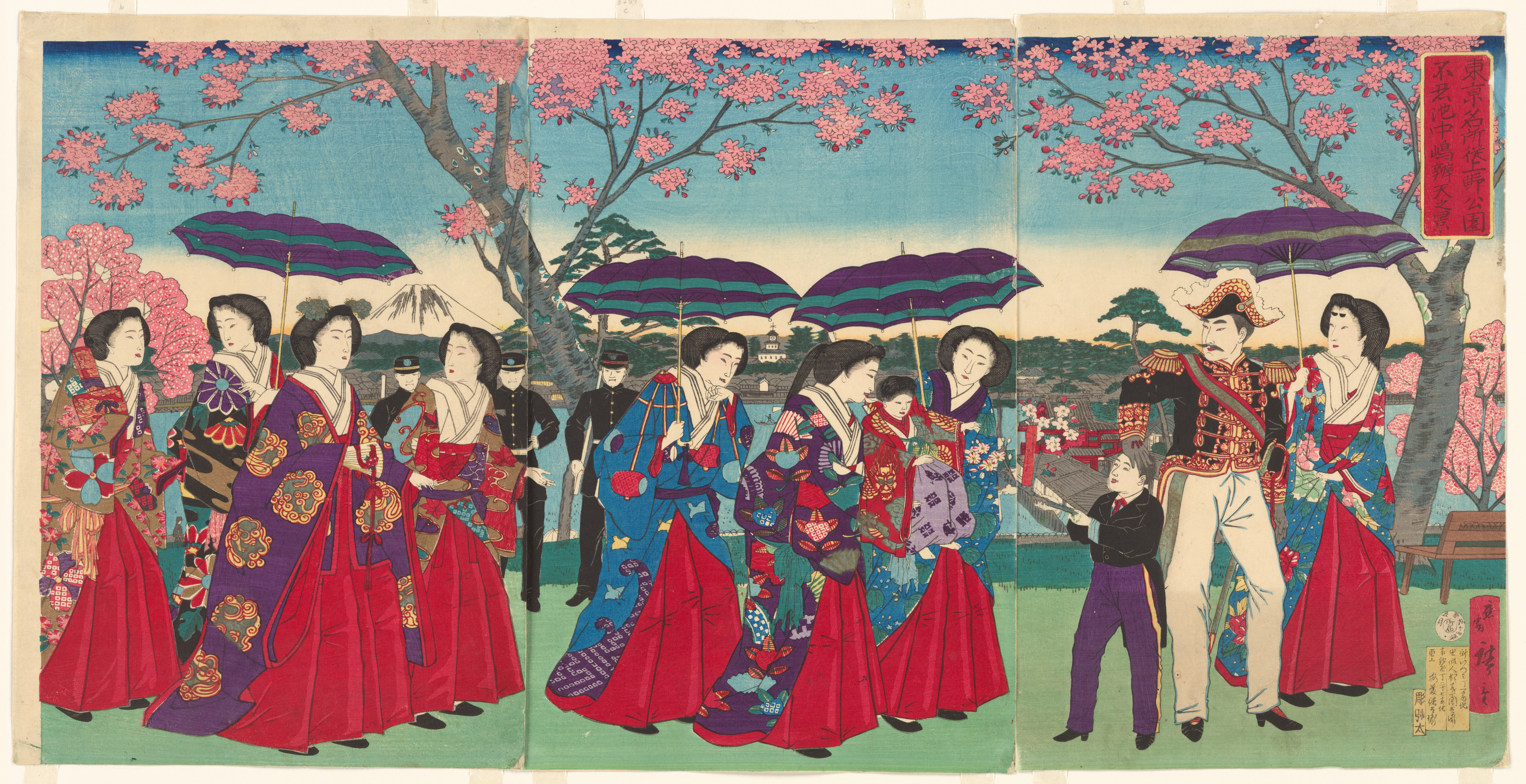
View of Benten Shrine on Nakanoshima Island in Shinobazu Pond, Ueno Park, from the series Famous Views of Tokyo (Tōkyō meisho yori Ueno kōen Shinobazu no ike Nakanoshima Benten no kei)
東京名所 上野公園不忍ノ池中島弁天之景
May, 1881
Triptych of woodblock prints (nishiki-e); ink and color on paper

Memorial Monument for Utagawa Hiroshige II
1882
Color woodblock print; ōban