
Biography
Utagawa Yoshikazu (歌川芳員, active c. 1848–1870), also known by the gō Issen, was a Japanese woodblock print designer of the late Edo and early Meiji periods who became one of the central figures in the brief but historically extraordinary genre of Yokohama-e — prints depicting the foreigners, ships, technologies, and customs that arrived in Japan after the opening of the Treaty Port of Yokohama in 1859. Yoshikazu produced one of the most extensive single-artist bodies of Yokohama-e in the genre's history, a primary visual record of Tokugawa Japan's encounter with the industrializing West.
Yoshikazu was a pupil of Utagawa Kuniyoshi (1797–1861), the great Edo designer of warrior prints (musha-e) and historical scenes. Kuniyoshi's studio produced a remarkable generation of pupils — including Yoshitoshi, Yoshitora, Yoshifuji, Yoshiiku, and Yoshikazu himself — whose names all began with the Yoshi character inherited from their master. Yoshikazu's earliest signed works date from around 1848 and include warrior prints in the Kuniyoshi tradition: scenes from the Genpei wars, the Taiheiki, the campaigns of Minamoto Yorimasa, and the legendary repertoire of heroic combat. The rich palette, dense compositions, and energetic figural drawing of these early musha-e place Yoshikazu firmly within his teacher's stylistic orbit.
The arrival of Commodore Matthew Perry's American squadron at Edo Bay in 1853 and 1854, followed by the Harris Treaty of 1858 and the formal opening of Yokohama as a treaty port in July 1859, transformed the visual economy of the city. Edo publishers responded with prints depicting the Black Ships (kurofune), the foreigners (gaikokujin) settling in the new foreign settlement, the steamships and railways and cameras and sewing machines they had brought with them, and the strange customs and dress that Japanese viewers found alarming and fascinating. Yokohama-e flourished from around 1860 to 1862, and Yoshikazu was one of its most prolific designers. By the dating preserved on his prints, he produced dozens of single-sheet and triptych compositions during this two-year peak. Most are signed Issen Yoshikazu ga or simply Yoshikazu ga, with censor's seals and publisher's marks that make precise dating possible.
The subjects of Yoshikazu's Yokohama-e span the full visual encyclopedia of Western life. He depicted foreigners of all five treaty nations — American, English, French, Dutch, and Russian — at work and at leisure: dining in foreign restaurants, photographing one another, sewing clothes, baking bread, riding in steam-powered ships and trains, parading through Yokohama, and entertaining themselves in the Gankirō, the foreign pleasure quarter built for the new arrivals. The series Yokohama meisho (Famous Places in Yokohama), to which Yoshikazu contributed numerous designs, set foreign figures against the topography of the treaty port. Other series, such as Gokakoku no uchi (Among the Five Nations), gave Japanese audiences ethnographic portraits of representative foreigners. His many depictions of American steamships, including the triptych "America: A Steamship in Transit" of 1861, document the arrival of Western maritime technology in the wake of Perry's Black Ships and constitute the direct visual descendants of the Perry narratives that had electrified Japan in the previous decade.
Yoshikazu was not always a sober reporter. His prints frequently blend documentary observation with fantastical invention: foreigners with exaggerated features, scenes of life in distant lands he had clearly never seen. The 1863 print "Island of Little People" (Kobitojima) places foreign figures in a frankly fantastical setting. This combination of journalism and fantasy was characteristic of Yokohama-e as a whole and reflects the way the genre served simultaneously as news, ethnography, and entertainment.
The peak of Yokohama-e production was brief. By the mid-1860s, photography had begun to supplant woodblock prints as the dominant medium for documenting foreigners in Japan. Yoshikazu continued designing into the early Meiji period — his latest dated works are from around 1870 — but his post-1862 output is comparatively modest. His prints are today held by major public collections, including the Metropolitan Museum of Art, the Art Institute of Chicago, the Museum of Fine Arts Boston, the Harvard Art Museums, the Library of Congress, and the British Museum. For students of Bakumatsu visual culture, Yoshikazu is an indispensable witness whose woodblock prints record the strange spectacle of the West arriving on Japanese shores.
Key Facts
- Nationality
- 🇯🇵Japan
- Movement
- Ukiyo-e
- Works Indexed
- 7
Frequently Asked Questions
Utagawa Yoshikazu (歌川芳員, active c. 1848–1870), also known by the gō Issen, was a Japanese woodblock print designer of the late Edo and early Meiji periods who became one of the central figures in the brief but historically extraordinary genre of Yokohama-e — prints depicting the foreigners, ships, technologies, and customs that arrived in Japan after the opening of the Treaty Port of Yokohama in 1859. Yoshikazu produced one of the most extensive single-artist bodies of Yokohama-e in the genre's history, a primary visual record of Tokugawa Japan's encounter with the industrializing West.
Utagawa Yoshikazu's work was shaped by the Ukiyo-e tradition in Japanese woodblock printmaking. Ukiyo-e: ## What is ukiyo-e? Ukiyo-e ([浮世絵](/glossary/ukiyo-e)) — literally "pictures of the floating world" — is the Edo-period Japanese print and painting tradition that flourished from roughly 1660 to 1868, depicting the pleasures of urban life in Edo (modern Tokyo): courtesans, kabuki actors, sumo wrestlers, famous landscapes, and seasonal beauties.
Original prints by Utagawa Yoshikazu can be found in collections including Metropolitan Museum of Art, Art Institute of Chicago.
Woodblock Prints by Utagawa Yoshikazu (7)
Americans on an Outing (Amerikajin yūkō no zu)
亜墨利加人遊行之図
1860
Color woodblock print; oban

Arrival and Departure of an American Steamship (Amerikakoku jōkisha ōrai)
亜墨利加国蒸気車往来
1861
Color woodblock print; oban triptych
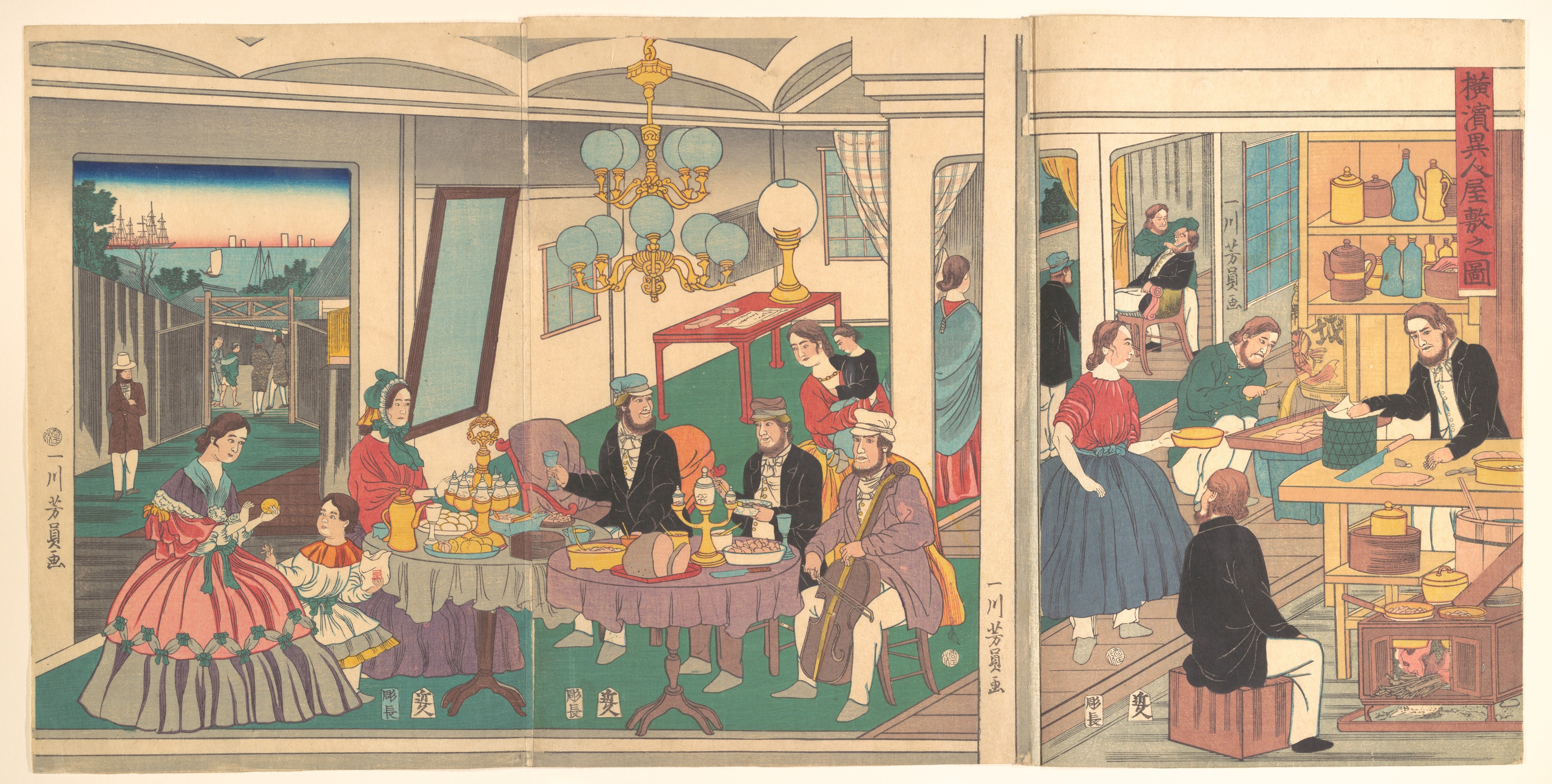
A Foreign Residence in Yokohama
1861
Triptych of woodblock prints (nishiki-e); ink and color on paper
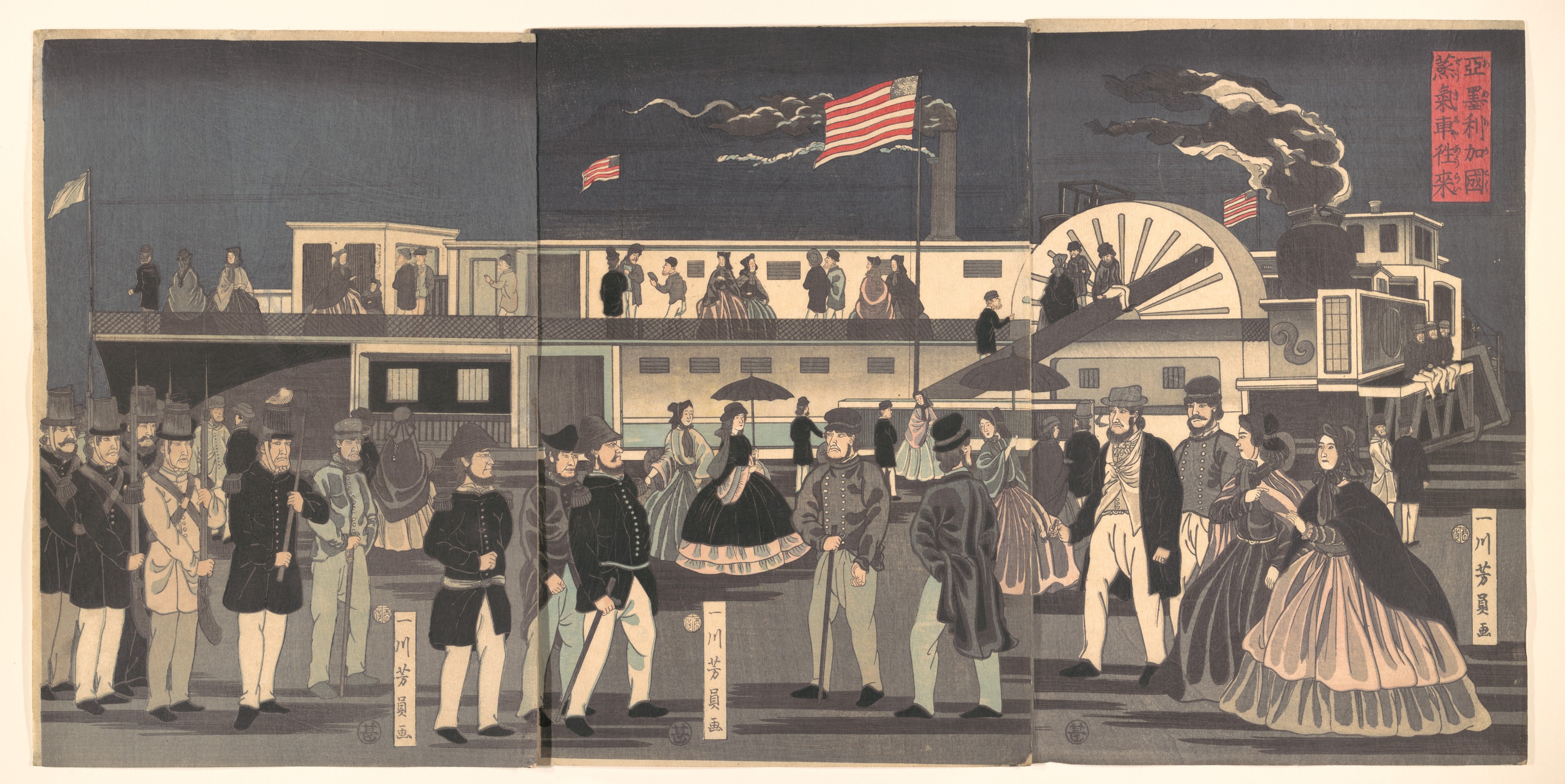
"America": A Steamship in Transit
1861
Triptych of woodblock prints; ink and color on paper
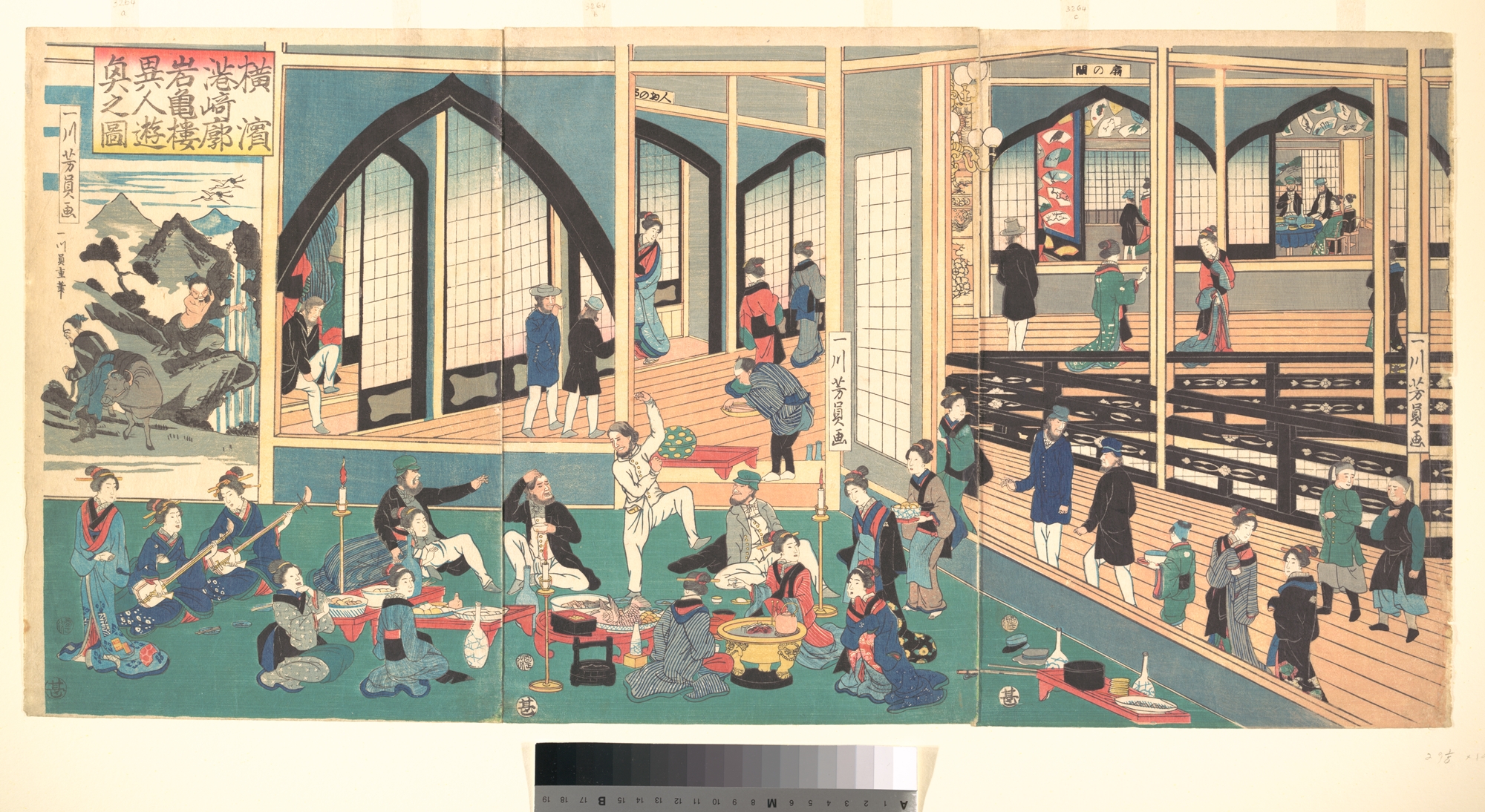
Foreigners Enjoying Themselves in the Gankirō
ca. 1861
Triptych of woodblock prints; ink and color on paper
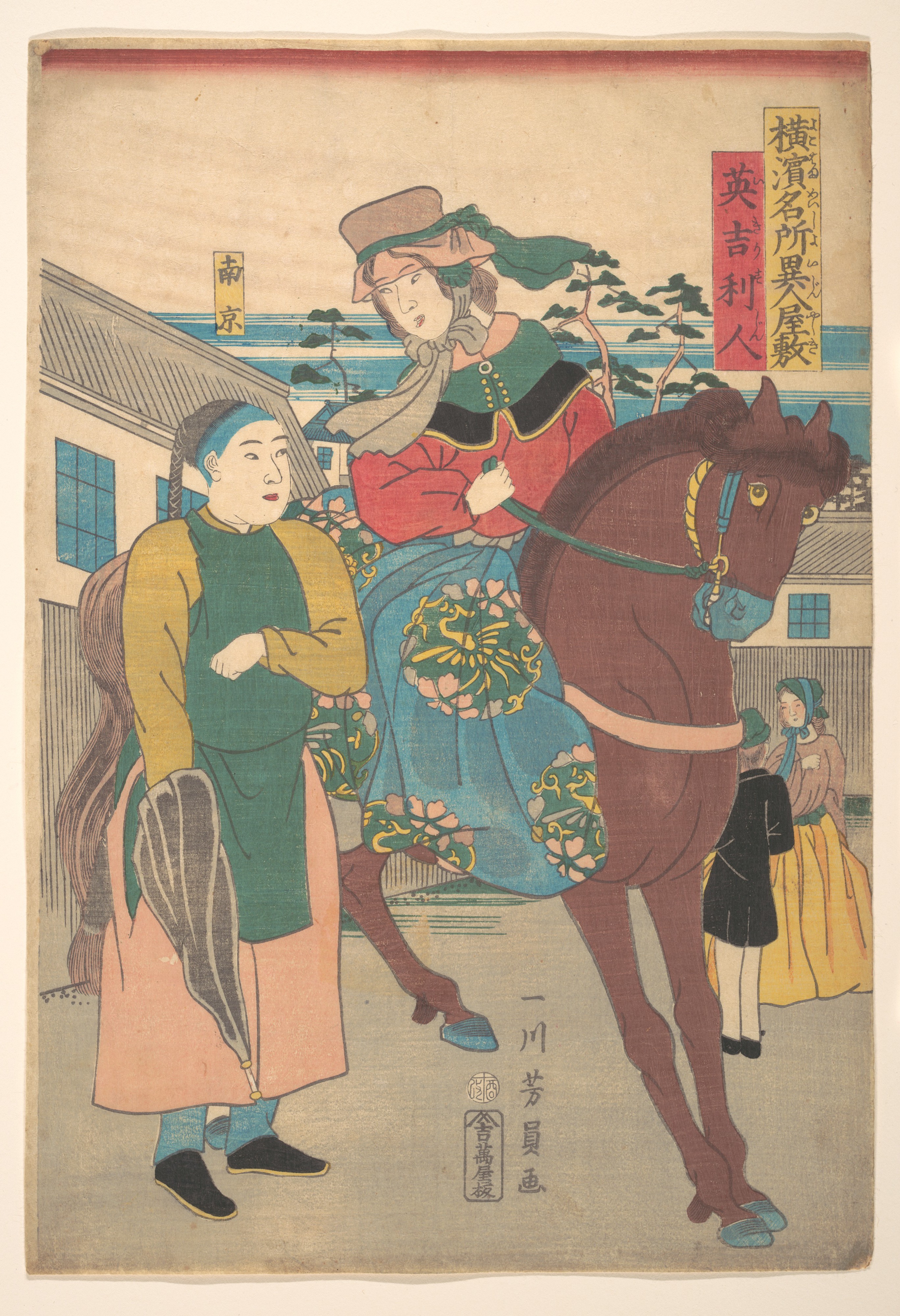
An English Woman with a Chinese Servant in the Foreign District, from the series Famous Places in Yokohama
横浜名所
1861
Woodblock print (nishiki-e); ink and color on paper

Foreigners Enjoying a Banquet
2nd month, 1862
Triptych of woodblock prints; ink and color on paper