Biography
Kitagawa Fujimaro (喜多川藤麿, active in the early nineteenth century, died 1830) was a pupil of Kitagawa Utamaro (c. 1753-1806) and a representative figure of the late-Edo nikuhitsu ukiyo-e tradition - the line of ukiyo-e painters who, alongside the woodblock-print designers of the same school, produced one-of-a-kind paintings on silk or paper for the same merchant patronage that consumed brocade prints. He was among the pupils who carried the Kitagawa manner forward after his teacher's death in 1806, and he continued to work into the following decades. His birth date is not securely recorded; the conventional terminus of his career is the 1830 death date preserved in nineteenth-century compilations.
Fujimaro's surviving output is dominated by single-figure or small-group bijin-ga (beautiful-women pictures) in the Utamaro manner, painted in ink, mineral pigments, and the white shell-derived pigment gofun on silk grounds and mounted as hanging scrolls. His brushwork is tighter than Utamaro's late style, the contour line carried at an even weight from the throat down through the folds of the kosode, and his palette - typically reserved, organised around the muted reds, mineral blues, and silver-grey ink washes that came into fashion in Edo painting after the turn of the nineteenth century - separates his work both from the more flamboyant chromatic register of Utamaro's polychrome prints of the 1790s and from the later, more theatrical bijin-ga of designers like Keisai Eisen. Where Utamaro's nishiki-e bijin had concentrated on close-cropped facial types in the okubi-e (large-head picture) format, Fujimaro typically returns the figure to full length, anchoring her within an implied interior or - more characteristically - on an outdoor stage of bank, garden, or riverside, with the surrounding landscape suppressed to a few washes of ink that establish setting without competing with the figure.
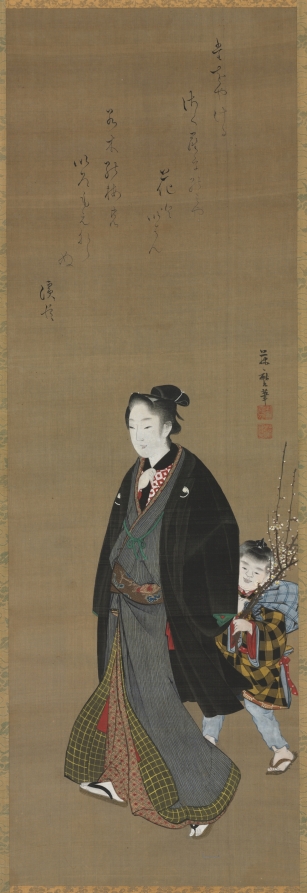
The Cleveland Museum of Art preserves a representative full-length scroll, Man Strolling with a Boy Carrying Flowering Branch (1985.256), datable to around 1810, in which a young man strolls in front of a boy carrying flowering plum branches. The inscribed poem deploys the standard Edo pun on iro - 'colour' and 'love' - and reads the cherry blossoms of Edo's Yoshiwara as a metaphor for mature courtesans while assigning the plum blossom to handsome young men, an exchange that signals the painting's place within the homoerotic strand of Edo cultural production. A second full-length painting, Two Oharame on the Bank of a Stream (Minneapolis Institute of Art, 74.1.161), presents two oharame - charcoal-bundle vendors from the village of Ohara north of Kyoto - balancing their loads on their heads beside a slow-moving stream. The inscription contrasts the women's pale skin with the dark brushwood they carry, exploiting a standard bijin-ga trope of complexion against accessory in a brief comic vein.
Fujimaro also designed woodblock prints, including surimono - the privately commissioned, limited-edition deluxe prints exchanged among kyoka poetry circles - though his print output was modest by comparison with the woodblock production of contemporaries such as Kikukawa Eizan or Keisai Eisen. His historical importance rests on the painted bijin-ga that bridge Utamaro's circle and the next generation of Edo nikuhitsu masters.
Fujimaro worked in the same milieu as other Kitagawa-school pupils - among them Tsukimaro, Kikumaro, and Hidemaro - who were also active in the years around and after Utamaro's death and produced bijin-ga in closely related styles. His relatively long career made him one of the continuators of his teacher's bijin-ga tradition into the early nineteenth century. His paintings are held today in American collections including the Cleveland Museum of Art and the Minneapolis Institute of Art.
Key Facts
- Nationality
- 🇯🇵Japan
- Movement
- Ukiyo-e
- Subjects
- Birds & FlowersChildren
- Works Indexed
- 2
Frequently Asked Questions
Kitagawa Fujimaro (喜多川藤麿, active in the early nineteenth century, died 1830) was a pupil of Kitagawa Utamaro (c. 1753-1806) and a representative figure of the late-Edo nikuhitsu ukiyo-e tradition - the line of ukiyo-e painters who, alongside the woodblock-print designers of the same school, produced one-of-a-kind paintings on silk or paper for the same merchant patronage that consumed brocade prints. He was among the pupils who carried the Kitagawa manner forward after his teacher's death in 1806, and he continued to work into the following decades. His birth date is not securely recorded; the conventional terminus of his career is the 1830 death date preserved in nineteenth-century compilations.
Kitagawa Fujimaro's work was shaped by the Ukiyo-e tradition in Japanese woodblock printmaking. Ukiyo-e: ## What is ukiyo-e? Ukiyo-e ([浮世絵](/glossary/ukiyo-e)) — literally "pictures of the floating world" — is the Edo-period Japanese print and painting tradition that flourished from roughly 1660 to 1868, depicting the pleasures of urban life in Edo (modern Tokyo): courtesans, kabuki actors, sumo wrestlers, famous landscapes, and seasonal beauties.
Kitagawa Fujimaro's prints frequently feature birds & flowers, children.
Original prints by Kitagawa Fujimaro can be found in collections including Cleveland Museum of Art, Minneapolis Institute of Art.
