
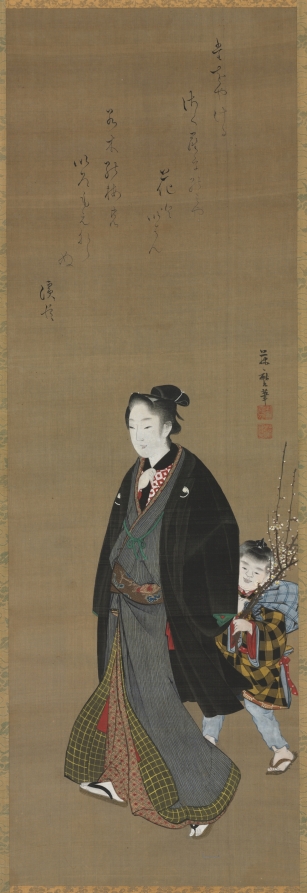
Two Oharame on the Bank of a Stream
- Date:
- 1810s
- Medium:
- Hanging scroll (nikuhitsu); ink, color, and gofun on silk
- Source:
- Minneapolis Institute of Art
Description
A nikuhitsu ukiyo-e hanging scroll by Kitagawa Fujimaro, pupil of Kitagawa Utamaro, of the 1810s, showing two oharame on the bank of a stream. The oharame were female peddlers from the village of Ohara, north of Kyoto, who brought bundles of charcoal twigs into the city for sale; their distinctive load-bearing pose - balancing the bundled brushwood on the head, walking with steady gait through the streets - made them a familiar urban type recurring across late-Edo painting and prints. The pairing of two figures, set against a brief wash of ink that suggests the stream-side ground without committing to a worked landscape, follows the bijin-ga convention of staging the female figure against the most minimal of implied settings, so that the elaborately folded textiles of the kimono and the precise contour of the carried bundle bear the entire pictorial weight. The inscribed poem above the figures, signed Fujimarotei Ichijin, reads in translation: 'The white complexions of the oharame are more noticeable than the black brushwood they are balancing on their heads' - a brief comic exploitation of the bijin-ga commonplace of pale skin against dark accessory. The signature 'Fujimaro hitsu' is accompanied by red artist's seals reading Hōshū (芳州) and Murasaki no in (紫之印), allowing the work to be distinguished from related paintings by other Kitagawa-school pupils active in the same years. The hanging scroll, painted in ink, mineral colour, and the white shell-derived gofun pigment on silk, measures 98 by 33 cm in the image. It is held by the Minneapolis Institute of Art (accession 74.1.161, Bequest of Richard P. Gale) and is one of the most fully documented examples of Fujimaro's nikuhitsu work outside Japan.
More Prints by Kitagawa Fujimaro
Frequently Asked Questions
Two Oharame on the Bank of a Stream was created by Kitagawa Fujimaro (喜多川藤麿) in 1810s.