Yamamoto Hōsui
山本芳翠
1850–1906
Japan
Biography
Yamamoto Hōsui (山本芳翠, 1850–1906) was a pioneering early-Meiji yōga (Western-style) painter whose years of study in Paris under Jean-Léon Gérôme made him one of the first Japanese artists to absorb academic oil painting at its source. His career bridges the experimental first-generation yōga of Takahashi Yuichi and the establishment of Western painting as an institutional discipline by Kuroda Seiki — a transition in which Hōsui himself was instrumental, both as a teacher and through the private painting school he passed to Kuroda in 1894.
He was born on 12 August 1850 in Akechi, in the mountains of Mino Province (today part of Ena District, Gifu Prefecture). He trained first in the literati Nanga manner before moving to Yokohama to seek Western training, where he studied with the English illustrator Charles Wirgman, the Japan correspondent of The Illustrated London News, and entered the studio of the early yōga pioneer Goseda Hōryū (1827–1892). He went on to study Western oil painting under the Italian painter Antonio Fontanesi, the foundational figure of academic oil-painting instruction in Japan, who taught at the Technical Art School (Kōbu Bijutsu Gakkō) in Tokyo after it opened in 1876.
In 1878 Hōsui sailed for Europe, settling in Paris, where he studied at the École des Beaux-Arts in the atelier of Jean-Léon Gérôme, one of the most celebrated academic masters of the late nineteenth century, remaining in France until about 1887. He became among the most thoroughly trained academic painters of his generation of Japanese yōga and moved in the artistic and literary circles of fin-de-siècle Paris, supplying illustrations for Les Chauves-souris, the verse collection of the aesthete Count Robert de Montesquiou — the dandy on whom Huysmans modelled Des Esseintes in À rebours.
Hōsui returned permanently to Tokyo around 1888 and immediately became a central figure in the institutional consolidation of yōga. In 1889 he was among the founders of the Meiji Bijutsukai (Meiji Fine Arts Society), the first organisation of Western-style painters in Japan, where he exhibited his major paintings of the 1890s. He ran a private painting school in Tokyo, the Seikōkan, modelled on the European atelier system, which served as an important training ground for the next generation of yōga painters before Kuroda Seiki's return from Paris in 1893. In 1894, in one of the formative gestures of late-Meiji painting, Hōsui handed the school to Kuroda and Kume Keiichirō, who renamed it the Tenshin Dōjō and made it the seedbed of Kuroda's plein-air, bright-palette manner that would dominate yōga for the next two decades.
A culmination of Hōsui's painting career was the Jūnishi (十二支, Twelve Earthly Branches) cycle of 1892, twelve large-scale academic oil paintings based on the animal signs of the Chinese-Japanese zodiac, now divided among several Japanese collections. The cycle exemplifies Hōsui's distinctive synthesis: Gérôme's polished classical surface and figural structure placed in the service of Japanese mythological subjects. His Urashima of the mid-1890s, now held at the Museum of Fine Arts, Gifu, applied the same procedure to the most familiar of Japanese folktales.
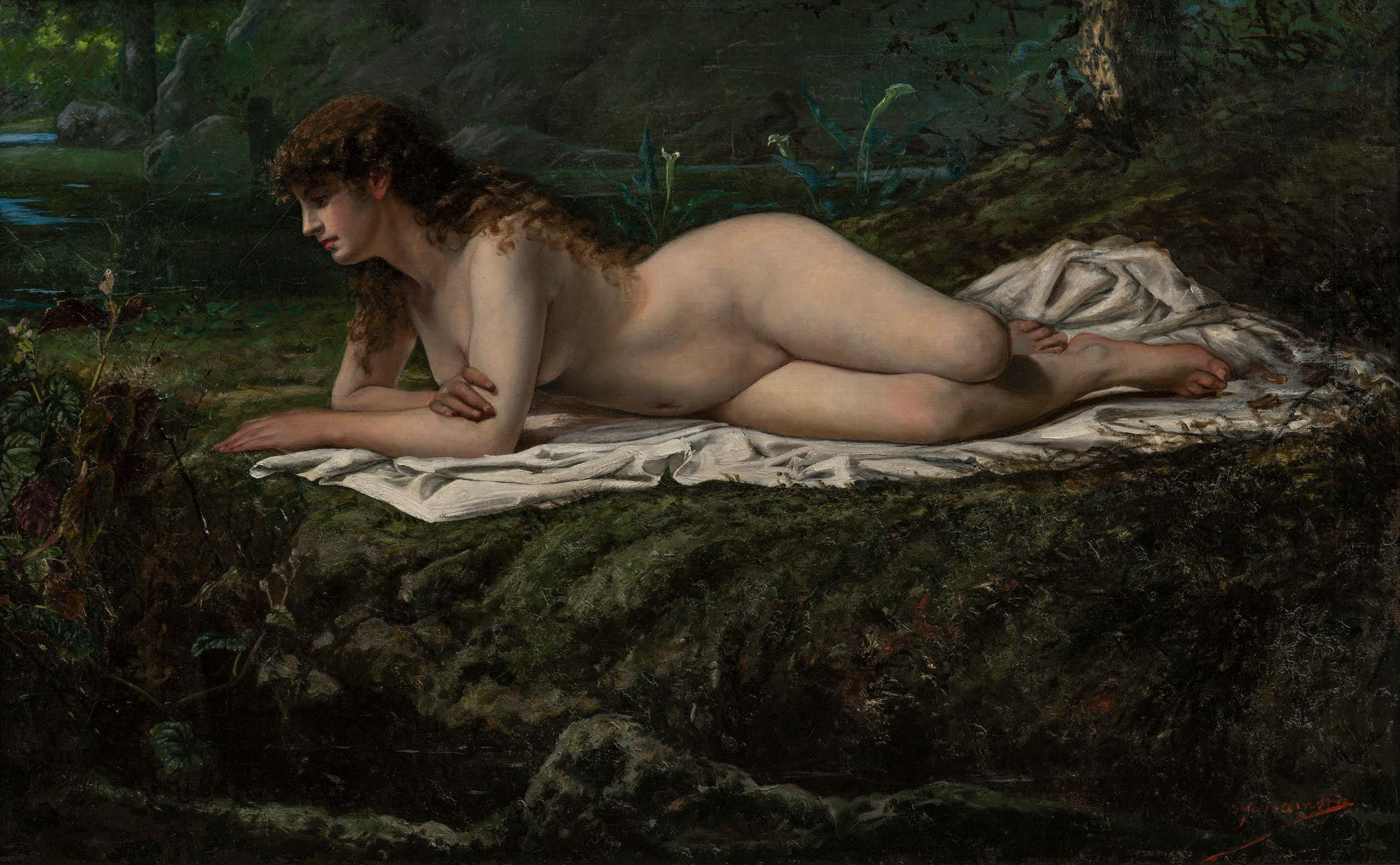
Hōsui died in Tokyo on 15 November 1906, aged fifty-six. His reputation lies less in any single painting than in his role as the principal transmitter of Parisian academic training to early-Meiji Japan and as the teacher whose school became, under Kuroda, an institutional foundation of modern Japanese oil painting. The principal collection of his work is at the Museum of Fine Arts, Gifu — which holds his Nude (Rafu), designated an Important Cultural Property — together with other public collections in Japan.
Key Facts
- Active Period
- 1850–1906
- Nationality
- 🇯🇵Japan
- Subjects
- Moonlight
- Works Indexed
- 7
Frequently Asked Questions
Yamamoto Hōsui (山本芳翠, 1850–1906) was a pioneering early-Meiji yōga (Western-style) painter whose years of study in Paris under Jean-Léon Gérôme made him one of the first Japanese artists to absorb academic oil painting at its source. His career bridges the experimental first-generation yōga of Takahashi Yuichi and the establishment of Western painting as an institutional discipline by Kuroda Seiki — a transition in which Hōsui himself was instrumental, both as a teacher and through the private painting school he passed to Kuroda in 1894.
Yamamoto Hōsui was active from 1850 to 1906.
Yamamoto Hōsui's prints frequently feature moonlight.
Original prints by Yamamoto Hōsui can be found in collections including Museum of Fine Arts, Gifu, Aichi Prefectural Museum of Art, Kanagawa Prefectural History Museum, Kōriyama City Museum of Art.
Woodblock Prints by Yamamoto Hōsui (7)

Portrait of Fukuchi Genichirō
福地源一郎像
c. 1876-1877
Oil on canvas
Rafu (Nude)
裸婦
c. 1880
Oil on canvas

Self-Portrait (Jigazō)
自画像
1882
Oil on cardboard

Gekka no rafu (Nude under the Moon)
月下の裸婦
c. 1882-1886
Oil on canvas

Eruption of Mount Bandai (Bandaisan funka shinzu)
磐梯山噴火真図
1888
Wood engraving after Yamamoto Hōsui, engraved by Gōda Kiyoshi

Tomoshibi o motsu otome (Young Woman with a Lamp)
灯を持つ乙女
c. 1892
Oil on canvas
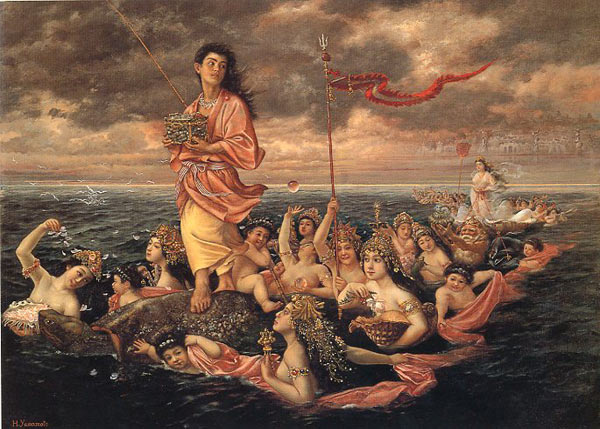
Urashima-zu (Urashima)
浦島図
1895
Oil on canvas