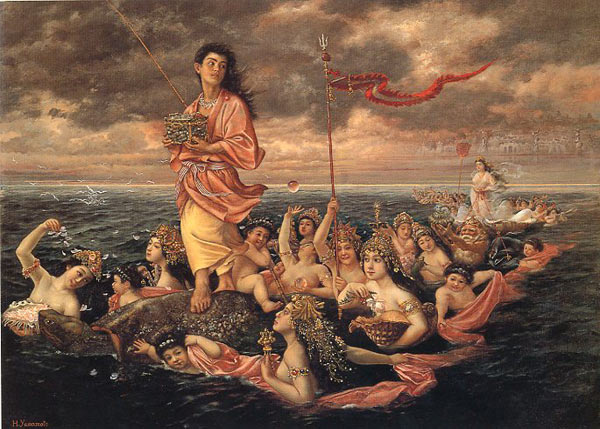
Urashima-zu (Urashima)
浦島図
- Date:
- 1895
- Medium:
- Oil on canvas
- Source:
- Museum of Fine Arts, Gifu
Description
Painted in 1895 and held in the Museum of Fine Arts, Gifu, Yamamoto Hōsui's Urashima-zu (浦島図, Urashima) is the culminating canvas of the painter's late career and the work in which his Paris academic training came most fully into dialogue with the Japanese mythological repertoire. The large oil on canvas (124 × 170 cm) was shown at the seventh exhibition of the Meiji Bijutsukai (Meiji Fine Arts Society) in 1895 and treats the most familiar of Japanese folktales: the young fisherman Urashima Tarō, who rescues a turtle, is carried to the dragon-king's undersea palace, marries the princess Otohime, and on his eventual return to land finds that centuries have passed and his family is long gone. Hōsui composes the scene in the manner of a Salon mythological canvas: a tall, vertical figure of Urashima at the moment of opening the forbidden tamatebako jewel-box, modelled in the polished academic surface he had absorbed from Gérôme, and set against a landscape that reads as much as a French academic seascape as a Japanese coastal scene. The picture was the painter's principal contribution to the Meiji project of constructing a Japanese mythological iconography in Western academic terms — the same programme that Aoki Shigeru would pursue in symbolist terms a decade later — and its later designation as an Important Cultural Property confirmed its central place in the early history of yōga.
More Prints by Yamamoto Hōsui



Frequently Asked Questions
Urashima-zu (Urashima) (浦島図) was created by Yamamoto Hōsui (山本芳翠) in 1895.