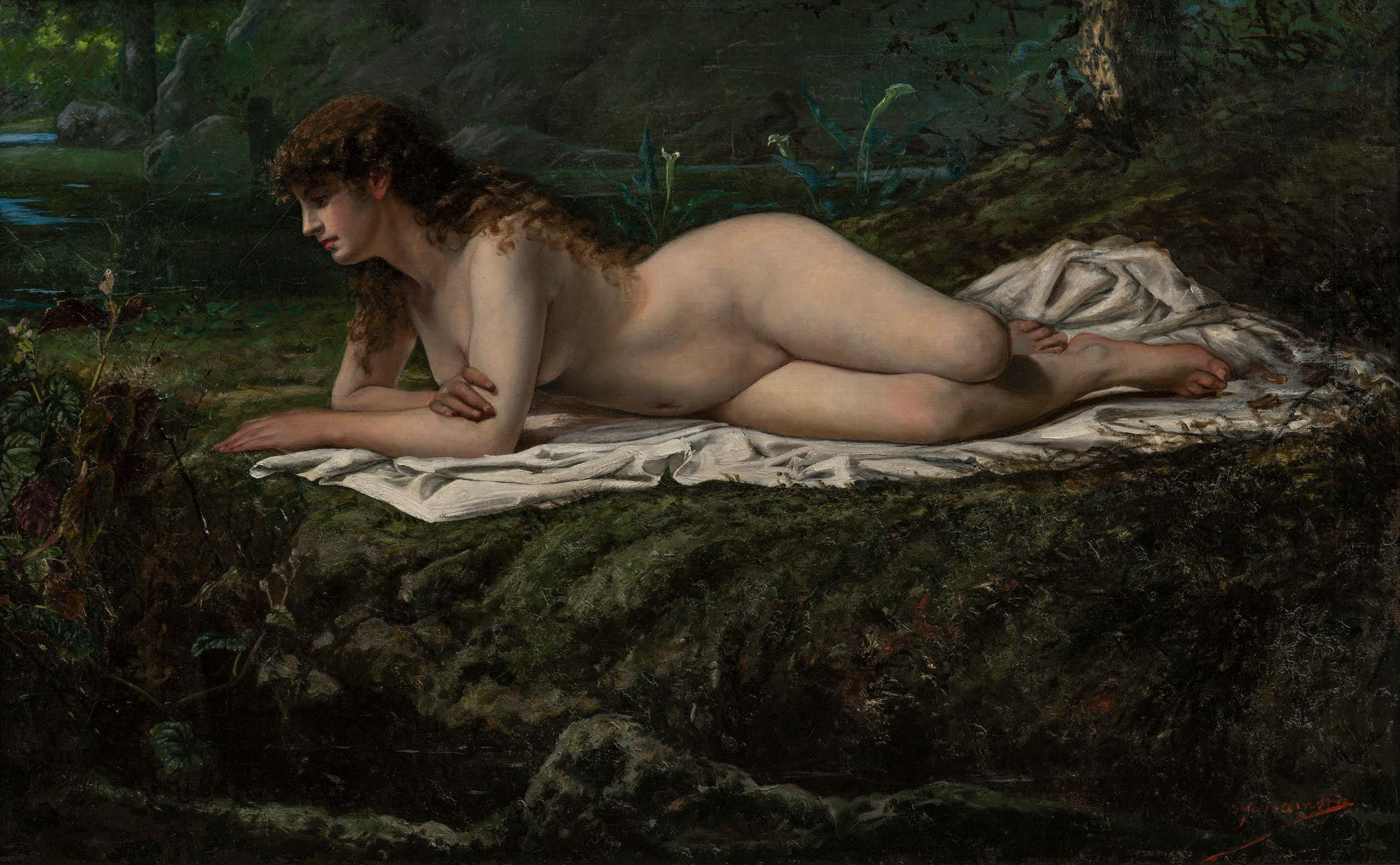
Rafu (Nude)
裸婦
- Date:
- c. 1880
- Medium:
- Oil on canvas
- Source:
- Museum of Fine Arts, Gifu
Description
Held in the Museum of Fine Arts, Gifu, and designated an Important Cultural Property of Japan in 2014, Yamamoto Hōsui's Rafu (裸婦, Nude) is the earliest fully academic life painting by a Japanese artist and one of the foundational works of Meiji yōga. The oil on canvas was executed during the painter's Paris years, around 1880, while he was studying at the École des Beaux-Arts under Jean-Léon Gérôme, and it shows him absorbing the entire technical apparatus of the French academic life class — the polished modelling, the cool studio light, the careful anatomical structure built around the central female figure — directly from Gérôme's atelier. Painted at a moment when the depiction of the nude was still a subject of intense cultural anxiety in Japan, where life-class study had no precedent and would not be domesticated until Kuroda Seiki's controversial Asagi (Morning Toilette) of 1893, Hōsui's Rafu stands as the first sustained engagement by a Japanese painter with the central genre of European academic art. Together with Gekka no rafu (Nude under the Moon, c. 1882-86, Aichi Prefectural Museum of Art), it documents the moment at which the Parisian life class entered Japanese painting and provided the technical foundation on which Kuroda's generation would build.
More Prints by Yamamoto Hōsui



Frequently Asked Questions
Rafu (Nude) (裸婦) was created by Yamamoto Hōsui (山本芳翠) in c. 1880.