Yokoyama Seiki
横山清暉
1792–1864
Japan
Biography
Yokoyama Seiki (横山清暉, 1792-1864) was a leading Kyoto painter of the late Edo period and one of the most accomplished pupils of Matsumura Keibun (1779-1843), the younger brother of Shijō school founder Matsumura Goshun. Working in the central Kyoto painting world from the 1810s through the early 1860s, Seiki became known for the technical refinement of his kachō-e (bird-and-flower) painting, for his landscape and figure subjects, and for the breadth of his work across hanging scrolls, screens, surimono, and illustrated books.
Born in Kyoto in 1792, Seiki was admitted as a young man to Matsumura Keibun's studio, where he absorbed the Shijō school's foundational practice of shasei (sketching from life) applied especially to birds, flowering plants, fish, and small animals. The Shijō approach descended from Maruyama Ōkyo's eighteenth-century reform of Kyoto painting, which insisted on close observation of natural forms while retaining the compositional habits — long diagonals, asymmetric placements, generous negative space, and softened ink line — inherited from Chinese painting and from the Rinpa decorative tradition. Through Keibun, Seiki sat at the heart of this lineage, and the kachō-e and small-figure paintings he produced over four decades show its discipline clearly: birds rendered with attention to feathering structure and posture, plants observed in their seasonal forms, and compositions built around the placement of a single closely studied subject in atmospheric space.
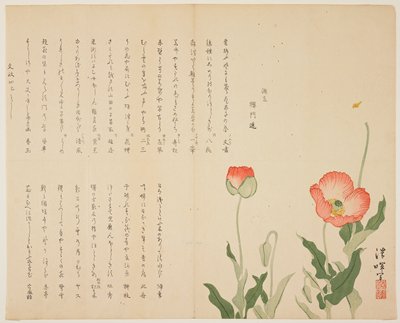
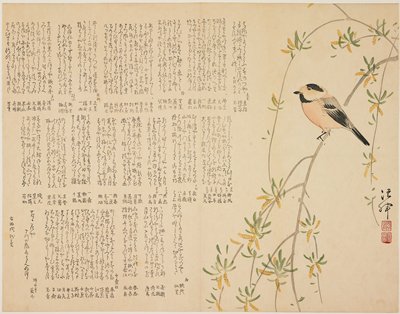
From an early date Seiki was associated with the Kyoto surimono trade, designing privately commissioned color woodblock prints for poetry societies (kyōka and haikai groups) that paired his bird-and-flower designs with poems by their members. His Two Poppies (Art Institute of Chicago, c. early 1820s) is characteristic of the accomplished Shijō-style surimono of the period: carefully gradated washes, restrained outline, and the kind of metallic and embossed effects that distinguished surimono from commercial nishiki-e. The compositions repurpose Shijō painting motifs into the small lyric format that surimono required, and the bird studies in particular show Seiki working at a high level within Keibun's school.
Alongside his print work, Seiki was a productive painter of hanging scrolls and screens in ink and color on silk or paper. His Plant and Seals, a hanging scroll dated 1856 now in the Metropolitan Museum of Art, belongs to a Kyoto tradition of paintings produced as personal records or scholarly commemorations, in which sprigs of plants are accompanied by carefully placed seals — functioning both as a botanical study and as a literati object suited to the social world of late Bakumatsu Kyoto. Esteemed among the painters of his city, Seiki was among the artists called upon to paint fusuma (sliding-door panels) for the Imperial Palace following the fire of 1854.
Seiki was also active in the Kyoto illustrated-book trade, contributing designs to multi-artist ehon and kyōka compilations; his hand appears, for example, alongside his teacher Keibun's in Shijō-school picture books of the period. His pupils carried his style into the late nineteenth century, and the position he held within the Keibun lineage is one of the channels through which the Maruyama-Shijō tradition passed forward to the Meiji-period Kyoto painters such as Kōno Bairei, Imao Keinen, and ultimately Takeuchi Seihō. Seiki died in 1864, on the eve of the Meiji Restoration, leaving a body of work that documents the Shijō school at its mature mid-nineteenth-century moment.
Key Facts
- Active Period
- 1792–1864
- Nationality
- 🇯🇵Japan
- Works Indexed
- 6
Frequently Asked Questions
Yokoyama Seiki (横山清暉, 1792-1864) was a leading Kyoto painter of the late Edo period and one of the most accomplished pupils of Matsumura Keibun (1779-1843), the younger brother of Shijō school founder Matsumura Goshun. Working in the central Kyoto painting world from the 1810s through the early 1860s, Seiki became known for the technical refinement of his kachō-e (bird-and-flower) painting, for his landscape and figure subjects, and for the breadth of his work across hanging scrolls, screens, surimono, and illustrated books.
Yokoyama Seiki was active from 1792 to 1864.
Original prints by Yokoyama Seiki can be found in collections including Minneapolis Institute of Art, Metropolitan Museum of Art (via Wikimedia Commons), Minneapolis Institute of Art (via Wikimedia Commons), Art Institute of Chicago.
Woodblock Prints by Yokoyama Seiki (6)
Poppies
罌粟図
1821
Woodblock print (surimono); ink and color on paper

Two Poppies
罌粟図
c. early 1820s
Color woodblock print; surimono
Chickadee on a Willow Branch
柳に四十雀図
1826
Woodblock print (surimono); ink and color on paper

Rocks and Stream
渓流岩石図
mid 19th century
Hanging scroll; ink and color on silk
Plum Blossom Designs by Five Artists (collaborative surimono)
梅花五人画賛図
1853 (Kaei 6, spring)
Woodblock print (surimono); ink and color on paper

Plant and Seals
草花印譜図
dated 1856
Hanging scroll; ink on paper