
Two Poppies
罌粟図
- Date:
- c. early 1820s
- Medium:
- Color woodblock print; surimono
- Source:
- Art Institute of Chicago
Description
Two Poppies is a Shijō-school color woodblock surimono designed by Yokoyama Seiki in the early 1820s, when the artist was a senior pupil in Matsumura Keibun's Kyoto studio. The print depicts a pair of poppy blossoms (keshi), executed in the carefully gradated washes and restrained outline that distinguished the best Kyoto surimono of the period from contemporary commercial nishiki-e. The poppy was a standard summer motif in the Shijō repertoire, observed from life in the manner of Maruyama Ōkyo's eighteenth-century shasei tradition and treated as both a botanical subject and a literary image; Seiki's drawing combines close observation of petal structure and stem with the kind of asymmetric placement against generous negative space that the school's compositional habits required. The Art Institute of Chicago copy (1972.1345), from the Charles H. Mitchell Collection, is part of a small but important group of Seiki surimono in public collections in the United States, all of which document his work for Kyoto kyōka and haikai poetry circles in the 1820s. Privately commissioned and printed in limited editions for distribution within a poetry society, surimono of this kind paired the artist's design with verses by the group's members; here, the simplicity of the design provides space for the poems that would have surrounded the central image on a typical sheet.
More Prints by Yokoyama Seiki
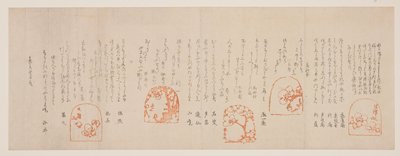
Plum Blossom Designs by Five Artists (collaborative surimono)
梅花五人画賛図
1853 (Kaei 6, spring)
Woodblock print (surimono); ink and color on paper

Plant and Seals
草花印譜図
dated 1856
Hanging scroll; ink on paper
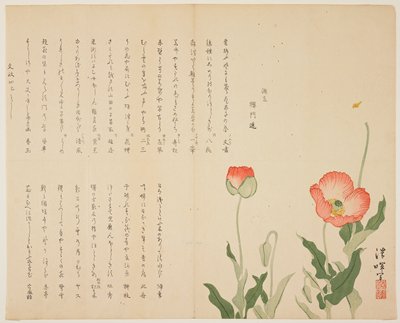
Poppies
罌粟図
1821
Woodblock print (surimono); ink and color on paper
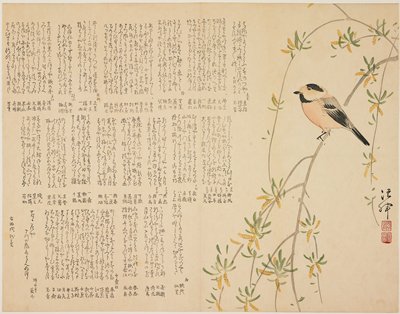
Chickadee on a Willow Branch
柳に四十雀図
1826
Woodblock print (surimono); ink and color on paper
Frequently Asked Questions
Two Poppies (罌粟図) was created by Yokoyama Seiki (横山清暉) in c. early 1820s.