
Mt. Fuji (The Last Work)
富士山(絶筆)
- Date:
- 1932
- Medium:
- Oil on board
- Source:
- Private collection
Description
Mt. Fuji, traditionally known as The Last Work (絶筆) by Aoyama Kumaji, is a small 21.6 × 27 cm oil on board painted on 11 December 1932 — the day of the artist's death. According to the documentation that accompanies the painting in private hands, Aoyama produced the work on a train as he traveled to visit a sick brother; he died suddenly at his destination on arrival, making this oil sketch his final work. The composition is a quick view of Mount Fuji from the train window, with the snow-covered cone occupying the upper part of the panel and a horizontal foreground of fields and tree lines rendered in rapid, tonal brushwork. The small board and the speed of execution are characteristic of plein-air oil sketches in the European nineteenth-century tradition, and the painting belongs to that lineage rather than to the more developed Mount Fuji compositions of his Tokyo yōga contemporaries. As a memento of his death it has retained particular sentimental and art-historical importance: the painting is reproduced in Japanese monographs on Aoyama as his zeppitsu (last brush), and despite its small size and informal subject it is one of the most often cited works in his catalogue. It remains in a private collection in Japan.
More Prints by Aoyama Kumaji


More Mount Fuji Prints
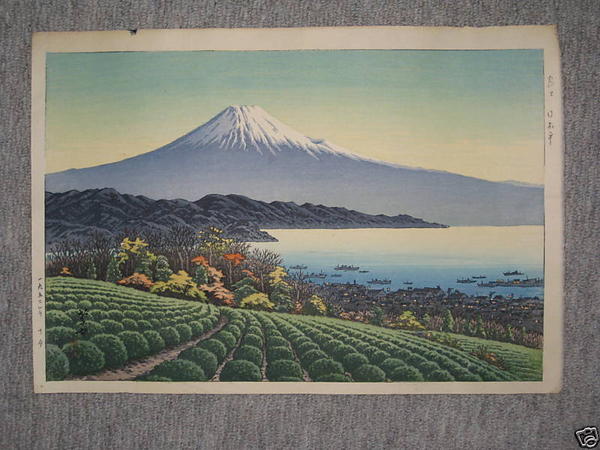
Fuji from tea farm
Woodblock print

Akasaka, Fujikawa, Okazaki, Chiryu, and Narumi, from the series "Famous Places on the Fifty-three Stations of the Tokaido, Five Stations (Tokaido gojusan eki goshuku meisho)"
c. 1830/35
Color woodblock print; oban
![Mount Fuji on a Moonlit Night, Kawai Bridge (Tsukiyo no Fuji [Kawaibashi]), from the series "Selection of Views of the Tokaido (Tokaido fukei senshu)" by Kawase Hasui](https://www.artic.edu/iiif/2/d0960668-1e73-339a-b182-fb995a54bff0/full/843,/0/default.jpg)
Mount Fuji on a Moonlit Night, Kawai Bridge (Tsukiyo no Fuji [Kawaibashi]), from the series "Selection of Views of the Tokaido (Tokaido fukei senshu)"
1947
Color woodblock print; oban

Mt. Fuji in Rain (Ame no Fuji)
n.d.
Color woodblock print
Featured in Collections
Curated cross-cuts that include this print.
Frequently Asked Questions
Mt. Fuji (The Last Work) (富士山(絶筆)) was created by Aoyama Kumaji (青山熊治) in 1932.
Mt. Fuji (The Last Work) depicts mount fuji.