
Mt. Fuji in Rain (Ame no Fuji)
by Kawase Hasui
- Date:
- n.d.
- Medium:
- Color woodblock print
- Format:
- Oban
- Publisher:
- Watanabe Shozaburo
- Edition:
- Published by Watanabe Shozaburo
- Source:
- Art Institute of Chicago
Description
Mount Fuji's snow-streaked peak rises pale blue-white against a grey sky marked with fine vertical lines indicating falling rain, its lower slopes wrapped in mist. Below, a vermillion torii gate and a stone lantern stand among dark green cedar or cypress trees on a ridge, with layered blue-grey hills receding behind them. Kawase Hasui, "Mt. Fuji in Rain (Ame no Fuji)," 1883, color woodblock print.
More Prints by Kawase Hasui

More Mount Fuji Prints
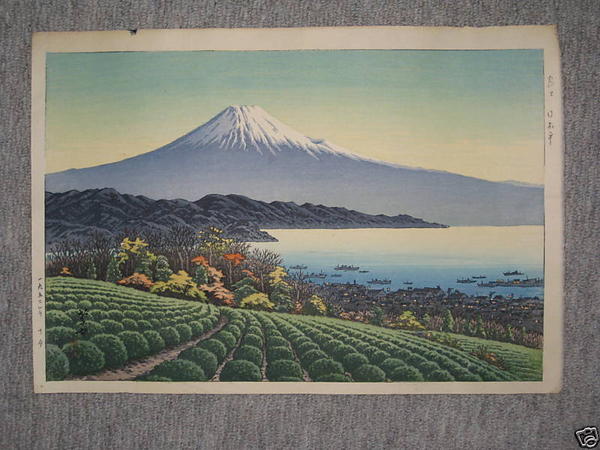
Fuji from tea farm
Woodblock print

Akasaka, Fujikawa, Okazaki, Chiryu, and Narumi, from the series "Famous Places on the Fifty-three Stations of the Tokaido, Five Stations (Tokaido gojusan eki goshuku meisho)"
c. 1830/35
Color woodblock print; oban
![Mount Fuji on a Moonlit Night, Kawai Bridge (Tsukiyo no Fuji [Kawaibashi]), from the series "Selection of Views of the Tokaido (Tokaido fukei senshu)" by Kawase Hasui](https://www.artic.edu/iiif/2/d0960668-1e73-339a-b182-fb995a54bff0/full/843,/0/default.jpg)
Mount Fuji on a Moonlit Night, Kawai Bridge (Tsukiyo no Fuji [Kawaibashi]), from the series "Selection of Views of the Tokaido (Tokaido fukei senshu)"
1947
Color woodblock print; oban
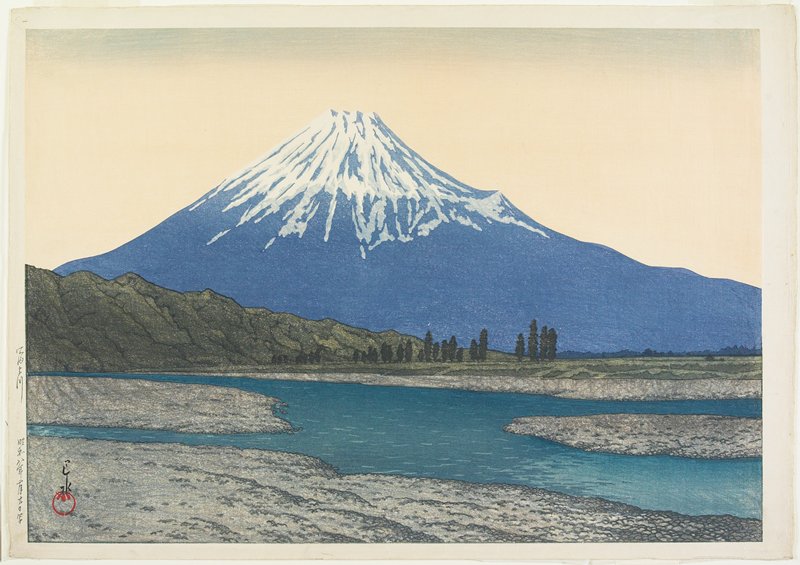
Fuji River
February 1933
Woodblock print, ink and color on paper
Featured in Collections
Curated cross-cuts that include this print.
Frequently Asked Questions
Mt. Fuji in Rain (Ame no Fuji) was created by Kawase Hasui (川瀬巴水) in n.d..
Mt. Fuji in Rain (Ame no Fuji) uses Bokashi, on color woodblock print.
Mt. Fuji in Rain (Ame no Fuji) was published by Watanabe Shozaburo (n.d.).
Mt. Fuji in Rain (Ame no Fuji) depicts mount fuji and rain, set at Mount Fuji.