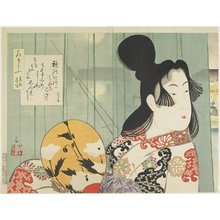
"Beauties of Kan'ei and Shoho Era"
- Medium:
- Woodblock print
- Source:
- Minneapolis Institute of Arts
- Image courtesy of
- Minneapolis Institute of Arts
Description
This [bijin-ga](/glossary/bijin-ga) print depicts women in the fashions of the early Edo period, specifically the Kan'ei (1624–1644) and Shōhō (1644–1648) eras, two reigns that marked a formative period in Japanese textile design and courtly aesthetic culture. Historical costume studies of this kind allowed Meiji-era artists to engage with the bijin-ga tradition while framing the subject as antiquarian, an approach that gained appeal at a moment when Western dress was becoming prevalent in public life. Figures in Kan'ei-era attire would wear kosode with the bold geometric designs and resist-dyeing techniques characteristic of that period, distinct from later Genroku-era fashions. Kiyochika's bijin subjects tend toward dignified historical or literary framing rather than the Yoshiwara-centered imagery of the mainstream bijin tradition. The flat, pattern-rich surfaces of early Edo costume provide compositional contrast with the atmospheric depth characteristic of his landscape work, requiring a different set of technical priorities in block carving and pigment application.