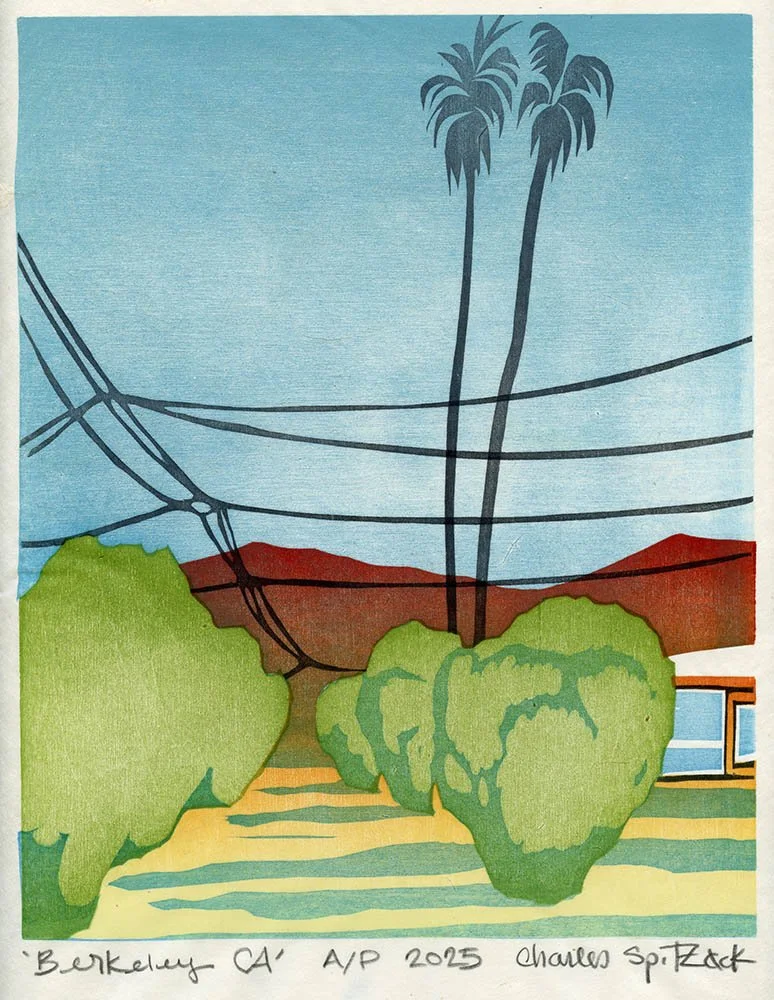
"Berkeley ca" California bay area woodcut print fine art printmaking contemporary art made at the kala art institute woodblock of palm trees mountains bushes by contemporary American artist Charles Spitzack
- Image courtesy of
- Artist website (Charles Spitzack)
Description
A California landscape combining palm trees, distant mountains, and intervening bushes — a configuration recognizable as the East Bay terrain visible from Berkeley. The print was made at the Kala Art Institute, a Berkeley print studio that hosts visiting and resident artists working across intaglio, lithography, and relief methods. The subject sits within the meisho-e tradition of named-place prints, transposed from Edo-period travel views to a contemporary American setting. Stacking palms against mountain ridges produces layered color planes, each likely cut as a separate block and registered with kentō notches at the sheet edges. The spatial logic — foreground plants, flattened middle ground, distant peaks — echoes compositional strategies used by Hokusai in his Thirty-six Views of Mount Fuji and by Hiroshige in his Tokaido series, though the local subject and contemporary palette mark the print as Spitzack's own contribution to American mokuhanga landscape.
More Prints by Charles Spitzack

trickster spitzack woodblock woodcut mokuhanga print printmaking washi seattle art

dog dawg pack spitzack woodblock woodcut mokuhanga print printmaking washi seattle art
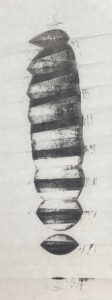
Expanded Egg #2
Mokuhanga (Japanese woodblock)
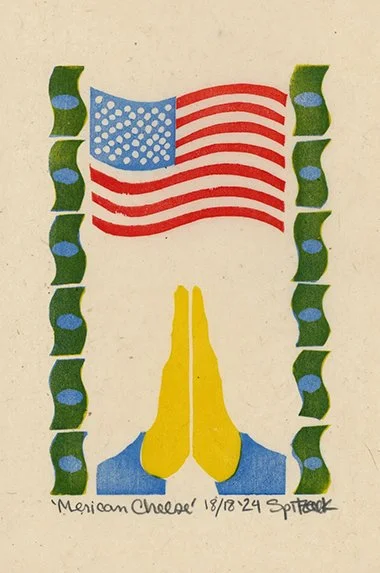
2024 charles spitzack merican cheese america the dollar money prayer flag emoji woodcut print woodblock mokuhanga seattle art artist relief printmaking lino linocut
More Seascapes Prints
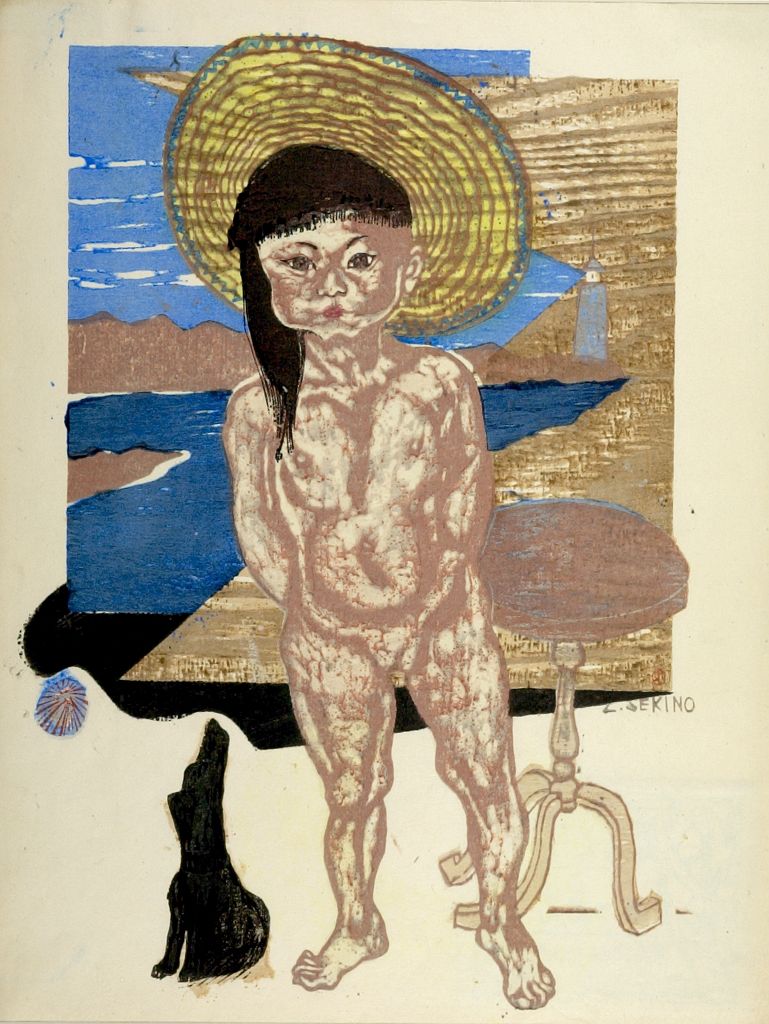
Child of the Sea
1940
Woodblock print

The Beach at Kaiganji in Sanuki Province (Sanuki Kaiganji no hama), from the series "Collection of Views of Japan II, Kansai Edition (Nihon fukei shu II Kansai hen)"
1934
Color woodblock print; oban

Pacific Ocean, Awa Province (Boshu Taikai), from the series "Souvenirs of Travel, Third Series (Tabi miyage dai sanshu)"
Boshu Taikai
1925
Color woodblock print; oban

Pine Beach at Miho (Miho no Matsubara), from the series "Selection of Views of the Tokaido (Tokaido fukei senshu)"
September 1931
Color woodblock print; oban
Frequently Asked Questions
"Berkeley ca" California bay area woodcut print fine art printmaking contemporary art made at the kala art institute woodblock of palm trees mountains bushes by contemporary American artist Charles Spitzack was created by Charles Spitzack.
"Berkeley ca" California bay area woodcut print fine art printmaking contemporary art made at the kala art institute woodblock of palm trees mountains bushes by contemporary American artist Charles Spitzack depicts seascapes.