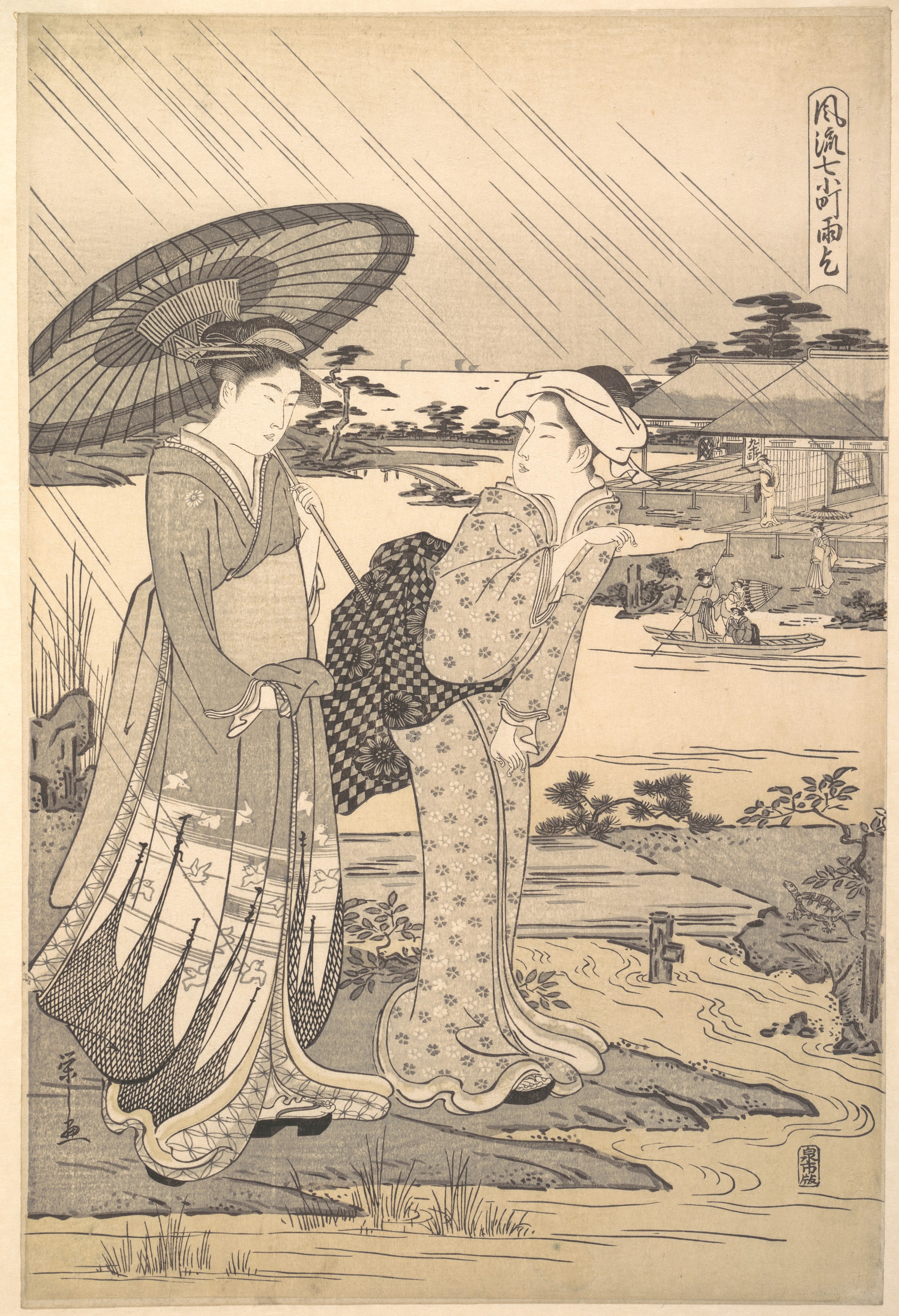
Ono no Komachi Praying for Rain
- Date:
- ca. 1791
- Medium:
- Monochrome woodblock print; ink on paper
- Source:
- Metropolitan Museum of Art
Description
Ono no Komachi Praying for Rain takes up one of the most enduring subjects of Japanese literature and visual art. Komachi, the ninth-century poet whose beauty and verses became legendary, was said to have ended a long drought by composing a waka so powerful that the heavens responded with rain. Chobunsai Eishi presents her at this critical moment, dressed in elegant robes and accompanied by suggestions of the imperial setting in which the legend unfolds. The Metropolitan Museum of Art preserves this impression. As Edo bijin-ga, the print transforms a story of supernatural poetic power into a delicately rendered female portrait, with Komachi's slender body, narrow shoulders, and downcast gaze drawn in the elongated ideal Eishi had perfected. His Kano-trained ukiyo-e draftsmanship is clearly visible in the disciplined contour of her sleeves and the careful integration of inscribed elements such as a poem cartouche or scroll, devices long used in classical painting traditions. Trained under Kano Eisen-in before turning to popular print, Eishi was particularly skilled at translating literary subjects into the visual vocabulary of late eighteenth-century Edo without losing the dignity they carried in earlier media. The viewer is asked not merely to admire Komachi's appearance but to remember the legend behind her pose, an act of cultivated recognition central to Eishi's audience. Chobunsai Eishi here demonstrates his commitment to making the classical tradition vivid for his contemporaries, presenting Komachi as both a historical poet and an idealized woman of timeless grace.
More Prints by Chōbunsai Eishi

Komurasaki of the Kadotamaya with Attendants Hatsune and Utano
c. 1790
Color woodblock print; oban

A Parody of the Tales of Ise
c. 1789/95
Color woodblock print; right sheet of oban triptych

Kiyomizu, from the series "Seven Komachi (Nana Komachi)"
c. 1791/92
Color woodblock print; chuban

A Woman's Poetry Party
c. 1793
Color woodblock print; oban triptych
More Rain Prints

Rain Shower at Shо̄no, from the series Fifty-three Stations of the Tо̄kaidо̄ (Tо̄kaidо̄ gojusan tsugi)
1962
Woodblock print, ink and color on paper

Shōno: Driving Rain (Shōno hakuu), from the series Fifty-three Stations of the Tōkaidō (Tōkaidō gojūsan tsugi no uchi), also known as the First Tōkaidō or Great Tōkaidō
c. 1833-36
Woodblock print (nishiki-e); ink and color on paper

Omiya in Rain (Ame no Omiya)
Ame no Omiya
1930
Color woodblock print; oban

Evening Shower at Teradomari (Teradomari no yau), from the series "Souvenirs of Travel, Second Series (Tabi miyage dai nishu)"
Teradomari no yau
1921
Color woodblock print; oban
Frequently Asked Questions
Ono no Komachi Praying for Rain was created by Chōbunsai Eishi (鳥文斎栄之) in ca. 1791.
Ono no Komachi Praying for Rain depicts rain.