
Omiya in Rain (Ame no Omiya)
Ame no Omiya
by Kawase Hasui
- Date:
- 1930
- Medium:
- Color woodblock print; oban
- Format:
- Oban
- Dimensions:
- 30.2 × 43.9 cm
- Publisher:
- Watanabe Shozaburo
- Edition:
- Published by Watanabe Shozaburo
- Source:
- Art Institute of Chicago
Description
A dusk scene rendered almost entirely in deep indigo blues and blacks: a dense stand of tall trees looms behind a low thatched-roof house, its windows glowing orange against the darkness. Diagonal streaks of falling rain are visible across the sky, and in the foreground a still body of water reflects the lit windows and silhouettes of tall grasses or reeds growing along its edge. No human figures appear in the composition. Kawase Hasui, "Omiya in Rain (Ame no Omiya)," 1930, color woodblock print, oban.
More Prints by Kawase Hasui

More Rain Prints

Rain Shower at Shо̄no, from the series Fifty-three Stations of the Tо̄kaidо̄ (Tо̄kaidо̄ gojusan tsugi)
1962
Woodblock print, ink and color on paper

Shōno: Driving Rain (Shōno hakuu), from the series Fifty-three Stations of the Tōkaidō (Tōkaidō gojūsan tsugi no uchi), also known as the First Tōkaidō or Great Tōkaidō
c. 1833-36
Woodblock print (nishiki-e); ink and color on paper

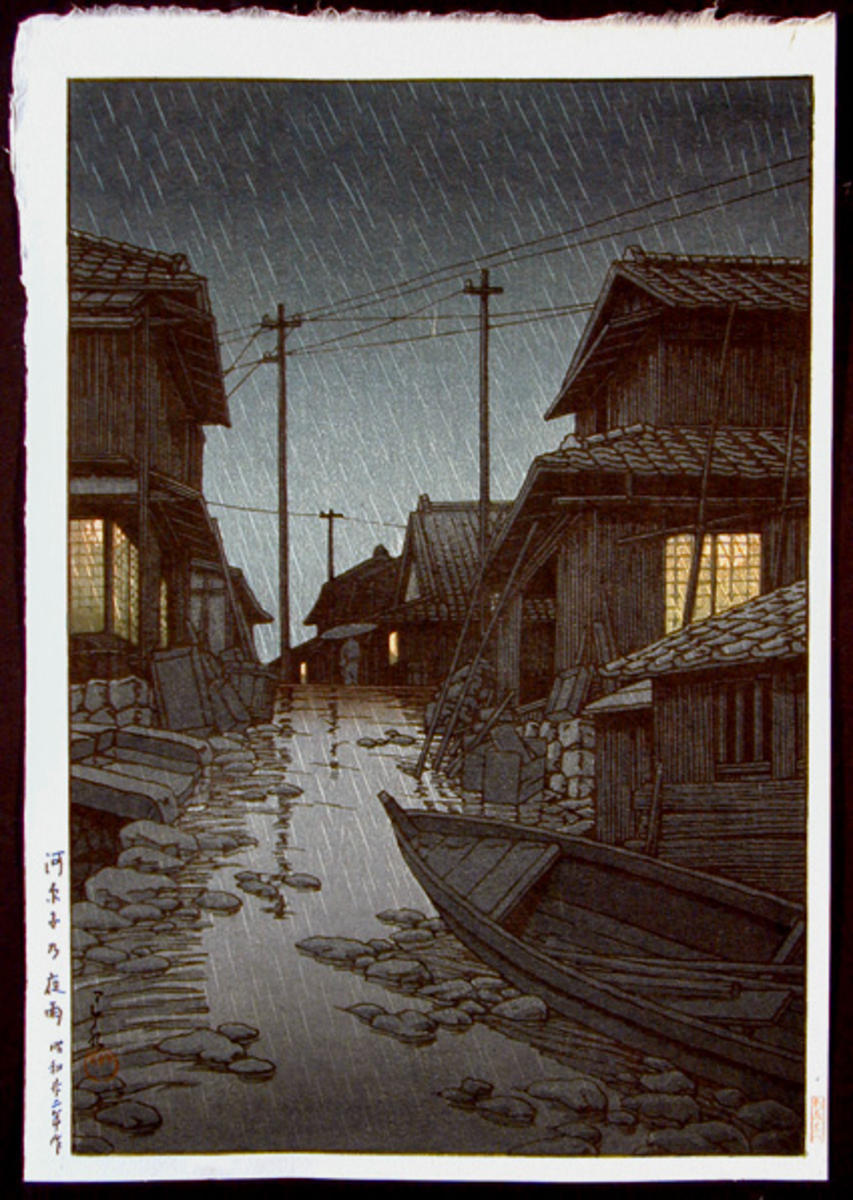
Evening Shower at Teradomari (Teradomari no yau), from the series "Souvenirs of Travel, Second Series (Tabi miyage dai nishu)"
Teradomari no yau
1921
Color woodblock print; oban

Mt. Fuji in Rain (Ame no Fuji)
n.d.
Color woodblock print
Featured in Collections
Curated cross-cuts that include this print.
Frequently Asked Questions
Omiya in Rain (Ame no Omiya) (Ame no Omiya) was created by Kawase Hasui (川瀬巴水) in 1930.
Omiya in Rain (Ame no Omiya) uses Bokashi, Nishiki-e, and Moku-hanga, on color woodblock print; oban.
Omiya in Rain (Ame no Omiya) was published by Watanabe Shozaburo (1930).
Omiya in Rain (Ame no Omiya) depicts rain.
Omiya in Rain (Ame no Omiya) measures 30.2 × 43.9 cm (Oban format).