
Refugees at a Camp (Shuyosho no hitobito), from the series "Journey to the Homeland (Sokoku e no tabi)"
- Date:
- 1947
- Medium:
- Woodblock print
- Edition:
- Self-printed
- Source:
- Art Institute of Chicago
Description
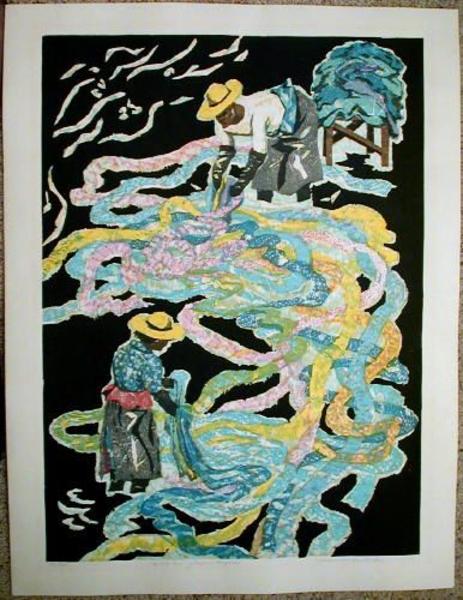
From the 1947 "Journey to the Homeland" series, this print shows the displaced persons gathered at a camp — the temporary holding facilities established along the repatriation route. The shuyosho (detention or assembly facility) provided minimal shelter for masses of people in uncertain legal and physical condition, and Kitaoka renders the population of such a place with careful attention to the variety of individual response to collective hardship: some gathered in groups, some isolated, all marked by the particular body language of people waiting for something beyond their control.
More Prints by Fumio Kitaoka


More Travel Scenes Prints

Rain Shower at Shо̄no, from the series Fifty-three Stations of the Tо̄kaidо̄ (Tо̄kaidо̄ gojusan tsugi)
1962
Woodblock print, ink and color on paper

Lake Kugushi in Wakasa Province (Wakasa Kugushiko), from the series Souvenirs of Travel I (Tabi miyage dai isshu)"
Wakasa Kugushiko
1920
Color woodblock print; oban

Pacific Ocean, Awa Province (Boshu Taikai), from the series "Souvenirs of Travel, Third Series (Tabi miyage dai sanshu)"
Boshu Taikai
1925
Color woodblock print; oban

Gosai Canal in Niigata (Niigata Gosaibori), from the series "Souvenirs of Travel, Second Series (Tabi miyage dai nishu)"
Niigata Gosaibori
1921
Color woodblock print; oban
Featured in Collections
Curated cross-cuts that include this print.
Frequently Asked Questions
Refugees at a Camp (Shuyosho no hitobito), from the series "Journey to the Homeland (Sokoku e no tabi)" was created by Fumio Kitaoka (北岡文雄) in 1947.
Yes — Refugees at a Camp (Shuyosho no hitobito), from the series "Journey to the Homeland (Sokoku e no tabi)" is part of the Journey to the Homeland (Sokoku e no tabi) series by Fumio Kitaoka.
Refugees at a Camp (Shuyosho no hitobito), from the series "Journey to the Homeland (Sokoku e no tabi)" depicts travel scenes.