
Maiko Girl Dancing (variant 2)
- Medium:
- Color woodblock print
- Source:
- ukiyo-e.org
Description
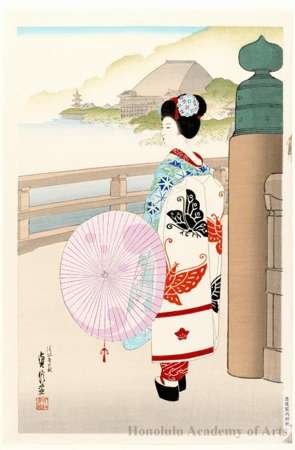
Maiko Girl Dancing is an undated Taishō or early Shōwa print by Hasegawa Sadanobu III (1881-1963), recorded on ukiyo-e.org via the Robyn Buntin database (https://ukiyo-e.org/image/robynbuntin/2e291381c32d781d453b12cb5b9884fc). The subject — a maiko, the apprentice geisha of Kyoto, shown in the act of formal Japanese dance — is one of the defining motifs of Sadanobu III's workshop output. The maiko is identifiable in Kyoto practice by her elaborately decorated darari obi sash, her unbleached red collar, and the heavy kanzashi hairpins distinguishing her from the fully fledged geiko. As the third head of the Hasegawa Osaka-Kyoto ukiyo-e house, Sadanobu III worked through the Taishō and early Shōwa years at a moment when Kyoto geisha culture was both a living institution and a self-consciously preserved emblem of traditional Kansai life — a combination that made the maiko subject central to the Hasegawa workshop's product line of Kyoto-themed prints aimed at local connoisseurs, domestic tourists, and the foreign collector market. The single-figure maiko-dancing format, in which the apprentice geisha is isolated against a plain ground with hairpins, obi, kimono pattern, and the angle of an upraised sleeve or fan carrying the descriptive weight of the image, belongs to a recognizable Hasegawa idiom that bridges late-ukiyo-e bijin-ga conventions and the cleaner palette and quieter outline of shin-hanga-era print culture. The ukiyo-e.org record preserves the impression as a Sadanobu III print without museum-level cataloguing; multiple closely related variants of the same maiko-dancing subject survive across the workshop's output, indicating a design kept in continuous circulation through the workshop's most active interwar years and reissued in slightly different colorings and impressions for distribution through Osaka, Kyoto, and Yokohama dealers.
More Prints by Hasegawa Sadanobu III
Featured in Collections
Curated cross-cuts that include this print.
Frequently Asked Questions
Maiko Girl Dancing (variant 2) was created by Hasegawa Sadanobu III (長谷川貞信三世).