
Ducks
- Medium:
- Mokuhanga (Japanese woodblock)
- Image courtesy of
- Saru Gallery
Description
Two mallard ducks float on a pale blue-gray pond rendered in fine rippling linework; the near duck faces left with an iridescent dark green-black head, yellow bill, white neck ring, and chestnut breast, its brown, tan, and white wings folded along its back, while the second duck is shown from behind, head submerged, only its mottled brown-and-cream back and dark wing markings visible above the water. A single white water lily with a yellow center and a dark green lily pad float in the lower right corner. Inscribed in the upper right with a date and the artist's signature and seal; per the record, "Ducks" by Hashiguchi Goyō, mokuhanga, year unknown.
More Prints by Hashiguchi Goyo
Woman at the Hot Springs
1920 (Taishō 9), 8th month
Unmatted modern Japanese woodblock print; ink and color on paper
Yaba Valley (Yabake)
1918 (Taishō 7)
Modern Japanese woodblock print; ink and color on paper

The Great Bridge of Sanjo in Kyoto (Kyoto Sanjo Ohashi)
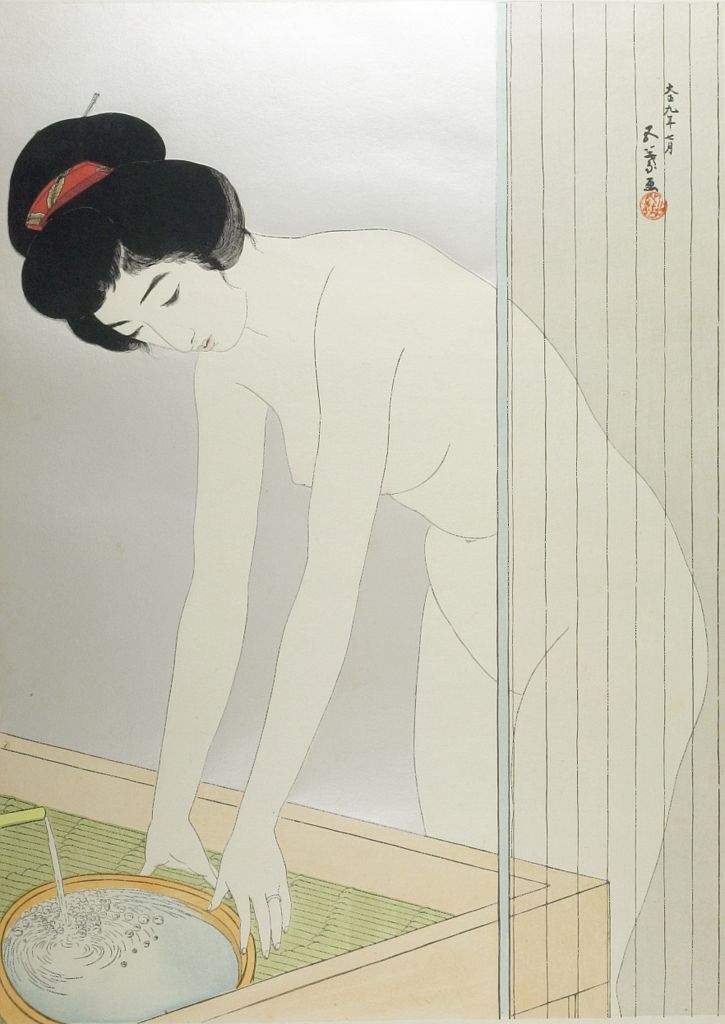
Female Bather Standing Before a Sink, Filling a Basin with Water, Taishô period, dated 1918 (7th month of Taishô 9)
Woodblock print
Featured in Collections
Curated cross-cuts that include this print.
Frequently Asked Questions
Ducks was created by Hashiguchi Goyo (橋口五葉).