
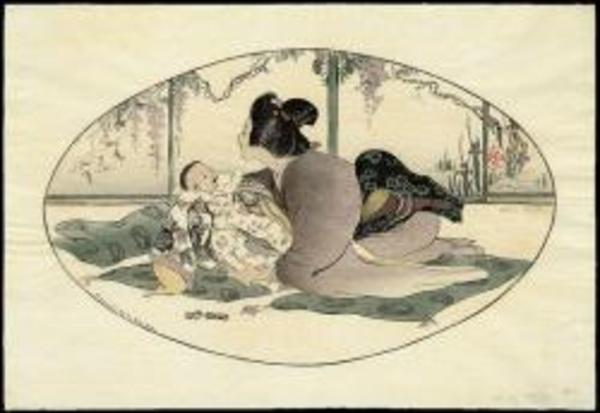
Belated
by Helen Hyde
- Date:
- 1901
- Medium:
- Color woodcut on cream wove paper
- Source:
- Art Institute of Chicago
Description
Belated, dated 1901, is among the early Tokyo-period prints in which Helen Hyde began to establish the iconographic and tonal vocabulary that would define her mature work. The title's suggestion of lateness or delay indicates the narrative subject matter she favored, capturing a figure caught in a quiet moment of arrival or interruption rather than a static portrait. As an American Japonisme artist working in Tokyo from 1899 and a shin-hanga precursor whose workshop practice preceded Watanabe Shozaburo's 1915 codification of the shin-hanga movement by fourteen years, Hyde had by this date settled into her collaboration with Japanese carvers and printers in the traditional ukiyo-e workshop system. Her teacher Kano Tomonobu had introduced her to Japanese figure painting conventions, and her access to Tokyo workshop printers ensured authentic multi-block color execution. The print reflects the late-Meiji moment of its making, a Tokyo still organized around the imperial palace and the merchant districts she observed daily from her Akasaka studio. The composition descends from the storytelling tradition of late ukiyo-e by Utagawa Kuniyoshi and Toyohara Chikanobu, but Hyde's gentler line and quieter palette align the work with the bijin-ga restraint that Hashiguchi Goyo and Ito Shinsui would carry into the shin-hanga movement after 1915. Held by the Art Institute of Chicago, which preserves the most important institutional collection of Hyde's work, Belated provides documentation of an American artist absorbing and contributing to Japanese print practice at the moment when ukiyo-e was transitioning toward the new shin-hanga movement.
More Prints by Helen Hyde


Featured in Collections
Curated cross-cuts that include this print.
Frequently Asked Questions
Belated was created by Helen Hyde in 1901.