
O Tsuyu San
by Helen Hyde
- Date:
- 1900
- Medium:
- Color woodcut on cream Japanese paper
- Source:
- Art Institute of Chicago
Description
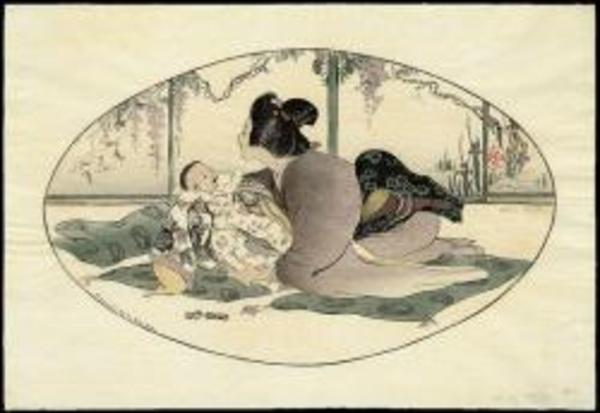
O Tsuyu San of 1900 takes its title from a personal name in the Japanese tradition, the honorific 'O' and the suffix 'San' framing the given name Tsuyu, meaning dew. The portrait-style composition reflects Helen Hyde's early decision to depict named individuals rather than generic types, an approach that distinguished her American Japonisme from much late-nineteenth-century Western treatment of Japan. As a shin-hanga precursor working in Tokyo a full fifteen years before Watanabe Shozaburo formally launched the shin-hanga movement in 1915, Hyde was already collaborating with Japanese carvers and printers in the traditional ukiyo-e workshop system to produce multi-block color prints of bijin subjects. The print descends from the bijin-ga tradition of Kitagawa Utamaro and Toyohara Chikanobu, but Hyde's recourse to a specific named subject and her use of psychologically attentive expression align the work with later shin-hanga bijin-ga by Hashiguchi Goyo and Ito Shinsui. Her teacher Kano Tomonobu had instructed her in the conventions of Japanese figure painting, and Mary Cassatt's portraits had provided a Western model of intimate observation. Held by the Art Institute of Chicago, which preserves the principal American institutional collection of Hyde's woodblocks, this print captures Hyde at the start of her productive Tokyo period, a moment when she was rapidly establishing the iconography and technique that would characterize her career. The print also reflects the late-Meiji moment in which an American artist could depict named Japanese individuals with attention rather than as anonymous figures of a generalized exotic East.
More Prints by Helen Hyde


Featured in Collections
Curated cross-cuts that include this print.
Frequently Asked Questions
O Tsuyu San was created by Helen Hyde in 1900.