
The Mirror
by Helen Hyde
- Date:
- 1904
- Medium:
- Color woodcut on cream Japanese paper
- Source:
- Art Institute of Chicago
Description
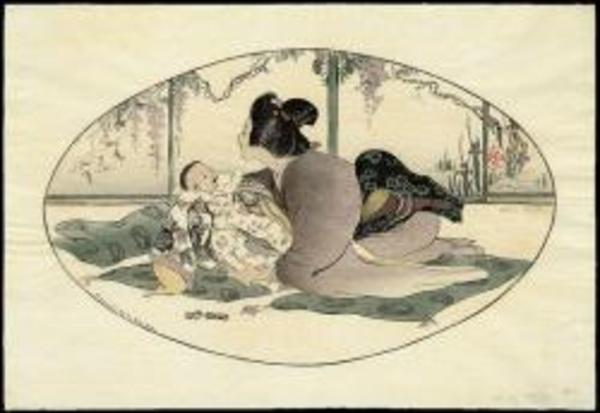
Created in 1904, The Mirror exemplifies Helen Hyde's mature engagement with American Japonisme during her years living in Tokyo. As a shin-hanga precursor, Hyde anticipated the early twentieth-century revival of Japanese woodblock printmaking by collaborating directly with Japanese carvers and printers in the traditional ukiyo-e workshop system, a practice that Watanabe Shozaburo would soon formalize into the shin-hanga movement. The Mirror depicts a young woman engaged in the quiet, intimate act of grooming, a subject inherited from Edo-period bijin-ga traditions of Suzuki Harunobu and Kitagawa Utamaro that Hyde knew through her studies of Japanese prints with Emil Orlik and others. The composition focuses tightly on the figure, using flat planes of color and the controlled outline of the brush that Hyde had absorbed from her Tokyo teacher Kano Tomonobu. Her debt to Mary Cassatt's color drypoints of mothers and children at the toilette is evident in the framing, but where Cassatt translated Japanese motifs through European etching, Hyde took the further step of having her designs cut and printed in authentic Japanese woodblock technique. Held by the Art Institute of Chicago, which holds the most significant institutional collection of her prints in the United States, this work reflects the early twentieth-century American fascination with Meiji-era Japan and shows Hyde at the height of her technical confidence with multi-block color printing. The Mirror's domestic intimacy and refusal of orientalist spectacle distinguish Hyde's vision from many of her American contemporaries and align her work with the gentle, observational sensibility that shin-hanga artists such as Hashiguchi Goyo and later Ito Shinsui would carry forward into the 1910s and 1920s.
More Prints by Helen Hyde


Featured in Collections
Curated cross-cuts that include this print.
Frequently Asked Questions
The Mirror was created by Helen Hyde in 1904.