
The Secret
by Helen Hyde
- Date:
- 1909
- Medium:
- Color woodcut on cream wove paper
- Source:
- Art Institute of Chicago
Description
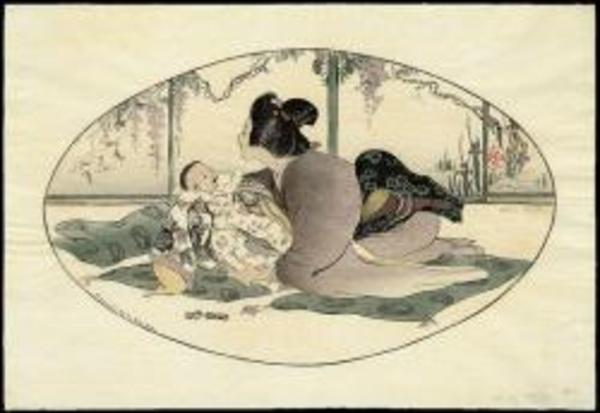
The Secret (1909) is a color woodblock print in which Helen Hyde captures two Japanese children in an intimate exchange of whispered confidence, one bending to the other's ear with the conspiratorial seriousness only small children muster. Hyde, an American Japonisme artist who lived in Tokyo from 1899 until illness forced her return to the United States in 1914, specialized in mother-and-child and child-with-child compositions that she observed in her own neighborhood. The flattened ground, rhythmic kimono pattern, and economical contour lines belong squarely to the Japanese ukiyo-e tradition, while the subject's domestic tenderness reflects the American genre painting Hyde absorbed earlier in San Francisco and Berlin. Her working method placed her among the most important shin-hanga precursors: she designed the image in watercolor, then collaborated with Tokyo carvers and printers who cut the keyblock and color blocks and pulled the impressions under her supervision, a division of labor that Watanabe Shozaburo would formalize a decade later as the foundation of the shin-hanga movement. The Secret is held by the Art Institute of Chicago, whose Hyde holdings derive from the artist's family bequest and constitute the principal scholarly archive for her work. The Chicago impression preserves the muted pinks, warm greys, and ink-line crispness that signal a quality lifetime printing. The print is a representative example of Hyde's narrative restraint, where the entire emotional content is carried by the angle of two heads and the careful placement of one small hand on the other child's shoulder, and it remains one of the most reproduced images in the catalogue of American Japonisme.
More Prints by Helen Hyde


Featured in Collections
Curated cross-cuts that include this print.
Frequently Asked Questions
The Secret was created by Helen Hyde in 1909.