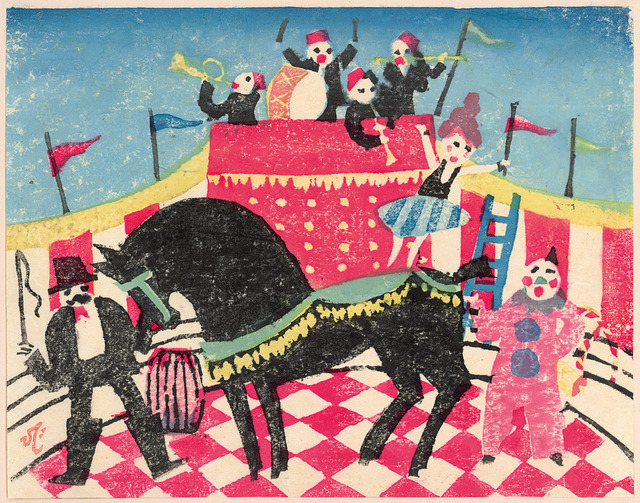
Circus
- Date:
- 1925
- Medium:
- Color woodcut on paper
- Image courtesy of
- Artsy
Description
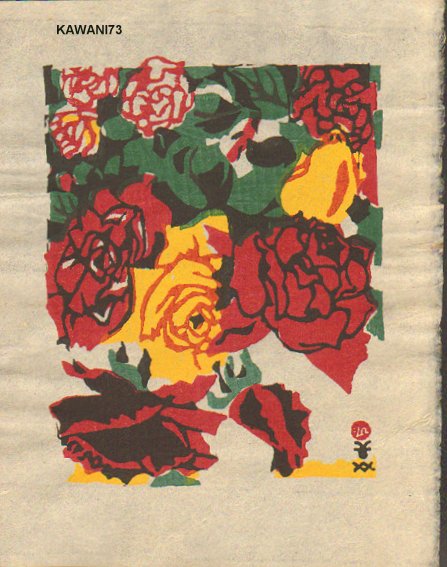
Circus is a Japanese woodblock print by Hide Kawanishi, dated 1925 in the working brief, executed in the sosaku-hanga or creative-print idiom that the artist used throughout his career. Kawanishi Hide (1894-1965) belonged to the Kobe-Osaka regional circle of the prewar creative-print movement and produced a distinctive body of work that drew on the look of foreign visitors, port-city life, popular entertainment, and circus or fairground subjects, often with a deliberately naive, folk-art drawing style and an emphatic decorative color sense. A 1925 design titled Circus draws directly on the entertainment culture that traveling Western and Japanese circuses had introduced to the major Japanese cities in the early twentieth century, where acrobats, clowns, ringmasters, animals, and tents furnished popular subjects for artists interested in the visual carnival of modern urban life. Kawanishi's sosaku-hanga ethos governed the design's production: the artist drew, carved, and printed his own blocks, allowing the woodgrain and the visible registration to register as part of the print's material identity rather than being suppressed in favor of pictorial polish. Within his wider output, this print belongs to the entertainment and fairground vein that runs alongside his prints of Kobe foreigners, Yokohama scenes, and folk-style narrative subjects. The impression discussed here is documented through the Artsy listing on the secondary market (https://www.artsy.net/artwork/kawanishi-hide-circus), which preserves a record of the design under the artist's name. The 1925 date is reproduced as supplied in the working brief and aligns with the early-Taisho explosion of circus popularity in urban Japan.
More Prints by Hide Kawanishi
Featured in Collections
Curated cross-cuts that include this print.
Frequently Asked Questions
Circus was created by Hide Kawanishi (川西英) in 1925.