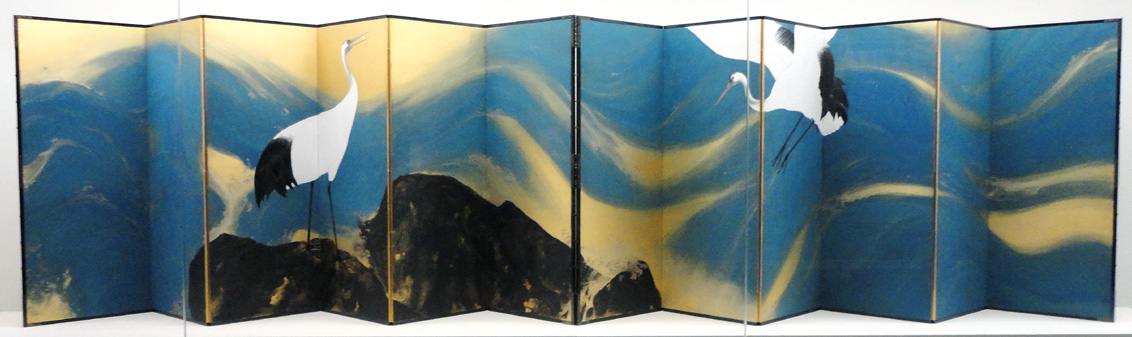
Cranes
鶴図
- Date:
- 1920s
- Medium:
- Pair of folding screens; ink and color on paper
- Source:
- Wikimedia Commons
Description
Cranes (鶴図) is a pair of folding screens by Hirafuku Hyakusui in ink and color on paper, dated to the 1920s, depicting cranes — among the most charged of all subjects in Japanese painting, carrying associations of longevity, marital fidelity, and the auspiciousness that surrounds the New Year season and other rites of passage. The crane has been a standard test of a senior Japanese painter since the Kanō school of the Muromachi period, and Hyakusui's treatment positions him within that long tradition while filtering it through his own Maruyama-Shijō training and the Tokyo nihonga reform of his generation. Across the two screens he renders the cranes at large scale with close attention to feathering, posture, and the structure of the leg — the kind of zoological precision that the Shijō school had inherited from Maruyama Ōkyo's eighteenth-century shasei practice and that Hyakusui had absorbed from his father, the Akita nihonga painter Hirafuku Suian. The composition uses the wide horizontal sweep of the paired screens to set the cranes against atmospheric space, with no decorative pattern interfering with the figure-ground reading. As a pair of large-format screens (byōbu) the work demonstrates Hyakusui's full command of the architectural-scale formats that a senior nihonga painter was expected to master, and complements his better-known hanging-scroll and book-illustration practice.
More Prints by Hirafuku Hyakusui


More Birds & Flowers Prints
Frequently Asked Questions
Cranes (鶴図) was created by Hirafuku Hyakusui (平福百穂) in 1920s.
Cranes depicts birds & flowers.