
Hirafuku Hyakusui
平福百穂
1877–1933
Japan
Biography
Hirafuku Hyakusui (1877–1933), whose given name was Teizō, was a leading nihonga painter, illustrator, and poet of the late Meiji, Taishō, and early Shōwa periods, known for the cool clarity of his landscape, figure, and animal painting in the lineage of the Maruyama-Shijō school. He was born in Kakunodate in Akita Prefecture in northern Japan, the son of Hirafuku Suian (1844–1890), a respected Akita painter of the Shijō school. This early apprenticeship under his father gave the younger Hyakusui a grounding in shasei (sketching from life) and in the bird-and-flower (kachō-e) and animal painting that would remain central to his work throughout his life.
After his father's death in 1890, Hyakusui continued his studies before moving to Tokyo in 1894 to study under Kawabata Gyokushō (1842–1913), a senior Maruyama-Shijō painter and professor at the Tokyo School of Fine Arts. In 1897 he enrolled in the Japanese-painting (nihonga) department of the Tokyo School of Fine Arts (Tōkyō Bijutsu Gakkō), and from 1902 he also took up Western-style painting. Out of this mixed training he developed a sharply observed naturalism — sober, atmospheric, and free of decorative excess — that combined the Maruyama-Shijō discipline of close observation with the compositional clarity of European art, while his mature work also absorbed elements of the Rinpa and Nanga traditions.
In 1900, together with Yūki Somei (1875–1957) and other young painters, Hyakusui helped found the Musei-kai ('Silent Society'), a group devoted to introducing a quieter, more realistic naturalism into traditional Japanese painting, centred on landscape and everyday figure subjects. The society's exhibitions in the early 1900s established him as one of the most thoughtful younger nihonga painters of his generation. He won a prize at the eighth Bunten (the Ministry of Education Fine Arts Exhibition) in 1914 and later served as a juror for its successor, the Teiten, from 1922.
Alongside his painting, Hyakusui worked as a book and newspaper illustrator, contributing illustrations to the Kokumin Shimbun and, later, to an Iwanami Shoten edition of two works by the novelist Natsume Sōseki (1867–1916), Kusamakura and Bunchō. Sōseki, who took a keen interest in painting, is recorded as having admired the turkey picture Hyakusui exhibited at that same 1914 Bunten. Hyakusui was also a published tanka poet, associated with the Araragi circle and its magazine, and his verse was gathered in the anthology Kanchiku.
In 1916 he became one of the founding members of the Kinreisha (Golden Bell Society), together with Yūki Somei, Kaburaki Kiyokata, Kikkawa Reika, and Matsuoka Eikyū — an exhibition society that played an important role in the Taishō-period reform of nihonga. He was appointed a professor at the Imperial Art School (Teikoku Bijutsu Gakkō) in 1929 and at the Tokyo School of Fine Arts in 1932, and he was named a member of the Imperial Art Academy (Teikoku Bijutsuin), among the highest official honors then available to a Japanese painter. He continued to produce major landscape work into the early 1930s, until his death in October 1933.
Hyakusui's significance lies in his restrained, clear-eyed nihonga — which maintained the Maruyama-Shijō discipline of close natural observation while absorbing the lighter decorative sense of Rinpa and the literati manner of Nanga — and in his deep involvement in the book illustration and poetry of his day. Among collectors of modern Japanese art he is valued especially for his northern landscapes, his bird and animal pictures, and his book illustrations. His work is held in international museum collections, including the British Museum in London and the Los Angeles County Museum of Art.
Key Facts
- Active Period
- 1877–1933
- Nationality
- 🇯🇵Japan
- Subjects
- SpringBirds & Flowers
- Works Indexed
- 8
Frequently Asked Questions
Hirafuku Hyakusui (1877–1933), whose given name was Teizō, was a leading nihonga painter, illustrator, and poet of the late Meiji, Taishō, and early Shōwa periods, known for the cool clarity of his landscape, figure, and animal painting in the lineage of the Maruyama-Shijō school. He was born in Kakunodate in Akita Prefecture in northern Japan, the son of Hirafuku Suian (1844–1890), a respected Akita painter of the Shijō school. This early apprenticeship under his father gave the younger Hyakusui a grounding in shasei (sketching from life) and in the bird-and-flower (kachō-e) and animal painting that would remain central to his work throughout his life.
Hirafuku Hyakusui was active from 1877 to 1933.
Hirafuku Hyakusui's prints frequently feature spring, birds & flowers.
Original prints by Hirafuku Hyakusui can be found in collections including Akita Museum of Modern Art (via Wikimedia Commons), Akita Senshu Museum of Art (via Wikimedia Commons), Wikimedia Commons, Museum of the Imperial Collections (via Wikimedia Commons).
Woodblock Prints by Hirafuku Hyakusui (8)
Hunter
狩人
1903
Ink and color on silk

Lion (folding screen)
獅子図屏風
1915
Folding screen; ink and color on paper

Portrait of the Abbot of Rengeji
蓮花寺住職像
before 1933
Ink and color on silk
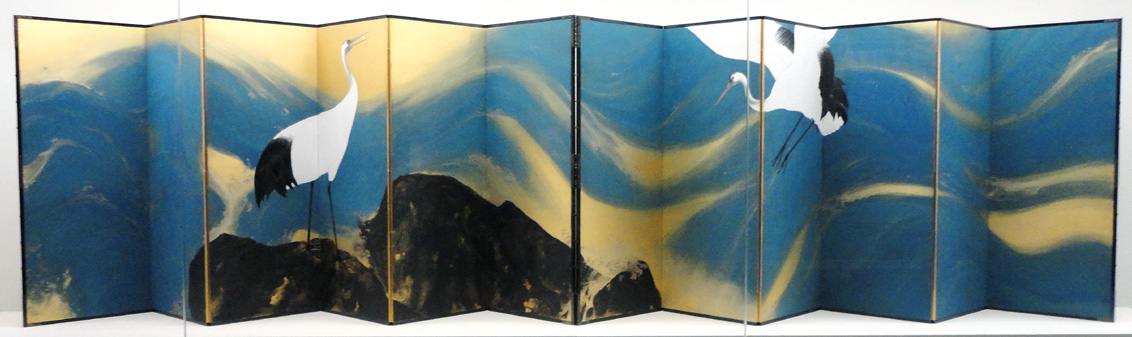
Cranes
鶴図
1920s
Pair of folding screens; ink and color on paper

Stormy Coast
怒涛
1926
Ink and color on silk

Oak Trees
槲樹
1928
Pair of six-fold screens; color on paper

Two Doves
双鳩図
1931
Hanging scroll; color on silk
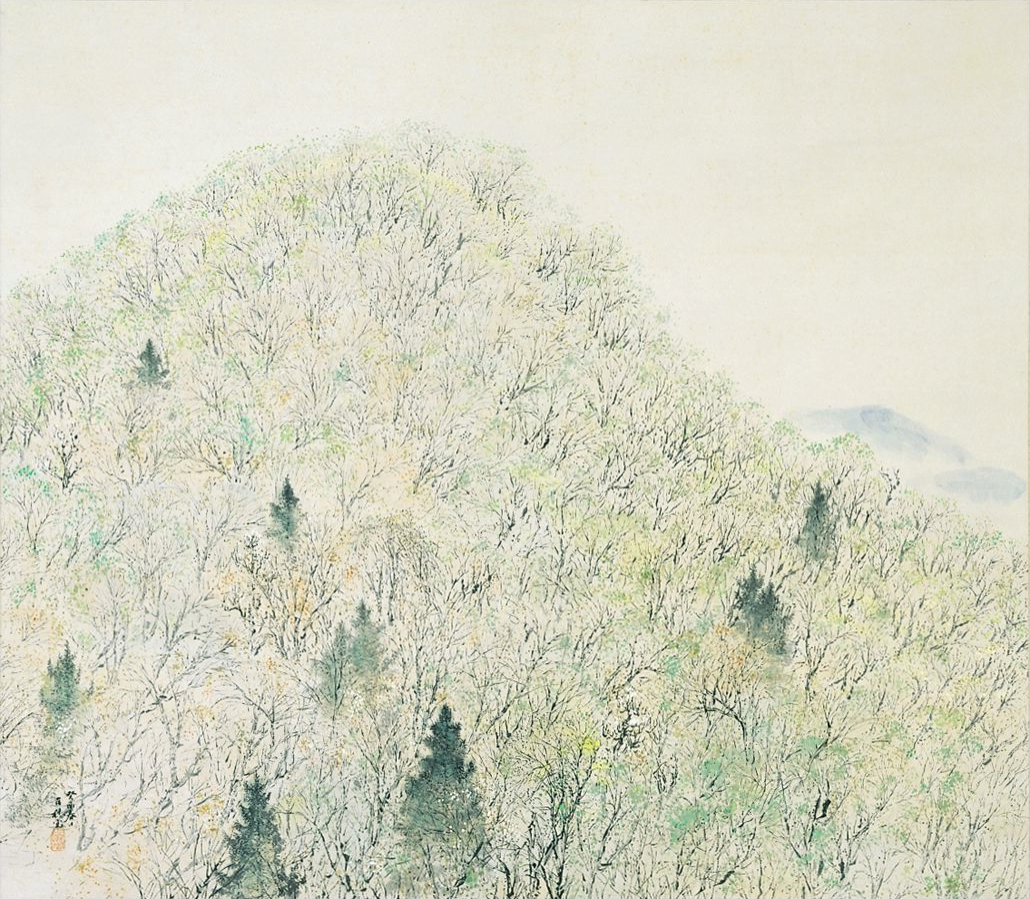
Spring Mountain (Haruyama)
春山
1933
Hanging scroll; ink and color on silk