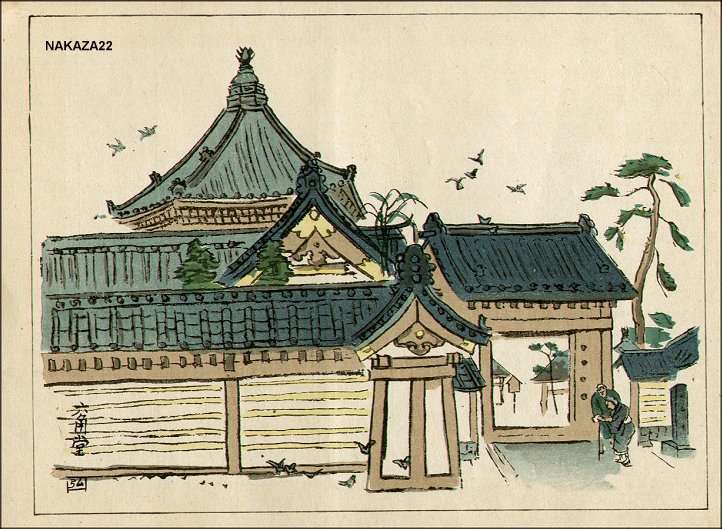
Rokkakudo
- Medium:
- Woodblock print
- Image courtesy of
- Asian Collection Internet Auction
Description
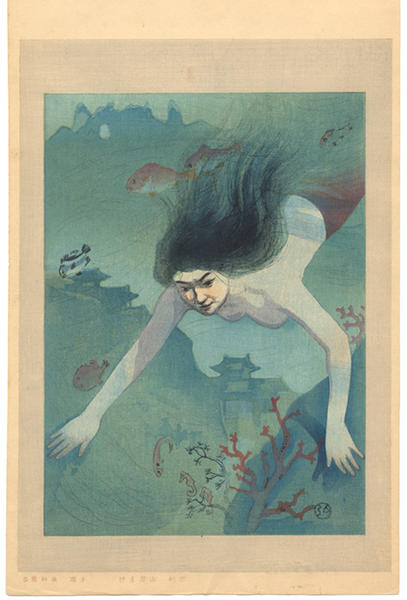
Rokkakudō, formally Chōhō-ji, is a Buddhist temple hall in central Kyoto notable for its distinctive hexagonal plan, a form associated in temple tradition with Prince Shōtoku. Hiromitsu Nakazawa, a Meiji-era woodblock artist known for architectural subjects, depicts this unusual structure with attention to its six-sided geometry and the urban Kyoto setting surrounding it. The hall sits on a low plinth with a surrounding pond and stone lanterns, and Nakazawa's composition likely emphasizes the hexagonal roof's pronounced upward-curving eaves (nokisaki) against the sky. His approach reflects Meiji-period printmaking conventions — more naturalistic and spatially measured than Edo ukiyo-e, with attention to atmospheric perspective influenced by Western methods. Rokkakudō is historically associated with the founding of ikebana flower arrangement, and seasonal vegetation in the print may allude to this connection. The surrounding pond's reflective surface offered Nakazawa the compositional device of a partial inverted image beneath the hall's distinctive architectural silhouette.
More Prints by Hiromitsu Nakazawa
Featured in Collections
Curated cross-cuts that include this print.
Frequently Asked Questions
Rokkakudo was created by Hiromitsu Nakazawa (中沢弘光).