
Nakabusa River Rapids
- Date:
- 1926
- Medium:
- Color woodblock print
- Format:
- Oban
- Dimensions:
- 41.7 × 28.1 cm
- Publisher:
- Yoshida Studio
- Source:
- Art Institute of Chicago
Description
Rapids is a powerful and dynamic large-format print created by Hiroshi Yoshida in 1928, depicting a turbulent mountain stream cascading over rocks with tremendous energy and movement. The composition focuses on the raw force of water as it surges through a narrow rocky channel, breaking into white foam and spray as it crashes against boulders and plunges over ledges. The surrounding rocks are rendered in deep earth tones — rich browns, grays, and moss-covered greens — while the water itself transitions from deep blue-green in the calmer pools to brilliant white where it erupts into rapids and falls.
This print represents a departure from the serene, contemplative mood that characterizes much of Yoshida's landscape work. Where his sailing boat scenes and mountain views emphasize stillness and atmospheric distance, Rapids confronts the viewer with nature's kinetic power at close range. The composition fills the picture plane with churning water and jagged rock forms, leaving little sky or distant horizon to provide visual relief. The effect is immersive and almost auditory — viewers often report a sense of hearing the roar and rush of the water.
Technically, Rapids demonstrates Yoshida's extraordinary command of the woodblock medium in rendering water in all its states. The carving required to suggest the complex patterns of flowing, splashing, and eddying water was among the most demanding work undertaken by Yoshida's block carvers. Different passages of water required entirely different approaches: smooth, flowing lines for the deeper channels; fragmented, irregular marks for the turbulent rapids; and areas of uninked paper left white to represent foam and spray.
The large format of this print — significantly bigger than the standard oban size used for most of Yoshida's work — gives the subject an imposing physical presence that reinforces its dramatic content. Rapids stands as evidence of Yoshida's range as an artist, demonstrating that his sensitivity to subtle atmospheric effects was matched by an equal ability to capture nature's more violent and spectacular manifestations.
More Prints by Hiroshi Yoshida
More Landscapes Prints

Lake Kugushi in Wakasa Province (Wakasa Kugushiko), from the series Souvenirs of Travel I (Tabi miyage dai isshu)"
Wakasa Kugushiko
1920
Color woodblock print; oban
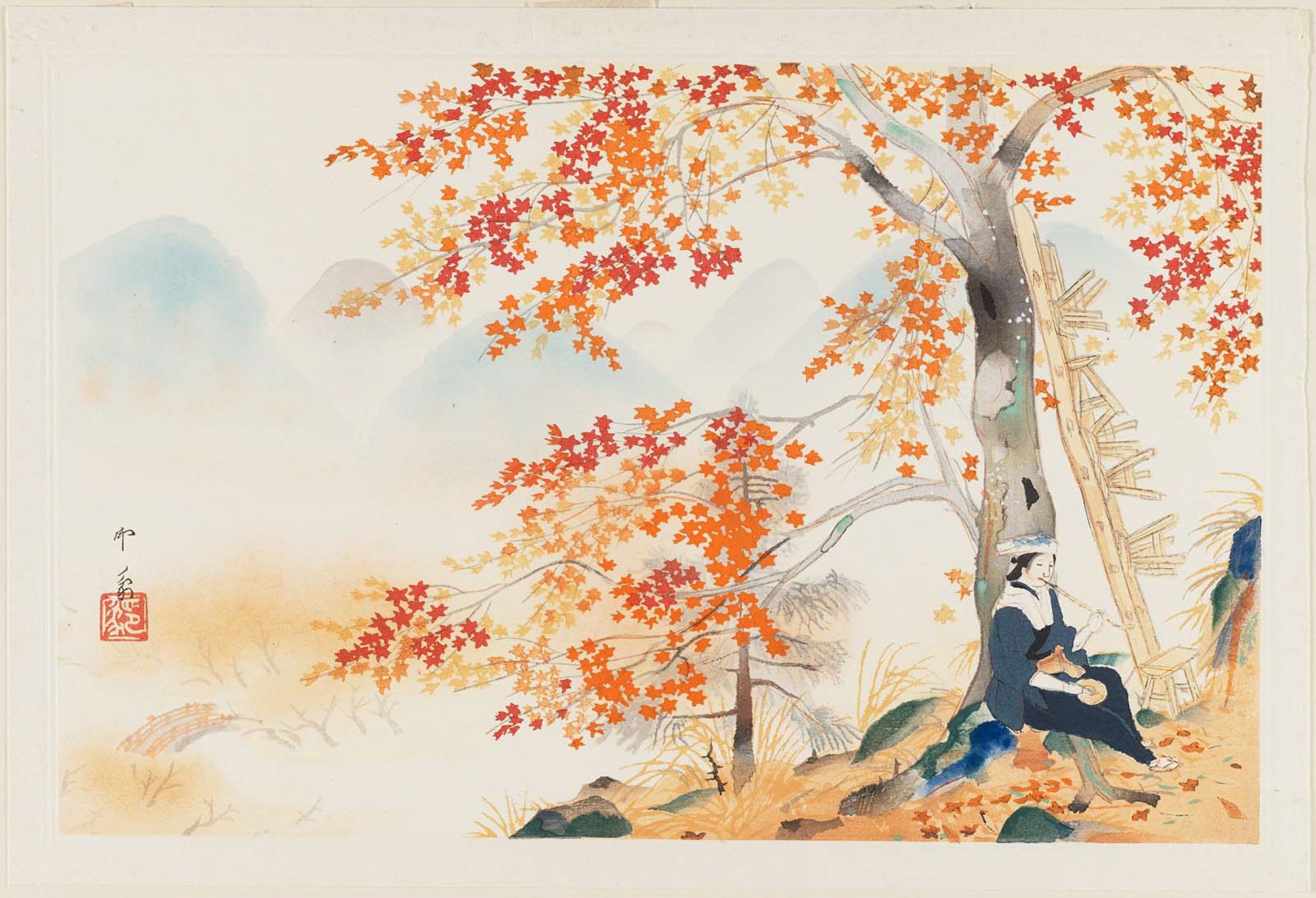
Autumn Maple Leaves at Takao, from the album Eight Views of Kyoto (Kyôto hakkei)
Woodblock print

The Beach at Kaiganji in Sanuki Province (Sanuki Kaiganji no hama), from the series "Collection of Views of Japan II, Kansai Edition (Nihon fukei shu II Kansai hen)"
1934
Color woodblock print; oban

Tea Kettle, section of a sheet from the series "Mirror of Stone Rubbings of Views of the Provinces" (Kohon meihitsu ishizuri kagami)
n.d.
Woodblock print; ishizuri-e, section of harimaze sheet
Featured in Collections
Curated cross-cuts that include this print.
Frequently Asked Questions
Nakabusa River Rapids was created by Hiroshi Yoshida (吉田博) in 1926.
Nakabusa River Rapids uses Moku-hanga, Nishiki-e, and Bokashi, on color woodblock print.
Nakabusa River Rapids was published by Yoshida Studio (1926).
Nakabusa River Rapids depicts landscapes and rivers & lakes.
Nakabusa River Rapids measures 41.7 × 28.1 cm (Oban format).