
Bodhisattva Kenshu
賢首菩薩
- Date:
- 1907
- Medium:
- Hanging scroll; color on silk
Description
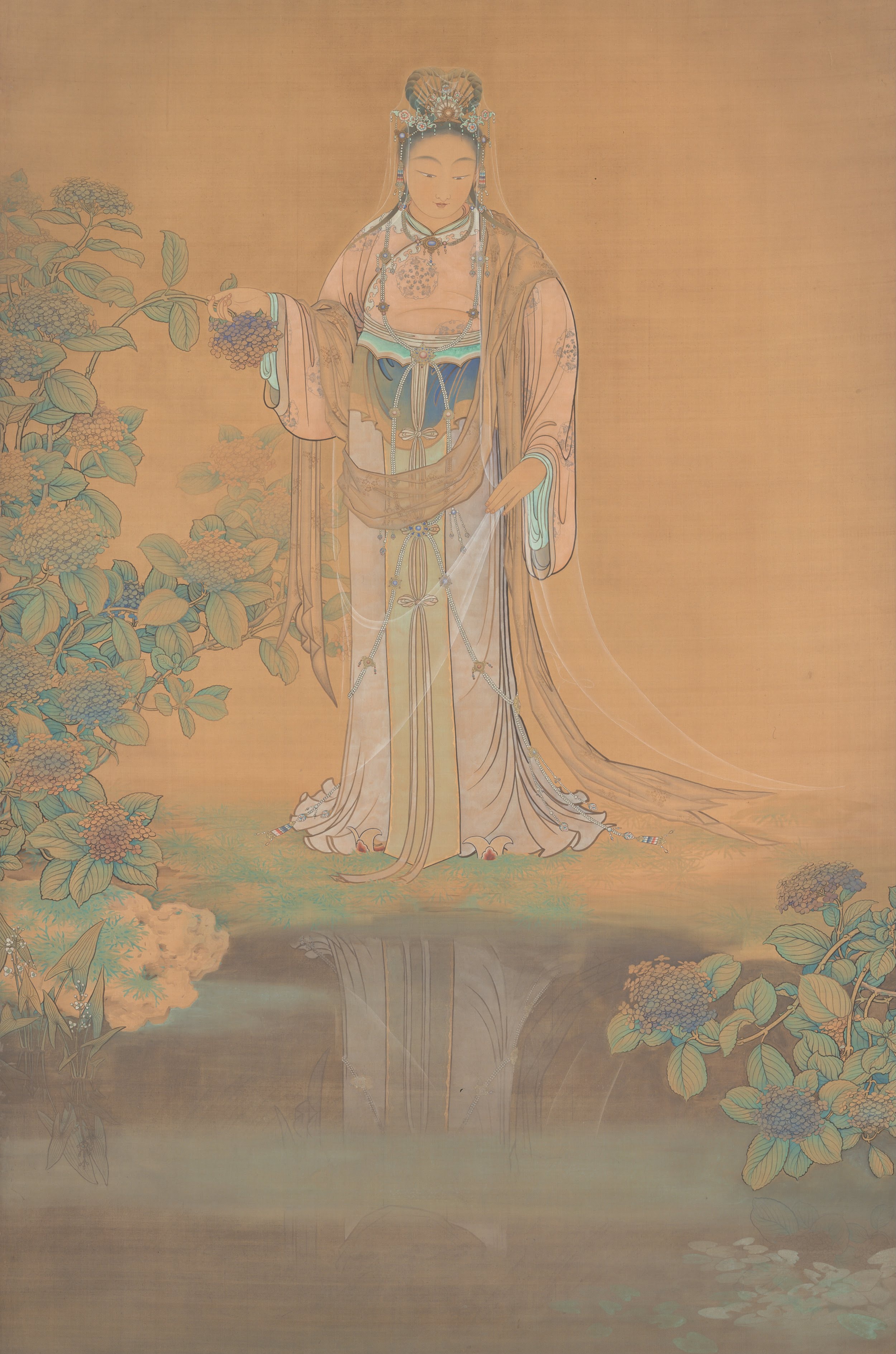
Painted in 1907, Bodhisattva Kenshu (Kenshu Bosatsu) is a hanging scroll in color on silk depicting the patriarch Kenshu, the Chinese-Korean monk traditionally identified as the third patriarch of the Huayan (Kegon) school of Buddhism, seated in robes of saffron and ochre and gazing meditatively into the middle distance. The figure occupies a tall vertical format, with the lower part of the composition given over to a richly patterned floor and the upper part filled with an atmospheric coloring suggestive of incense smoke and meditative space. The face of Kenshu is drawn with precise fine-line detail, with the eyes, brow, and mouth carefully observed in the manner of traditional Buddhist portraiture (chinso), while the surrounding robes, floor, and atmospheric ground are handled in the mōrō-tai vocabulary of soft, layered washes that integrate the figure into a continuous atmospheric environment. The work was painted during the period when Hishida was producing his most ambitious religious subjects, drawing on the iconographic vocabulary of Tang and Song dynasty Buddhist portraiture but rendering it in the new atmospheric mode that he and Yokoyama Taikan had developed through the early 1900s. Bodhisattva Kenshu is now held in the National Museum of Modern Art, Tokyo (MOMAT), where it represents Hishida's mature engagement with the religious and historical subjects that were a central concern of the Nihon Bijutsuin circle in its early years.
More Prints by Hishida Shunsō


Frequently Asked Questions
Bodhisattva Kenshu (賢首菩薩) was created by Hishida Shunsō (菱田春草) in 1907.