
Biography
Hishida Shunsō (菱田春草, 1874-1911) was one of the most consequential Meiji-era Japanese painters and a founding figure of the modern nihonga (Japanese-style painting) movement, whose brief career — cut short by chronic kidney disease at age thirty-six — produced a body of work that reshaped the trajectory of twentieth-century Japanese painting. Working in close partnership with Yokoyama Taikan and under the philosophical direction of the art theorist Okakura Tenshin (Okakura Kakuzō), Hishida helped develop the controversial mōrō-tai (朦朧体, "hazy style" or "vague style") technique, which attempted to synthesize traditional East Asian brushwork with atmospheric optical effects associated with European Impressionism. He is best remembered today for a group of masterpieces — Black Cat (Kuroki Neko, 1910), Fallen Leaves (Ochiba, 1909), and Wang Zhaojun (Ōshōkun, 1902) — of which Fallen Leaves and Black Cat are designated Important Cultural Properties of Japan, and his position among the founding generation of the Nihon Bijutsuin (Japan Art Institute) circle is secure.
Hishida was born on September 21, 1874 in the town of Iida in what is now Nagano Prefecture, into a family of modest means; his father, Hishida Enji, was a former retainer of the Iida domain. The Iida region in the Ina Valley was a remote mountain community far from the cultural centers of Tokyo, Kyoto, and Osaka, but it had a tradition of local painters working in the kanō and nanga (literati) schools, and the young Hishida appears to have shown drawing talent from early childhood. In 1889 he moved to Tokyo to study, first entering the private art school of the Kanō-school painter Yūki Masaaki. The following year, in 1890, he enrolled at the institution that would become his lifelong artistic home: the Tokyo School of Fine Arts (Tōkyō Bijutsu Gakkō), the government art academy that had opened in 1889 on the initiative of Okakura Tenshin and the American philosopher and art historian Ernest Fenollosa.
The Tokyo School of Fine Arts, in its founding configuration, was conceived as a deliberate counterweight to the prevailing pro-Western current of Meiji culture. Where the earlier official art academy, the Kōbu Bijutsu Gakkō, had been established in 1876 to teach oil painting and Western academic drawing under the Italian artist Antonio Fontanesi, Okakura and Fenollosa argued for an institution dedicated to the revival and modernization of Japanese painting traditions. The curriculum that the young Hishida entered was therefore focused on traditional nihonga techniques: brush-and-ink drawing, copying from old masters of the kanō and tosa schools, and instruction in pigments and mineral colors on silk and paper. Among his principal teachers was Hashimoto Gahō (1835-1908), a leading master of the kanō school, who had been recruited by Okakura to serve as the school's chief painting instructor. Gahō's pedagogy combined rigorous training in the conservative kanō pictorial vocabulary with encouragement of personal interpretation and atmospheric effect — qualities that would later define Hishida's own mature style.
Hishida graduated from the Tokyo School of Fine Arts in 1895, at the age of twenty-one. His graduation project, Widow and Orphan (Kafu to Koji), a melancholic depiction of a mourning mother and child rendered in subdued ink and color, is among the formative documents of early-Meiji nihonga and is held in the collection of the Tokyo University of the Arts. In 1897 he produced Reflection in the Water (Mizu-kagami), depicting a celestial maiden gazing at her image in a still pool, a work that shows his command of conventional nihonga draftsmanship combined with an unusually sensitive treatment of atmospheric light — a quality that would soon develop into the more radical experiments of the mōrō-tai years.
The defining institutional rupture of Hishida's career came in 1898, when Okakura Tenshin was forced out of the Tokyo School of Fine Arts in the dispute known as the "Okakura incident" — a complex political conflict involving rival faculty factions and the gradual displacement of Okakura's traditionalist program by more Western-oriented administrators. Okakura resigned in protest and was followed out of the institution by a substantial group of loyal faculty members and recent graduates, including Hashimoto Gahō, the painter Yokoyama Taikan (1868-1958), the slightly older Shimomura Kanzan (1873-1930), and the young Hishida himself. In 1898 this exiled faction founded the Nihon Bijutsuin (日本美術院, Japan Art Institute), a private painting academy that would serve as the home of progressive nihonga for decades and that survives today as one of the central institutions of Japanese-style painting.
Within the Nihon Bijutsuin, Hishida and Yokoyama Taikan formed an extraordinarily close working partnership that would last until Hishida's death. Encouraged by Okakura's theoretical program — articulated most fully in The Ideals of the East (1903) and The Book of Tea (1906) — the two younger painters began to experiment with a no-line technique in which the traditional ink contour line that had defined East Asian painting was suppressed or eliminated, with form built up instead from washes of color and graduated tone. Critics, hostile to the loss of the calligraphic line that had long been the aesthetic foundation of literati painting, dismissed the new manner with the derogatory label mōrō-tai ("hazy style" or "vague style"). Hishida and Taikan adopted the name as a badge of honor.
The mōrō-tai years were, paradoxically, the most travel-intensive period of Hishida's brief life. In 1903, accompanied by Yokoyama Taikan, he traveled to India, a journey that formed part of Okakura's pan-Asian cultural project: Okakura believed that a unified Asian artistic identity, drawing on Indian, Chinese, and Japanese sources alike, could serve as a counterweight to European cultural hegemony. From 1904 to 1905 the two painters traveled together to the United States, where they held exhibitions of their work, and then to Europe, holding exhibitions in London, Paris, and Berlin and studying Western painting in the major museums. Hishida returned to Japan in 1905.
The years following his return were marked by both an intensification of his stylistic experiments and the progress of the chronic nephritis (kidney disease) that would eventually kill him. The illness brought on retinitis, and in 1908 Hishida moved to the Yoyogi district of Tokyo to recuperate, painting intensively during periods of remission in the shadow of a feared loss of sight. Despite these limitations, the works of his last years are widely considered his masterpieces. Bodhisattva Kenshu (1907) shows the mōrō-tai technique brought to a refined synthesis with traditional nihonga, its luminous atmospheric color washes integrated with carefully observed naturalistic detail. Fallen Leaves (Ochiba, 1909), a pair of six-panel folding screens depicting a stand of oak trees with their autumn leaves drifting downward through a still forest, is generally considered his single greatest achievement; the screens were exhibited at the third Bunten exhibition in 1909 to great acclaim and have since been designated an Important Cultural Property of Japan. They are held by the Eisei Bunko Museum, Tokyo. Black Cat (Kuroki Neko), painted in 1910 during the final year of his life, shows a single black cat on the bough of an oak tree — a virtuoso demonstration of mōrō-tai atmospheric color combined with the sharp draftsmanship of his early training. It too is designated an Important Cultural Property and belongs to the Eisei Bunko collection, displayed at the Kumamoto Prefectural Museum of Art.
Hishida Shunsō died on September 16, 1911, five days before his thirty-seventh birthday, at his home in Tokyo. He was mourned by the entire Nihon Bijutsuin circle. Okakura Tenshin, who would himself die in 1913, regarded Hishida as among the most gifted of his generation. Yokoyama Taikan, who would live another forty-seven years to become the grand old man of nihonga, returned repeatedly throughout his long career to themes and techniques that he and Hishida had developed together during the mōrō-tai years.
In the longer view of twentieth-century Japanese art history, Hishida Shunsō occupies a position of foundational importance for nihonga as a modern medium. The mōrō-tai experiments that critics derided in the 1900s are now recognized as an early and serious attempt to translate atmospheric optical effects into the materials and conventions of East Asian ink-and-color painting on silk, and the synthesis Hishida achieved in his late works — luminous color, suppressed contour, and fine naturalistic detail integrated with a strong overall compositional rhythm — became part of the foundational vocabulary for nihonga as it was practiced through the twentieth century. His influence extended to the later generations of Nihon Bijutsuin painters, and his work is widely held in major Japanese collections, including the Tokyo University of the Arts, the National Museum of Modern Art, Tokyo, the Eisei Bunko collection, and the Adachi Museum of Art.
Key Facts
- Active Period
- 1874–1911
- Nationality
- 🇯🇵Japan
- Movement
- Meiji/Taishō Prints
- Works Indexed
- 11
Frequently Asked Questions
Hishida Shunsō (菱田春草, 1874-1911) was one of the most consequential Meiji-era Japanese painters and a founding figure of the modern nihonga (Japanese-style painting) movement, whose brief career — cut short by chronic kidney disease at age thirty-six — produced a body of work that reshaped the trajectory of twentieth-century Japanese painting. Working in close partnership with Yokoyama Taikan and under the philosophical direction of the art theorist Okakura Tenshin (Okakura Kakuzō), Hishida helped develop the controversial mōrō-tai (朦朧体, "hazy style" or "vague style") technique, which attempted to synthesize traditional East Asian brushwork with atmospheric optical effects associated with European Impressionism. He is best remembered today for a group of masterpieces — Black Cat (Kuroki Neko, 1910), Fallen Leaves (Ochiba, 1909), and Wang Zhaojun (Ōshōkun, 1902) — of which Fallen Leaves and Black Cat are designated Important Cultural Properties of Japan, and his position among the founding generation of the Nihon Bijutsuin (Japan Art Institute) circle is secure.
Hishida Shunsō was active from 1874 to 1911. They were associated with the Meiji/Taishō Prints movement.
Hishida Shunsō's work was shaped by the Meiji/Taishō Prints tradition in Japanese woodblock printmaking. Meiji/Taishō Prints: Meiji and Taishō era prints (1868–1926) bridge the transition from traditional ukiyo-e to the modern shin-hanga and sosaku-hanga movements.
Hishida Shunsō's prints frequently feature cats, autumn foliage, birds & flowers, fish.
Original prints by Hishida Shunsō can be found in collections including Tokyo University of the Arts (Geidai), Eisei Bunko Foundation / Kumamoto Prefectural Museum of Art, Eisei Bunko Museum, Google Art Project / Adachi Museum of Art.
Woodblock Prints by Hishida Shunsō (11)
Widow and Orphan
寡婦と孤児
1895
Color on silk
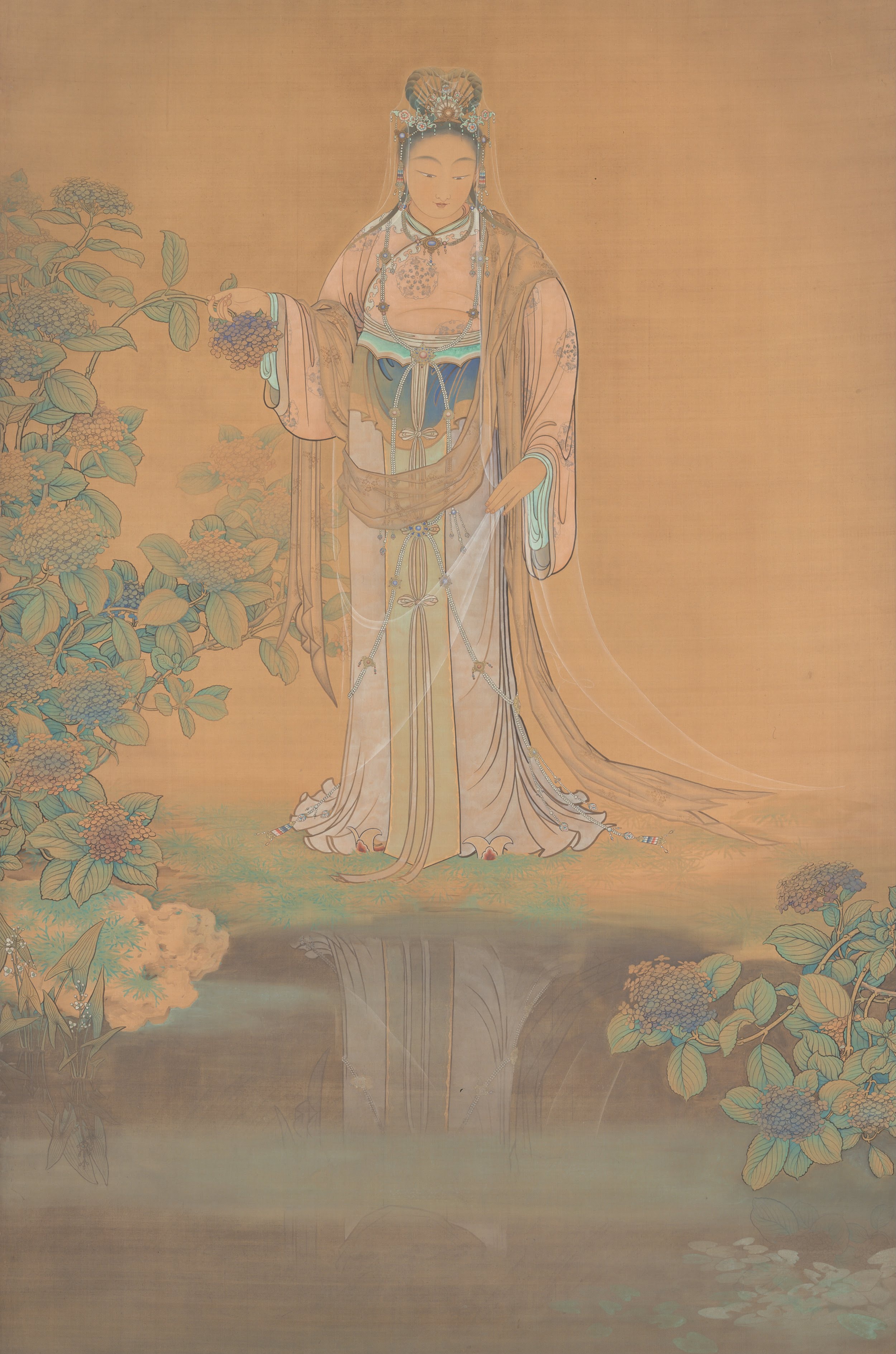
Reflection in the Water (Mizu-kagami)
水鏡
1897
Hanging scroll; color on silk
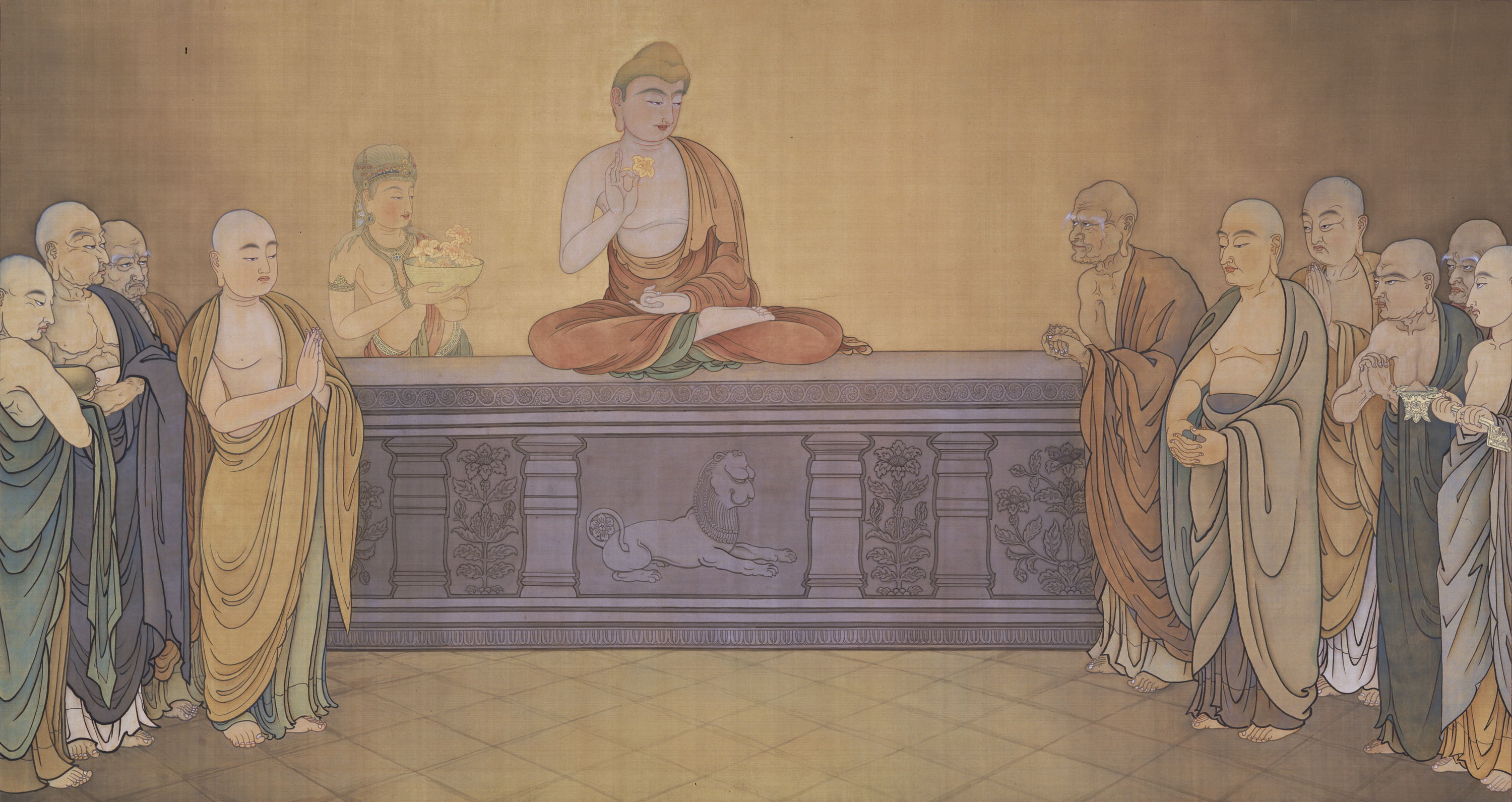
Mahakasyapa Smiling at the Lotus Flower
拈華微笑
1897
Color on silk

Fisherman in a Mist-Enshrouded Landscape
Meiji era, c. late 1890s
Hanging scroll; ink and color on silk

Herd Boy
Meiji era, c. 1900
Hanging scroll; ink and color on silk

Hydrangeas
紫陽花
c. 1902
Color on silk

Wang Zhaojun (Ō Shōkun)
王昭君
1902
Pair of six-panel folding screens; color on paper
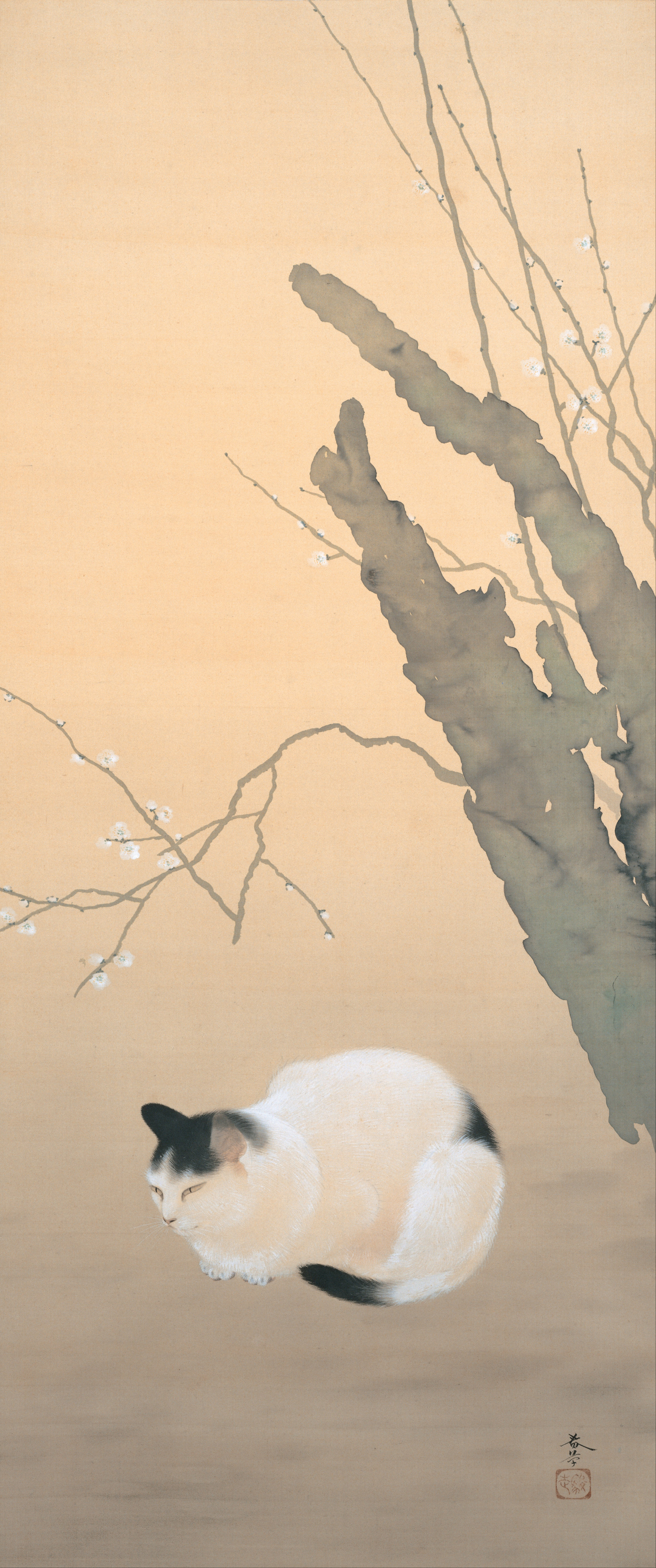
Cat and Plum Blossoms
梅に猫
c. 1906
Hanging scroll; color on silk

Bodhisattva Kenshu
賢首菩薩
1907
Hanging scroll; color on silk

Fallen Leaves (Ochiba)
落葉
1909
Pair of six-panel folding screens; color on paper

Black Cat (Kuroki Neko)
黒き猫
1910
Hanging scroll; color on silk