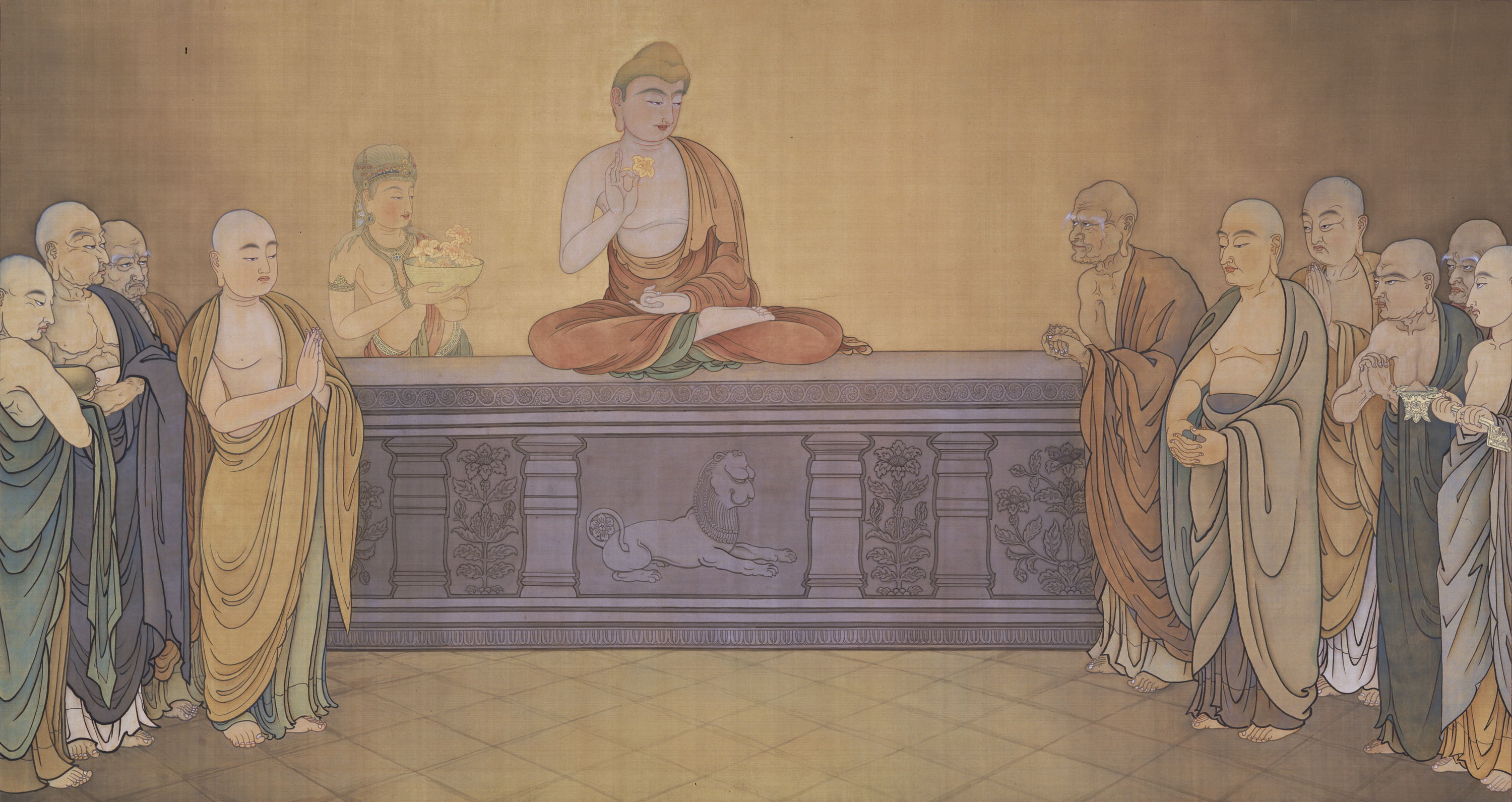
Mahakasyapa Smiling at the Lotus Flower
拈華微笑
- Date:
- 1897
- Medium:
- Color on silk
Description
Painted in 1897, when Hishida Shunsō was just twenty-three and had been on the faculty of the Tokyo School of Fine Arts for two years, Mahakasyapa Smiling at the Lotus Flower (Nenge Mishō) depicts the foundational moment in the Zen Buddhist tradition of the silent transmission of the dharma: the Buddha Sakyamuni, seated on Vulture Peak before his disciples, raised a single lotus flower in silent presentation, and only his senior disciple Mahakasyapa understood the gesture and smiled in recognition. From that smile, according to the Zen tradition, the entire lineage of mind-to-mind teaching descended through the patriarchs to the present day. Hishida's composition focuses on Mahakasyapa alone, seated in monastic robes with the bright lotus flower held aloft in his right hand, his face caught in an expression of quiet recognition. The work shows Hishida's command of traditional Buddhist iconography learned under his teacher Hashimoto Gahō, with the figure's robes and face handled in the careful kanō-school manner, while the background and atmospheric coloring already show hints of the more radical mōrō-tai vocabulary that would emerge fully in his work after 1900. The painting was selected by the Tokyo School of Fine Arts for its collection and is now held by the Tokyo University of the Arts (Geidai), where it serves as an important document of the artist's formative years before the founding of the Nihon Bijutsuin in 1898.
More Prints by Hishida Shunsō


More Birds & Flowers Prints
Frequently Asked Questions
Mahakasyapa Smiling at the Lotus Flower (拈華微笑) was created by Hishida Shunsō (菱田春草) in 1897.
Mahakasyapa Smiling at the Lotus Flower depicts birds & flowers.