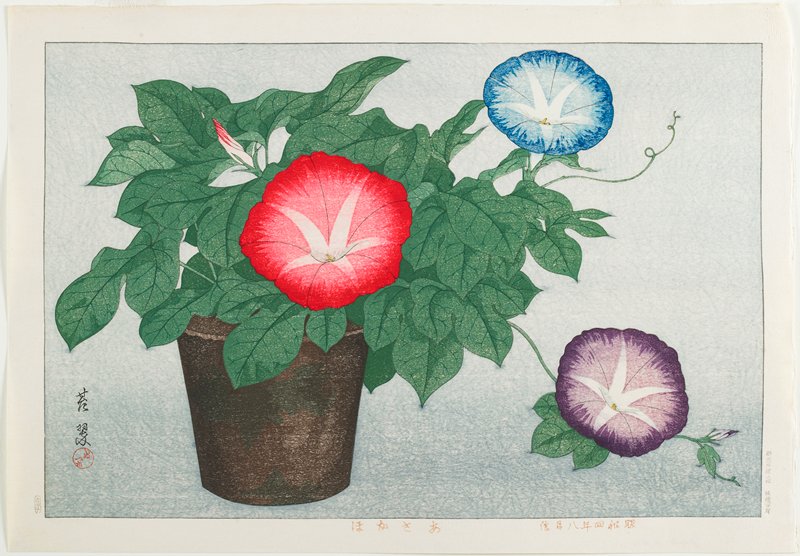
Morning Glories
- Date:
- August 1929
- Medium:
- Woodblock print, ink and color on paper
- Dimensions:
- 27.6 × 39.7 cm
- Source:
- Minneapolis Institute of Art
Description
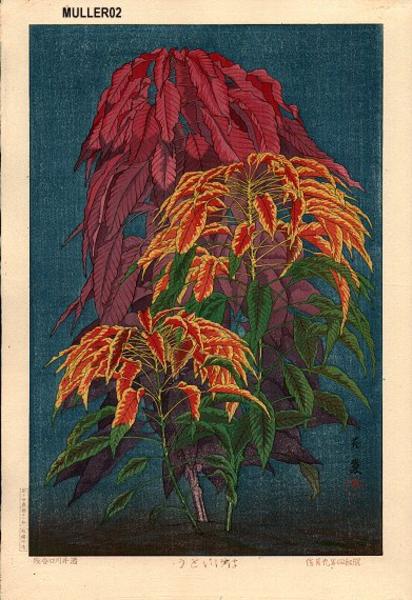
Morning glories, or asagao, hold a special place in Japanese horticultural culture. Introduced from China as a medicinal plant, they became objects of intense aesthetic cultivation during the Edo period, with growers competing to produce novel colors and petal forms. Taisui's August 1929 woodblock print captures these climbing vines with their trumpet-shaped flowers unfurling in shades of blue, purple, and white. The ink-and-color-on-paper medium suits the morning glory's translucent petals, which in life appear almost backlit, a quality the printer could suggest by leaving areas of paper lightly touched. The twisting, tendrilled vines add curving energy to the composition, contrasting with the open, radial symmetry of the flowers themselves. August is the heart of morning glory season in Japan, when the plants bloom most profusely in the early hours before the midday heat causes the blossoms to close.
More Prints by Inuzuka Taisui
More Birds & Flowers Prints
Featured in Collections
Curated cross-cuts that include this print.
Frequently Asked Questions
Morning Glories was created by Inuzuka Taisui (犬塚泰水) in August 1929.
Morning Glories depicts birds & flowers, still life, and summer.
Morning Glories measures 27.6 × 39.7 cm.