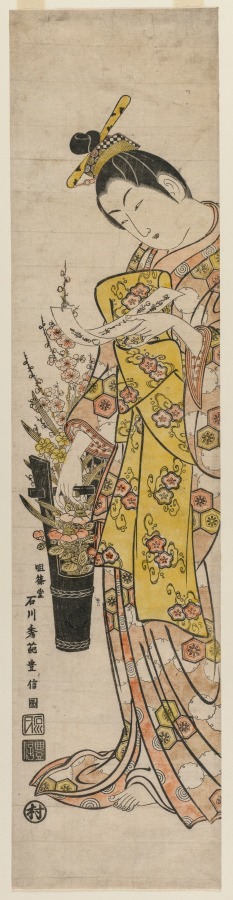
Courtesan Reading a Poem Slip Tied to Flowers in a Vase
- Date:
- mid-1740s
- Medium:
- color woodblock print
- Source:
- Cleveland Museum of Art
Description
Held by the Cleveland Museum of Art, Ishikawa Toyonobu's "Courtesan Reading a Poem Slip Tied to Flowers in a Vase" is a refined bijin-ga that gathers many of his characteristic strengths into a single elegant composition. A young woman of the licensed quarters stands beside a tall floral arrangement and lifts a folded poem slip — tanzaku — that has been tied to one of the stems; her head bends to read the words inscribed on it. The motif draws on the long Japanese poetic tradition of attaching poems to plants and trees, and on the more specifically Edo custom of poetic exchange between courtesans and clients in the Yoshiwara. Toyonobu organizes the figure and the vase as a paired vertical, the woman's tall slender silhouette echoing the rising stems of the flowers, and uses the poem slip itself as a small focal point that the eye must travel to find. The work belongs to Ishikawa Toyonobu's benizuri-e production, the limited two- to three-color hand-printed mode that dominated early Edo ukiyo-e in the 1740s and 1750s before full-color nishiki-e emerged in the 1760s. Within that palette of pinks, greens, and the black keyblock, Toyonobu plays patterned costume off plain background, allowing the figure to read clearly while sustaining the painterly grace he carried from his training under Nishimura Shigenaga. The Cleveland sheet also illustrates how thoroughly Toyonobu integrated literary and visual culture: the print is at once a fashion image, a tribute to the world of the courtesan, and a small celebration of the place of poetry in everyday Edo life, and it confirms Ishikawa Toyonobu's reputation as one of the most cultivated bijin designers of the early Edo ukiyo-e generation.
More Prints by Ishikawa Toyonobu

Young Woman after a Bath
c. 1745
Hand-colored woodblock print; wide hashira-e, beni-e

A Young Couple Visiting a Shrine
18th century
Color woodblock print; hashira-e

Young Woman and Hotei
c. 1741
Hand-colored woodblock print; wide hashira-e, sumizuri-e

Youth Carrying a Lantern and an Umbrella
1740s
Hand-colored woodblock print; hashira-e, beni-e
More Birds & Flowers Prints
Frequently Asked Questions
Courtesan Reading a Poem Slip Tied to Flowers in a Vase was created by Ishikawa Toyonobu (石川豊信) in mid-1740s.
Courtesan Reading a Poem Slip Tied to Flowers in a Vase depicts birds & flowers.