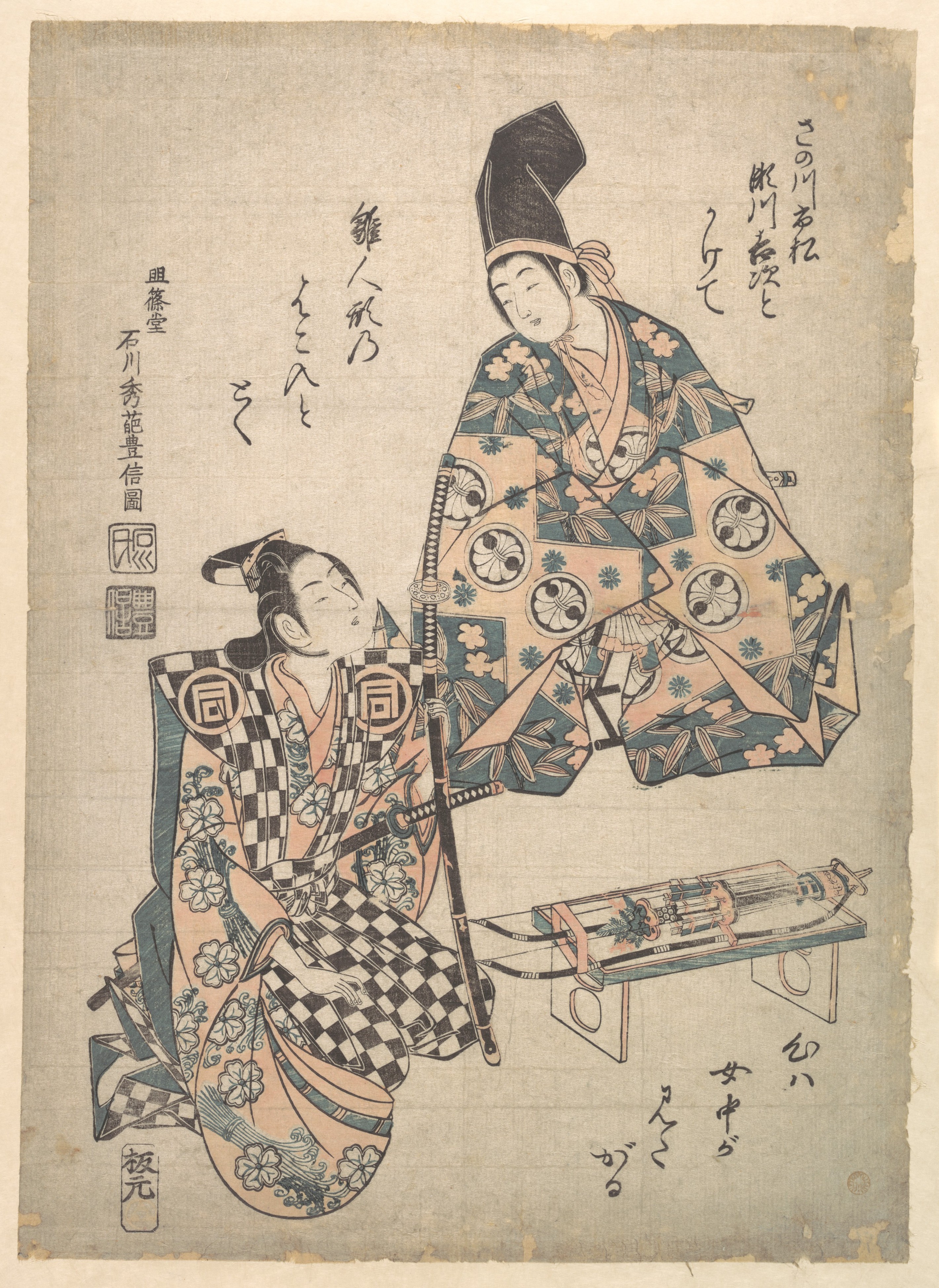
The Actor Segawa Kichiji as a Daimyo's Young Son, and Sanogawa Ichimatsu as a Samurai Attendant
- Date:
- ca. 1750
- Medium:
- Woodblock print; ink and color on paper
- Source:
- Metropolitan Museum of Art
Description
In this double actor print at the Metropolitan Museum of Art, Ishikawa Toyonobu pairs Segawa Kichiji in the role of a daimyō's young son with Sanogawa Ichimatsu as a samurai attendant. The composition typifies Toyonobu's mature handling of two-figure yakusha-e: the higher-ranked young master stands behind and slightly above his attendant, the patterns of their kimono and the angles of their swords playing off one another so that the social hierarchy of the stage roles is legible at a glance. Both Segawa Kichiji and Sanogawa Ichimatsu were celebrities of mid-eighteenth-century Edo kabuki — Ichimatsu in particular gave his name to the checkered pattern that still circulates in Japanese textiles — and contemporary buyers would have purchased the print partly for the thrill of seeing two such figures side by side. Technically the sheet sits inside the benizuri-e family that defined early Edo ukiyo-e before full-color printing arrived in the 1760s. Toyonobu's signature painterly keyblock is supplemented by rose, green, and at times muted yellow blocks aligned through kento registration; the limited palette focuses attention on textile pattern and the soft drape of long sleeves rather than spectacle. Behind the figures Toyonobu leaves the ground bare in the manner typical of his actor pages, transforming the print into something close to a stage tableau frozen at a moment of dramatic pause. The work is a strong example of how Ishikawa Toyonobu functioned as a kind of theatrical reporter in early Edo ukiyo-e, recording for an urban public the specific casting choices of a specific kabuki season while simultaneously elevating those performances into lasting collectible images.
More Prints by Ishikawa Toyonobu

Young Woman after a Bath
c. 1745
Hand-colored woodblock print; wide hashira-e, beni-e

A Young Couple Visiting a Shrine
18th century
Color woodblock print; hashira-e

Young Woman and Hotei
c. 1741
Hand-colored woodblock print; wide hashira-e, sumizuri-e

Youth Carrying a Lantern and an Umbrella
1740s
Hand-colored woodblock print; hashira-e, beni-e
Frequently Asked Questions
The Actor Segawa Kichiji as a Daimyo's Young Son, and Sanogawa Ichimatsu as a Samurai Attendant was created by Ishikawa Toyonobu (石川豊信) in ca. 1750.