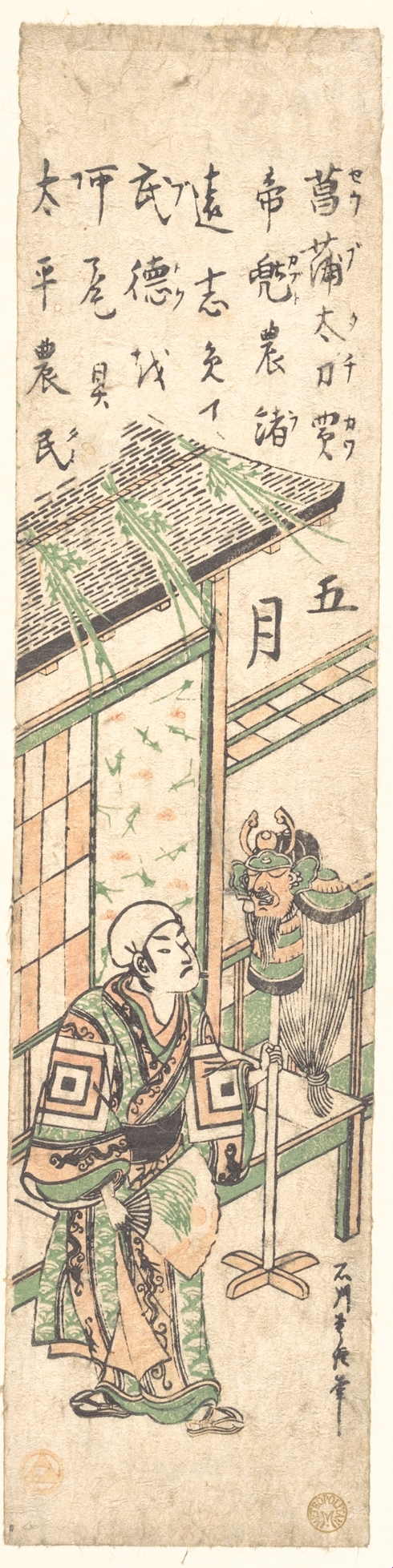
The Fifth Month
- Date:
- ca. 1748
- Medium:
- Woodblock print; ink and color on paper
- Source:
- Metropolitan Museum of Art
Description
"The Fifth Month" is a calendar-themed print by Ishikawa Toyonobu in the Metropolitan Museum of Art, depicting the customs and atmosphere associated with the fifth lunar month — the month of the Boys' Festival, of irises hung at doorways for protection, and of seasonal courtship in the Edo pleasure districts. Toyonobu organizes the sheet around a single elegant female figure whose costume and accessories carry the seasonal references that contemporary viewers would have recognized at once. The print belongs to a broader Edo tradition of associating each month of the year with a particular flower, custom, or scene, a structure that allowed ukiyo-e publishers to issue thematic series across the calendar and tied print buying to the rhythms of urban life. Technically the work is a fine example of benizuri-e, the two- and three-color woodblock technique that Ishikawa Toyonobu helped consolidate in the 1740s and 1750s. After the late seventeenth century's hand-colored tan-e and beni-e prints, benizuri-e introduced the discipline of registered color blocks — a technical step toward the full-color nishiki-e that would emerge in the 1760s — and Toyonobu's work in this idiom is particularly admired for the way it preserves the linear elegance of brush painting within a small color palette. The figure's sash, the patterned outer robe, and the carefully drawn hair ornaments all benefit from the restraint of the printing scheme: nothing in the color competes with the keyblock's drawing. Within Toyonobu's oeuvre "The Fifth Month" represents the seasonally minded bijin-ga that helped early Edo ukiyo-e bind itself to the calendar of city life, and confirms his standing as one of the most lyrical figural designers of his generation.
More Prints by Ishikawa Toyonobu

Young Woman after a Bath
c. 1745
Hand-colored woodblock print; wide hashira-e, beni-e

A Young Couple Visiting a Shrine
18th century
Color woodblock print; hashira-e

Young Woman and Hotei
c. 1741
Hand-colored woodblock print; wide hashira-e, sumizuri-e

Youth Carrying a Lantern and an Umbrella
1740s
Hand-colored woodblock print; hashira-e, beni-e
Frequently Asked Questions
The Fifth Month was created by Ishikawa Toyonobu (石川豊信) in ca. 1748.