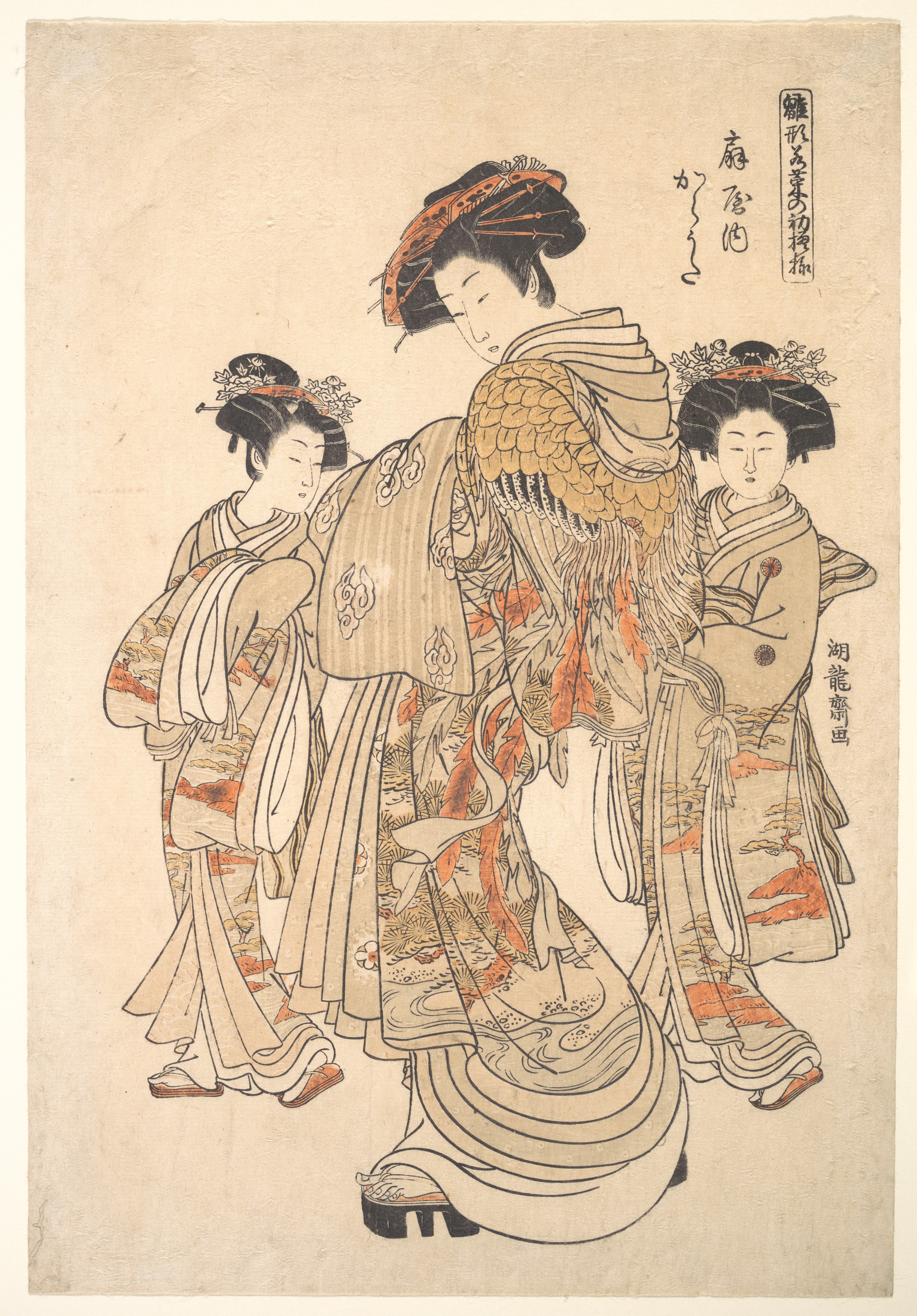
The Courtesan Karauta of the Ōgiya Brothel, from the series “A Pattern Book of the Year’s First Designs, Fresh as Spring Herbs” (“Hinagata wakana no hatsu moyō”)
- Date:
- 1777–78
- Medium:
- Woodblock print; ink and color on paper
- Source:
- Metropolitan Museum of Art
Description
This vertical pillar-format portrait of the courtesan Karauta of the Ogiya brothel belongs to Isoda Koryusai's most ambitious project, the Hinagata Wakana no Hatsu Moyo, or A Pattern Book of the Year's First Designs, Fresh as Spring Herbs. Issued through the Yoshiwara publisher Nishimuraya Yohachi beginning in 1776 and continuing for several years, the series ran to roughly 140 sheets and established the oban tate-e format as the standard scale for high-end Edo bijin-ga. Karauta stands in measured contrapposto, the long sweep of her uchikake robe filling the slender sheet with seasonal motifs that double as a printable fashion catalogue. Koryusai had inherited the slender, doll-like figure type from his older colleague Suzuki Harunobu, but here he stretches the body into the more imposing presence that would dominate ukiyo-e through the 1780s. The composition carefully balances the courtesan's outer kimono, embroidered obi tied in the front to identify her profession, and the elaborate hairpins of an oiran of the first rank. Color blocks of indigo, vermilion, and dyer's-yellow are pressed against passages of unprinted paper so the textile patterns read as fresh design proposals rather than mere description. The print's title plays on the New Year custom of gathering wakana, the first tender herbs of spring, treating Karauta's wardrobe as the year's opening fashion. The Metropolitan Museum of Art holds an early impression that preserves the clean keyblock and saturated pigments characteristic of the first edition. As a document of Isoda Koryusai's role in shaping mature Edo bijin-ga and as an emblem of the celebrated Hinagata Wakana set, the sheet remains a foundational image for collectors of late eighteenth-century woodblock prints.
More Prints by Isoda Koryūsai


More Spring Prints

Frequently Asked Questions
The Courtesan Karauta of the Ōgiya Brothel, from the series “A Pattern Book of the Year’s First Designs, Fresh as Spring Herbs” (“Hinagata wakana no hatsu moyō”) was created by Isoda Koryūsai (礒田湖龍斎) in 1777–78.
The Courtesan Karauta of the Ōgiya Brothel, from the series “A Pattern Book of the Year’s First Designs, Fresh as Spring Herbs” (“Hinagata wakana no hatsu moyō”) depicts spring.