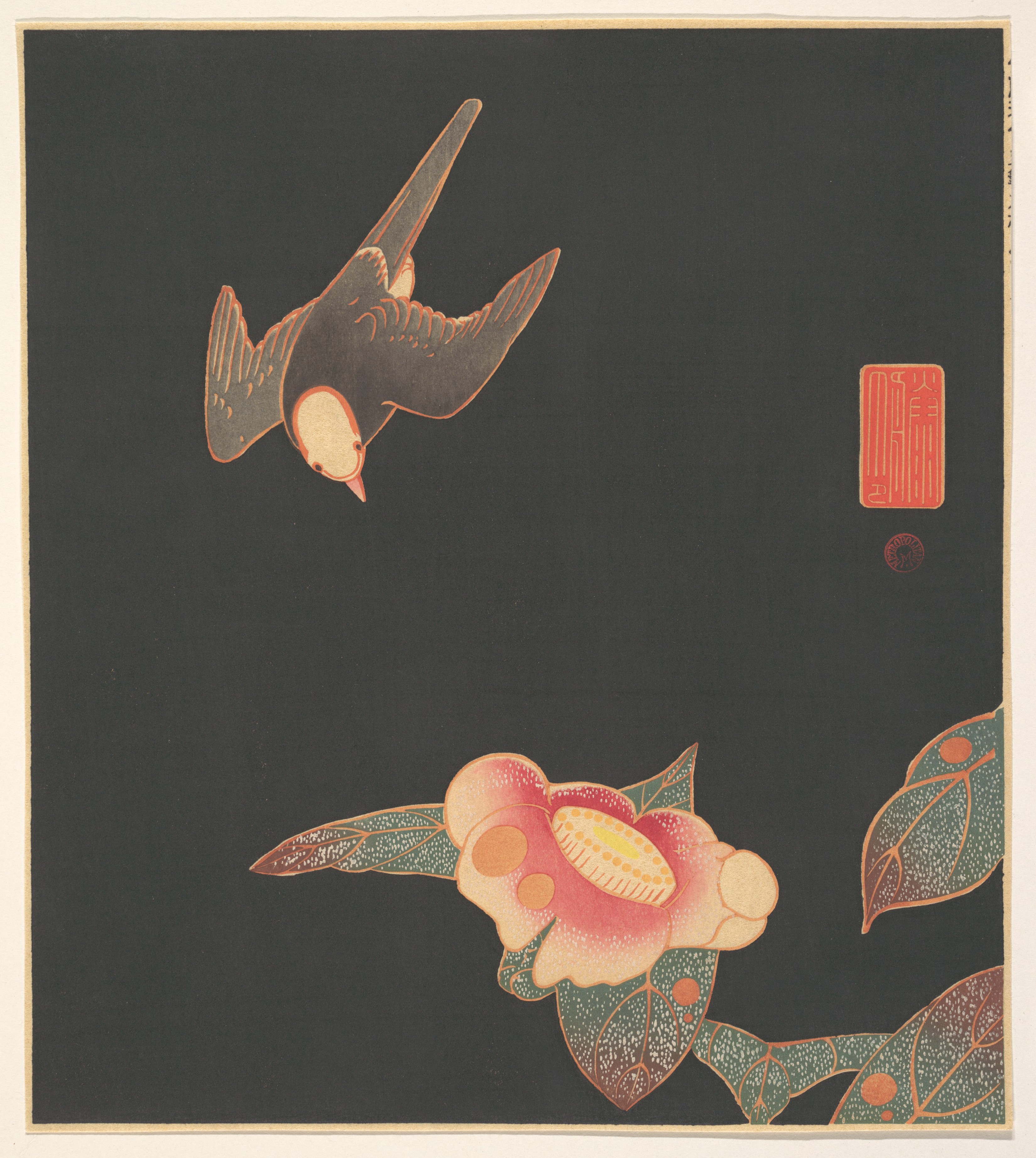
Swallow and Camellia
by Itō Jakuchū
- Date:
- ca. 1900
- Medium:
- Reproduction of an original Jakuchū design; woodblock print, ink and color on paper
- Source:
- Metropolitan Museum of Art
Description
Swallow and Camellia, held in the Metropolitan Museum of Art with accession number MJP12, is a color woodblock print produced around 1900 as a reproduction of an original Ito Jakuchu design, part of the late Meiji series of Jakuchu reproductive prints that introduced his bird-and-flower compositions to early twentieth-century audiences. At 23.5 by 21 centimeters in ink and color on paper, the print pairs a swallow with a camellia branch, drawing on the deep kacho-ga tradition of pairing birds and flowers as seasonal emblems. The swallow, returning to Japan each spring, and the camellia, with its rich winter-into-spring blooming season, together signal the threshold between the seasons in classical East Asian pictorial vocabulary. Jakuchu's original painted design would have demonstrated the meticulous naturalistic observation that characterized his work, with attention to the bird's flight posture, the foliage of the camellia branch, and the petal structure of the bloom. The reproductive woodblock print preserves this compositional information through carefully registered color blocks layered to recover the chromatic nuance of the painted source. As one of the Met's group of around 1900 Jakuchu bird-and-flower reproductions, Swallow and Camellia documents the early international reception of the Kyoto eccentric and contributes substantially to the museum's foundational holdings of his work in printed form.
More Prints by Itō Jakuchū

Frequently Asked Questions
Swallow and Camellia was created by Itō Jakuchū (伊藤若冲) in ca. 1900.