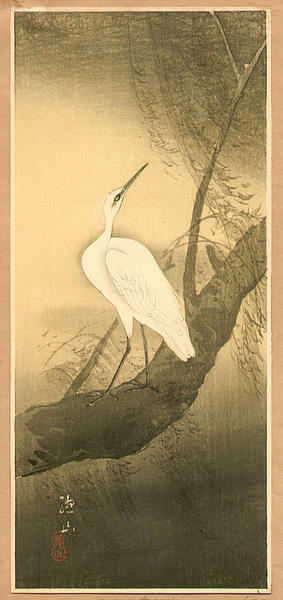
White Egret on Willow
by Ito Sozan
- Medium:
- Woodblock print
- Source:
- Japanese Art Open Database
Description
White Egret on Willow, made by Itō Sōzan around 1930, belongs to the early-Shōwa shin-hanga kachō-e (bird-and-flower print) tradition that Watanabe Shōzaburō and other Tokyo publishers cultivated for the export market. Sōzan, also signed Sōan, worked primarily during the Taishō and early Shōwa periods producing nature studies in the lineage descending from Ohara Koson — the genre's defining figure — but with his own more restrained, sometimes slightly more decorative sense of composition. In White Egret on Willow, the long white bird is set against the soft cascading lines of willow branches, its body curving along the print's vertical axis while the willow's leaves drift across the surface in characteristic late-shin-hanga atmospheric treatment. The choice of subject reaches back through Edo kachō-e — egret and willow form one of the canonical pairings inherited from Chinese painting — and the print's restrained palette of white, pale green, and subtle ink-grey gradations places it firmly in the early-Shōwa register of kachō-e that publishers like Watanabe and Sakai-Kawaguchi exported widely to Western collectors. The Japanese Art Open Database preserves this impression in its open-access reference image (https://ukiyo-e.org/image/jaodb/Ito_Sozan-No_Series-White_Egret-00037091-041213-F06) and catalogues Sōzan as one of the secondary but distinctive contributors to shin-hanga kachō-e. For collectors of Koson and the broader kachō-e tradition, this 1930 White Egret on Willow shows how the genre at its early-Shōwa moment kept the contemplative pictorial economy of Edo-period precedents while embracing the sharper printing technique and gentler tonal range of mature shin-hanga production.
More Prints by Ito Sozan

Featured in Collections
Curated cross-cuts that include this print.
Frequently Asked Questions
White Egret on Willow was created by Ito Sozan (伊藤宗山).