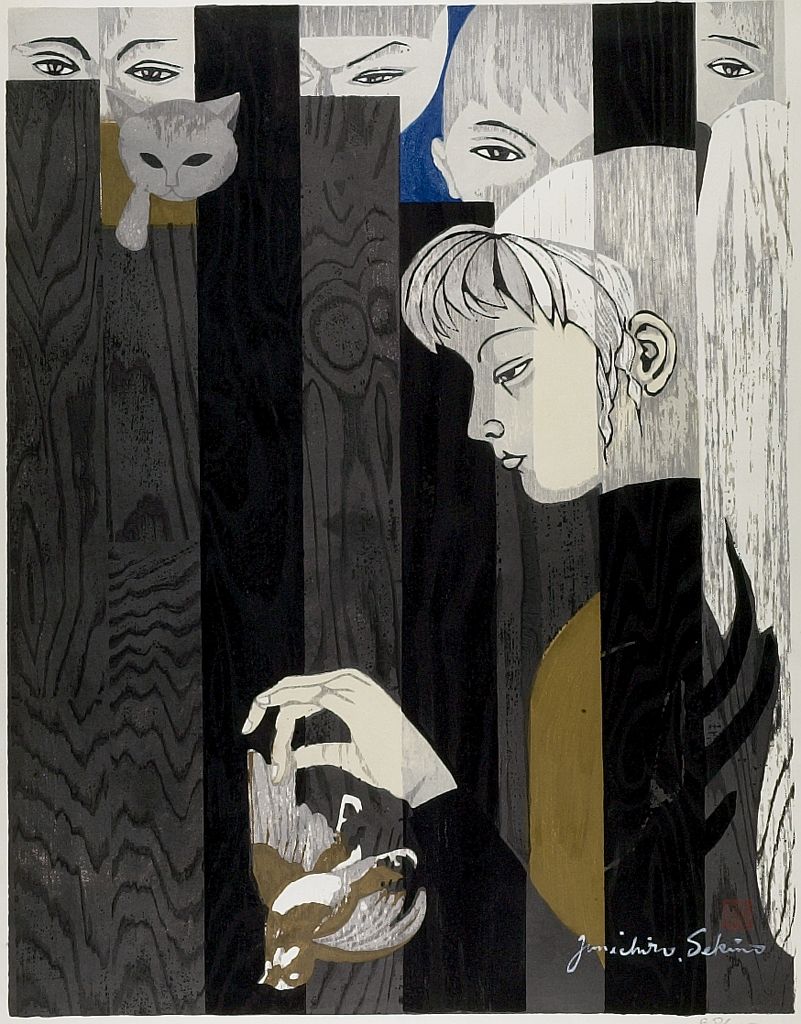
Death of a Bird
- Date:
- 1956
- Medium:
- Woodblock print
- Edition:
- Self-printed
- Source:
- ukiyo-e.org
Description
A young woman in profile looks down with a somber expression as she holds a limp, wounded bird in her raised hand, its wing splayed and beak open. Above her, a row of disembodied eyes and a grey cat's head peer down from behind vertical bands of dark, heavily grained woodgrain, the composition divided into alternating strips of black, grey, blue, and mustard yellow. The palette is otherwise muted — black, grey, and cream — with the woman's dark garment set against a mustard-yellow circular form behind her shoulder.
More Prints by Jun'ichiro Sekino

More Birds & Flowers Prints
Featured in Collections
Curated cross-cuts that include this print.
Frequently Asked Questions
Death of a Bird was created by Jun'ichiro Sekino (関野準一郎) in 1956.
Death of a Bird uses Nishiki-e, Moku-hanga, and Kento, on woodblock print.
Death of a Bird depicts birds & flowers.