
Kameyama - Tokaidô
- Medium:
- Mokuhanga (Japanese woodblock)
- Image courtesy of
- Saru Gallery
Description
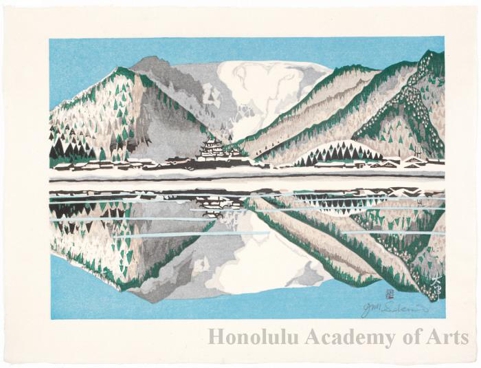
Kameyama, the forty-sixth station of the Tokaido, sat in present-day Mie Prefecture, rising on a small castle hill above the surrounding plain. Hiroshige's nineteenth-century treatment had shown the station in clearing snow, and Sekino's print enters into direct dialogue with that template while translating it into a sosaku-hanga vocabulary. As across his Fifty-Three Stations of the Tokaido (1960–1974), Sekino designed, carved, and printed every block himself on washi, marking the sosaku-hanga rejection of the ukiyo-e workshop division between designer, carver, and printer. The composition draws on bokashi gradations to register sky and ground transitions and on flat opaque planes for built mass and silhouette, the matte surface registering the absorption characteristic of baren-pulled impressions. Sekino's approach to Kameyama sets aside Hiroshige's anecdotal travelers and treats the station as a study in volume and weather, a tendency seen across his post-1960 landscapes. The print belongs to a campaign that occupied his studio for fourteen years and constitutes one of the most ambitious twentieth-century reconsiderations of the meisho-e tradition.
More Prints by Jun'ichiro Sekino
Featured in Collections
Curated cross-cuts that include this print.
Frequently Asked Questions
Kameyama - Tokaidô was created by Jun'ichiro Sekino (関野準一郎).