
Kameyama - Tokaidô
- Medium:
- Mokuhanga (Japanese woodblock)
- Image courtesy of
- Saru Gallery
Description
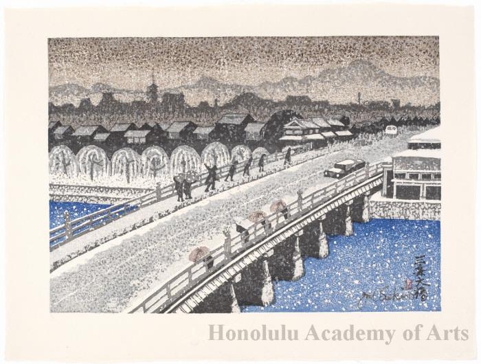
This second Kameyama is a variant impression or alternate composition within Sekino's Fifty-Three Stations of the Tokaido (1960–1974), the central late-career project of his career. Sekino occasionally produced more than one design for a single station, and impressions could vary in palette, registration, or block state across the long working period. Kameyama itself, the forty-sixth station on the Edo–Kyoto road, was known for its hilltop castle remains and for the snow scene Hiroshige had made canonical. Sekino's reading shifts the emphasis from anecdotal travel toward quieter formal investigation, using bokashi to model graduated tonal passages and selectively inked blocks to vary surface against the grain of the washi. As a sosaku-hanga artist he carved his own blocks and pulled his own impressions, in keeping with the movement's principle of single authorship across the whole process. Compared with the commercially produced Tokaido prints of the nineteenth century, this version foregrounds handmade qualities — registered color edges, visible baren passage, and the matte absorption of pigment into the paper.
More Prints by Jun'ichiro Sekino

Featured in Collections
Curated cross-cuts that include this print.
Frequently Asked Questions
Kameyama - Tokaidô was created by Jun'ichiro Sekino (関野準一郎).