
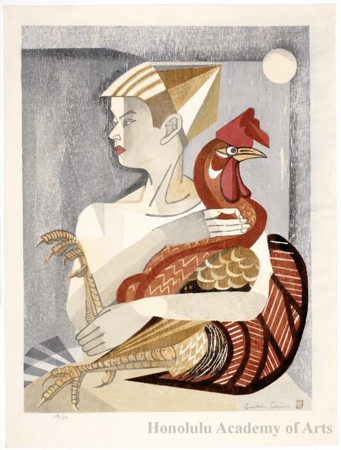
Rooster and boy
- Medium:
- Mokuhanga (Japanese woodblock)
- Image courtesy of
- Saru Gallery
Description
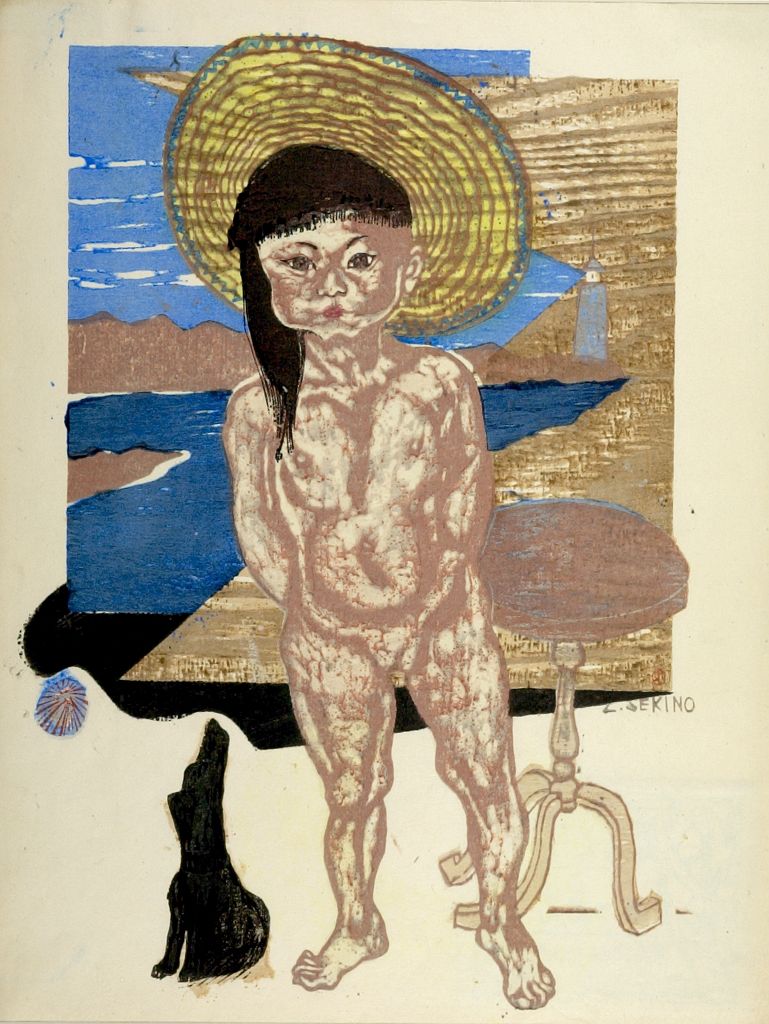
This print belongs to Sekino's strand of folk-life and childhood subjects, in which a single anecdotal pairing — a boy and a rooster — carries the whole composition. Roosters had long been a staple of kacho-e bird-and-flower prints, but Sekino's twentieth-century treatment moves the bird out of that decorative tradition and into a genre scene of rural childhood, a subject closer to the Mingei folk-craft sensibility he shared with fellow Aomori artist Shiko Munakata. Compositionally such prints typically rely on a strong silhouette: the child's body and the rooster's tail-arc cut as bold shapes on the key block, set against a flat or lightly bokashi-graded ground. Sekino often used a restrained palette for these works — earth reds, indigo, sumi black — printed onto absorbent kozo washi so that the color sits matte rather than glossy. The sheet reflects his interest in the everyday textures of northern Japanese life, observed without sentimentality or nostalgia.
More Prints by Jun'ichiro Sekino
More Children Prints
Featured in Collections
Curated cross-cuts that include this print.
Frequently Asked Questions
Rooster and boy was created by Jun'ichiro Sekino (関野準一郎).
Rooster and boy depicts children.