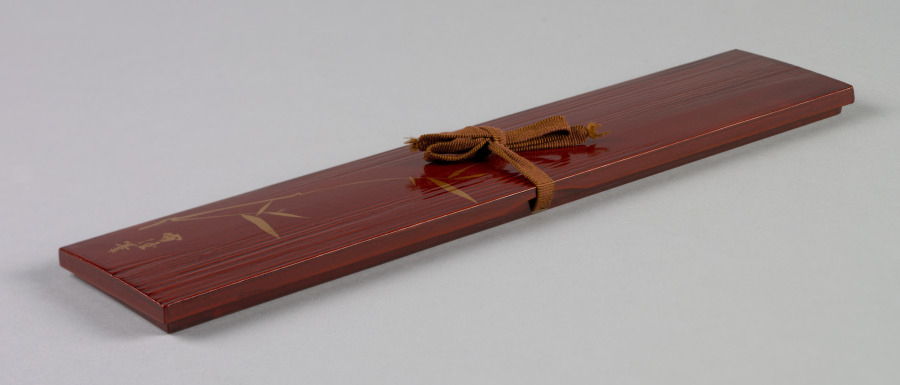
Poem Card Box with Lid
短冊箱
- Date:
- Meiji period, 1868-1912
- Medium:
- Wood with lacquer, mother-of-pearl inlay, and gold maki-e (designed with the lacquer artist Iwamura Sadazō)
- Source:
- Cleveland Museum of Art
Description
Poem Card Box with Lid (Tanzaku-bako) is a lacquer box of c. 1900-1912 in the Cleveland Museum of Art (1991.120, anniversary gift of Leighton R. Longhi), designed by Kamisaka Sekka (1866-1942) in collaboration with the Kyoto lacquer artist Iwamura Sadazō. The box was made to hold tanzaku — long narrow paper cards used in Japanese poetry composition for the inscription of waka and other classical verse — and is one of the principal surviving examples of Sekka's work in lacquer outside the print medium. The exterior is finished with a 'golden bamboo lid' (the museum's phrase): a flat compositional field of stylized bamboo culms and leaves in raden mother-of-pearl and gold lacquer (maki-e), and the interior is fitted with poem cards bearing gold-leaf designs in the same neo-Rimpa decorative idiom Sekka had developed for the Momoyogusa printed plates. The box exemplifies Sekka's working method across media: the same flat-plane, gold-ground decorative composition that defined his pattern albums for the Kyoto kimono trade was deployed in collaboration with named master lacquerers for the connoisseurial decorative-arts market, producing objects in which his print-derived design vocabulary was given the material weight of the Edo-period Rimpa lacquer tradition that Ogata Kōrin and his brother Kenzan had perfected two centuries earlier.
More Prints by Kamisaka Sekka
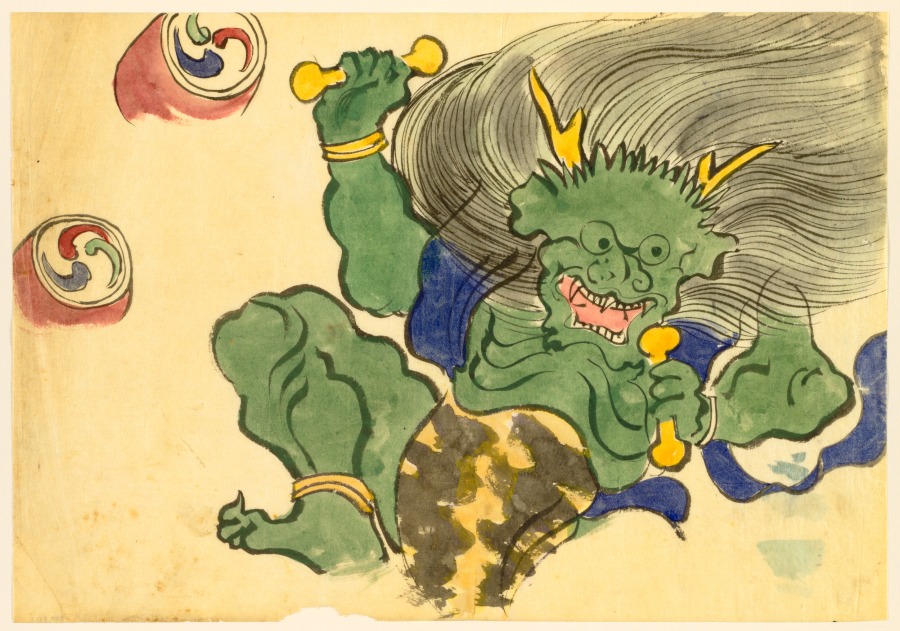
Preparatory drawings for Flowers of a Hundred Worlds (Momoyogusa): God of Thunder (Raijin)
百々世草下絵 雷神
1909
Drawing on tracing paper; ink and color

Peonies, from the series Worlds of Things (Momoyogusa)
百々世草 牡丹
1909-10
Color woodblock print

Courtiers' Carriages, from the series Worlds of Things (Momoyogusa)
百々世草 御所車
1909-10
Color woodblock print

Silvered Waves Against a Beach, from the series Worlds of Things (Momoyogusa)
百々世草
1909-10
Color woodblock print
Frequently Asked Questions
Poem Card Box with Lid (短冊箱) was created by Kamisaka Sekka (神坂雪佳) in Meiji period, 1868-1912.