Biography
Kamisaka Sekka (神坂雪佳, 1866–1942) was a Kyoto-based painter, designer, and design theorist whose work led the Rimpa revival of the late Meiji and Taishō periods and helped transform the historical court-decorative idiom of Ogata Kōrin and Tawaraya Sōtatsu into a modern visual language with international reach. As a leading designer for the Kyoto publisher Unsōdō and as an instructor at the city's municipal arts-and-crafts school, Sekka stood at the intersection of painting, decorative arts, and industrial design in early-twentieth-century Japan — a figure routinely described in the secondary literature as "the last Rimpa master."
Sekka was born in 1866 in Kyoto into a samurai family. He began his training in the Maruyama-Shijō manner of painting, studying from his teens under Suzuki Zuigen, and in 1888 entered the atelier of Kishi Kōkei, a painter to the Imperial Household who was himself a collector of Rimpa works by Hon'ami Kōetsu and Ogata Kōrin. Through this milieu Sekka turned to the close study of Rimpa — the Edo-period decorative tradition of Tawaraya Sōtatsu (active c. 1600–40), Ogata Kōrin (1658–1716), and their followers, characterized by flat planes of colour, gold and silver grounds, stylized natural motifs, and the tarashikomi (puddled-ink) technique. By the turn of the century Sekka was an established figure in Kyoto's design world, and in 1901 the Japanese government sent him to Glasgow, where Japan was taking part in the International Exhibition and where he encountered the Glasgow School and the European Art Nouveau then being driven by the same Japonisme that had absorbed Rimpa motifs a generation earlier. The Glasgow trip confirmed for Sekka that Rimpa was not a closed historical style but a living vocabulary capable of speaking to modern design, and he returned to Kyoto to put that conviction into practice.
One institutional vehicle for Sekka's project was the Kyoto Municipal School of Arts and Crafts (Kyōto Shiritsu Bijutsu Kōgei Gakkō), where he taught for much of the rest of his career. There he helped train a generation of Kyoto designers — among them Furuya Kōrin, who became one of his closest collaborators — in a programme that fused classical Rimpa composition, the naturalistic observation (shasei) of the Shijō line, and the design sensibility Sekka had sharpened in Glasgow. His students carried the neo-Rimpa idiom into the kimono, lacquer, ceramic, and metalwork ateliers clustered around Kyoto. In parallel Sekka became a principal designer for the Kyoto publisher Unsōdō, founded in 1891 by Yamada Naosaburō; together they did much to build late-Meiji Kyoto's design-publishing industry.
Sekka's printed publications under Unsōdō are the body of work for which he is best known internationally. The defining title is Momoyogusa (百々世草, Flowers of a Hundred Worlds), a three-volume woodblock-printed orihon (accordion-bound) album issued in 1909–10, comprising sixty colour-printed plates. The plates set Rimpa motifs — irises, plum branches, waves and plovers, autumn grasses, scattered fans, classical court figures, the Six Immortal Poets — against grounds of silver, gold, and mineral pigment, often punctuated by embossed (karazuri) backgrounds and tarashikomi effects rendered in print. Momoyogusa was conceived at once as a pattern library for Kyoto's kimono and lacquer trades and as a connoisseurial decorative-art object, and it stands today as one of the foundational documents of modern Japanese graphic design. The Cleveland Museum of Art holds the complete three-volume set (accession 1988.23), and the Art Institute of Chicago holds individual plates from the series.
Around Momoyogusa, Sekka produced a sustained run of design and pattern books for Unsōdō across the 1900s and 1910s, and he was involved, alongside Furuya Kōrin, with the Unsōdō design journal Shin-Bijutsukai. He also worked across painting (folding screens, hanging scrolls, and fan paintings), lacquer, textile and kimono design, and ceramic decoration. His painted work remained close to the Rimpa template — gold-ground screens with stylized natural motifs, scattered-fan compositions, and revivals of Sōtatsu and Kōrin subjects — but treated with the spare graphic clarity that the print medium had taught him.
Sekka remained active until shortly before his death in Kyoto in 1942. His Rimpa revival is now recognized as one of the defining strands of modern Japanese art: the bridge between Edo-period decorative painting and twentieth-century graphic design, and between the Kyoto craft trades and the international design culture that Japonisme had created in Europe and North America. Momoyogusa is preserved in major Western collections — including the Cleveland Museum of Art, the Metropolitan Museum of Art, the Art Institute of Chicago, and the Smithsonian — and remains one of the most influential design publications of late-Meiji Japan. Sekka is properly read alongside his collaborator Furuya Kōrin and his Unsōdō publishing programme as the architect of a deliberately constructed neo-Rimpa moment that carried the Kyoto decorative tradition out of the Edo period and into modern design.
Key Facts
- Active Period
- 1866–1942
- Nationality
- 🇯🇵Japan
- Movement
- Meiji/Taishō Prints
- Subjects
- Birds & FlowersWinterMoonlight
- Works Indexed
- 11
Frequently Asked Questions
Kamisaka Sekka (神坂雪佳, 1866–1942) was a Kyoto-based painter, designer, and design theorist whose work led the Rimpa revival of the late Meiji and Taishō periods and helped transform the historical court-decorative idiom of Ogata Kōrin and Tawaraya Sōtatsu into a modern visual language with international reach. As a leading designer for the Kyoto publisher Unsōdō and as an instructor at the city's municipal arts-and-crafts school, Sekka stood at the intersection of painting, decorative arts, and industrial design in early-twentieth-century Japan — a figure routinely described in the secondary literature as "the last Rimpa master."
Kamisaka Sekka was active from 1866 to 1942. They were associated with the Meiji/Taishō Prints movement.
Kamisaka Sekka's work was shaped by the Meiji/Taishō Prints tradition in Japanese woodblock printmaking. Meiji/Taishō Prints: Meiji and Taishō era prints (1868–1926) bridge the transition from traditional ukiyo-e to the modern shin-hanga and sosaku-hanga movements.
Kamisaka Sekka's prints frequently feature birds & flowers, winter, moonlight.
Original prints by Kamisaka Sekka can be found in collections including Cleveland Museum of Art, Art Institute of Chicago.
Based on 45 recorded auction sales from 2013–2025, most Kamisaka Sekka prints sold in the $200–$460 range, with a median around $360. Top results exceeded $550. Actual prices vary widely with edition, condition, and subject.
Woodblock Prints by Kamisaka Sekka (11)
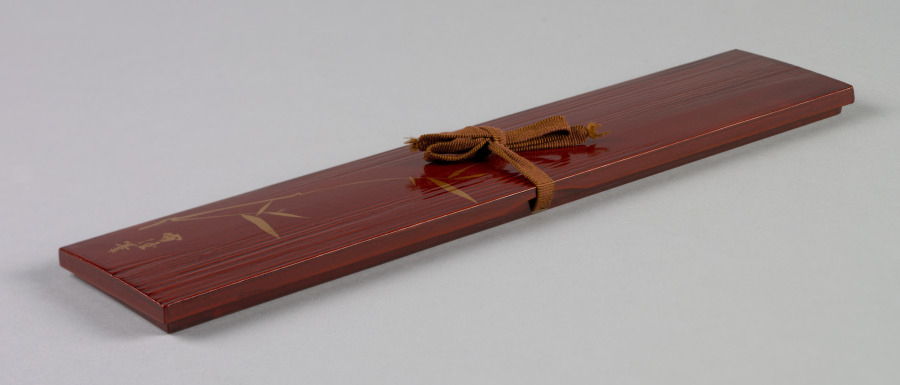
Poem Card Box with Lid
短冊箱
Meiji period, 1868-1912
Wood with lacquer, mother-of-pearl inlay, and gold maki-e (designed with the lacquer artist Iwamura Sadazō)

Peonies, from the series Worlds of Things (Momoyogusa)
百々世草 牡丹
1909-10
Color woodblock print

Courtiers' Carriages, from the series Worlds of Things (Momoyogusa)
百々世草 御所車
1909-10
Color woodblock print

Silvered Waves Against a Beach, from the series Worlds of Things (Momoyogusa)
百々世草
1909-10
Color woodblock print

Hydrangeas, from the series Worlds of Things (Momoyogusa)
百々世草 紫陽花
1909-10
Color woodblock print

The Six Immortal Poets, from the series Worlds of Things (Momoyogusa)
百々世草 六歌仙
1909-10
Color woodblock print

Moon over Musashino, from the series Worlds of Things (Momoyogusa)
百々世草 武蔵野の月
1909-10
Color woodblock print

Pine Beach with Shrine Gate, from the series Worlds of Things (Momoyogusa)
百々世草
1909-10
Color woodblock print
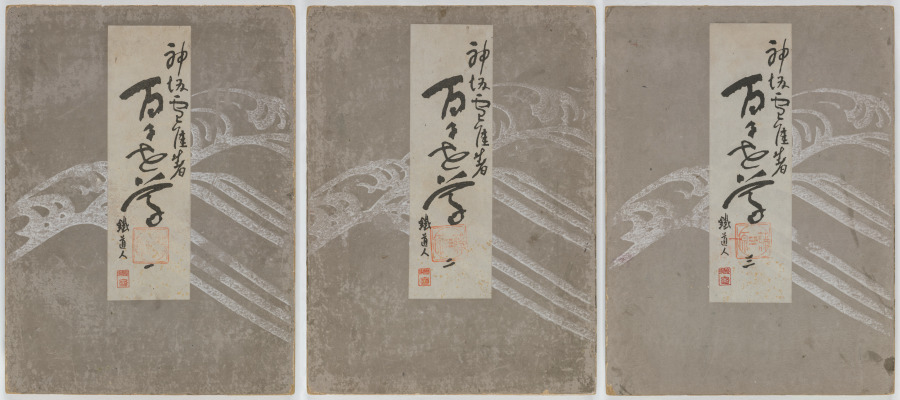
Flowers of a Hundred Worlds (Momoyogusa), vols. 1-3
百々世草
1909-10
Set of three woodblock-printed folding-books (orihon); ink, color, gold, and silver on paper
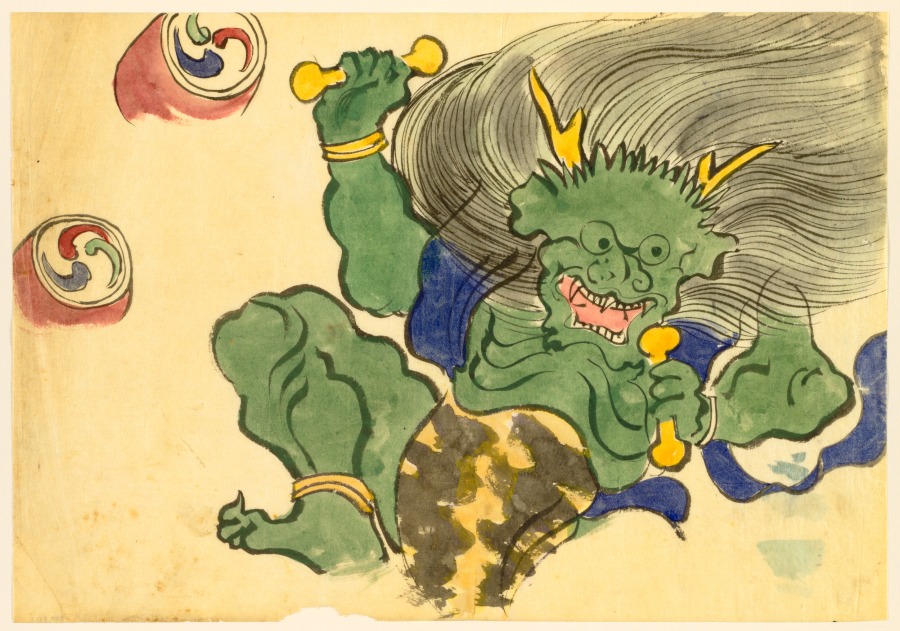
Preparatory drawings for Flowers of a Hundred Worlds (Momoyogusa): God of Thunder (Raijin)
百々世草下絵 雷神
1909
Drawing on tracing paper; ink and color

Plovers Flying Across a River above Snow-Laden Reeds (Fuyu no Kawa), from the series Worlds of Things (Momoyogusa)
百々世草 冬の川
1909-10
Color woodblock print