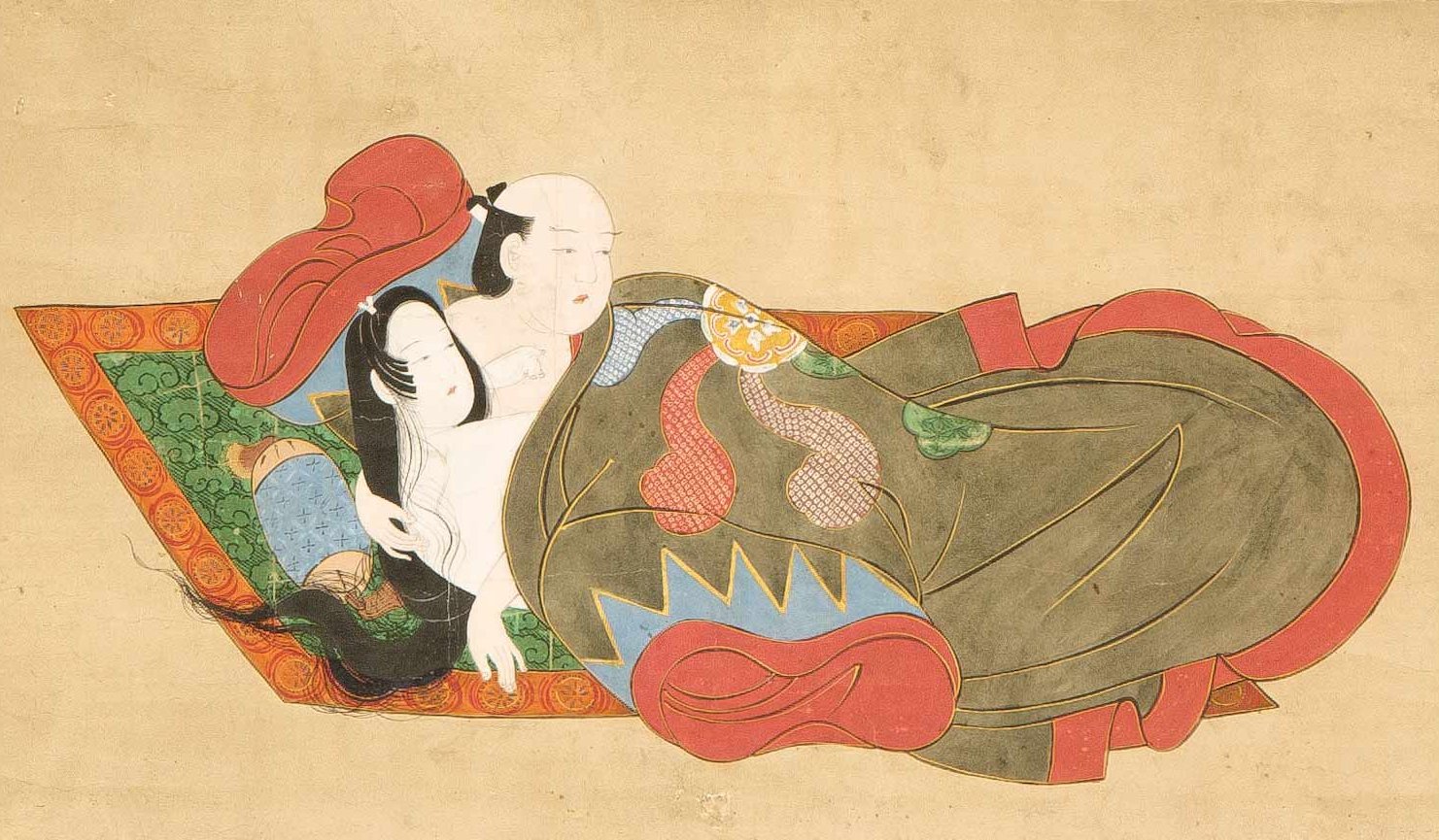
Lovers Surprised (Caught in the Act)
- Date:
- late 1660s
- Medium:
- Hanging scroll; ink and color on paper
- Source:
- Honolulu Museum of Art
Description
Held in the Honolulu Museum of Art and dated to the late 1660s, Lovers Surprised (also known as Caught in the Act) is a hanging scroll painted in ink and color on paper that ranks among the most important surviving Kanbun Master kakemono-e in any collection. The work depicts the moment of erotic disruption that gives the painting its title: a pair of lovers in mid-embrace are suddenly intruded upon by a third figure, a narrative situation drawn from the makura-e (pillow-picture) and shunga (spring-picture) traditions that the Kanbun Master worked extensively in throughout his career. The composition's organization of three figures in shallow pictorial space, with the bold and continuous outlining of bodies and the dense patterning of kimono and bedding, is characteristic of the Kanbun Master's vocabulary at full maturity. The work entered the Honolulu Museum's collection in 2007 from the estate of Richard Lane (1926-2002), the American scholar of ukiyo-e whose own collection was among the finest in private hands during the second half of the twentieth century and whose 1978 publication Images from the Floating World remains a standard reference on early ukiyo-e. Lane's attribution of this work to the Kanbun Master, formed during decades of close study of pre-Moronobu Edo painting, has been accepted by subsequent scholarship, and the painting is widely reproduced as one of the canonical examples of the Kanbun Master's amorous subjects. Its survival from the late 1660s makes it one of the earliest hand-painted ukiyo-style depictions of an intimate genre subject to come down to us in good condition, providing essential evidence of the way in which the Kanbun Master's style anticipated by a full decade the foundational visual idiom that Hishikawa Moronobu would crystallize in his shunga albums of the late 1670s and 1680s.
More Prints by Kanbun Master (anonymous)
Frequently Asked Questions
Lovers Surprised (Caught in the Act) was created by Kanbun Master (anonymous) (寛文の名手) in late 1660s.