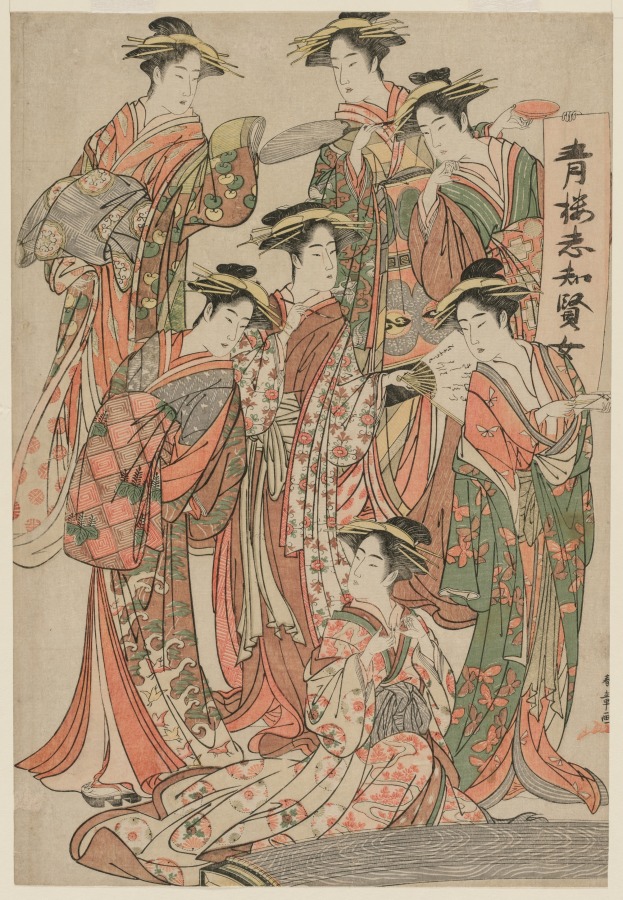
Seven Wise Women of the Pleasure Quarters
- Date:
- c. mid 1780s
- Medium:
- color woodblock print
- Source:
- Cleveland Museum of Art
Description
This Katsukawa Shunsho design, dated 1783 and held by the Cleveland Museum of Art, reworks the classical Chinese theme of the Seven Sages of the Bamboo Grove by transposing those scholar-recluses into a contemporary Edo setting of pleasure-quarter beauties. Such mitate, or parody-allusion, compositions were a favored device of late eighteenth-century ukiyo-e, allowing Shunsho to exhibit the technical refinement of the Katsukawa school within the bijin-ga tradition rather than within his more familiar yakusha-e specialty. The composition groups the seven figures across a horizontal field, each woman rendered with the close attention to coiffure, kimono pattern, and posture that defined the era's elite courtesan portraiture. Shunsho's role in bijin-ga production is sometimes overshadowed by his actor prints, yet works like this established the visual foundation for his student Kitagawa Utamaro's later innovations in the genre. The conceptual layer, in which Yoshiwara courtesans stand in for the legendary sages of third-century China, would have been instantly legible to Edo viewers familiar with the literary canon, and the humor of the substitution depended on viewers recognizing both the classical source and the contemporary subjects. The Cleveland Museum's sheet documents the Katsukawa school's range beyond the theater district and stands as an example of how Edo ukiyo-e artists used cross-cultural allusion to elevate the pictorial standing of the floating world's inhabitants.


