
Two Birds and Iris
- Date:
- Early 20th century
- Medium:
- Color woodblock print
- Source:
- Art Institute of Chicago
Description
Two Birds and Iris is an undated bird-and-flower (kacho-e) design by Katsushika Hokusai in the collection of the Art Institute of Chicago. The composition pairs a flowering iris stem with two small birds, possibly swallows or finches, in the kind of vertical kakemono-e or hashira-e format that Hokusai favored for his late kacho-e prints. Iris (kakitsubata or shobu) had been a beloved seasonal motif in Japanese poetry and painting since at least the Heian period, associated with early summer and with celebrated literary sites like Yatsuhashi. Hokusai distills the subject into a slender vertical movement: long iris leaves rise diagonally across the sheet, the open blossoms occupy a focal point near the upper third, and the birds animate the design with a swift counter-curve. The Art Institute of Chicago holds this impression in its Hokusai collection. As an Edo ukiyo-e print, Two Birds and Iris belongs to the kacho-e tradition that Hokusai developed in tandem with his major landscape series of the late 1820s and 1830s, particularly the famous untitled "large flowers" set and the related smaller bird-and-flower studies. These works tied ukiyo-e printmaking back to centuries of East Asian flower-and-bird painting while inflecting the genre with the bold flat color, crisp keyblock outlines, and decorative geometry of Hokusai's mature style. They remain among the most influential bird-and-flower images produced anywhere in the nineteenth century.
More Prints by Katsushika Hokusai
Hokusai manga (Hokusai Sketchbooks)
19th century
Woodblock-printed book; ink and light color on paper
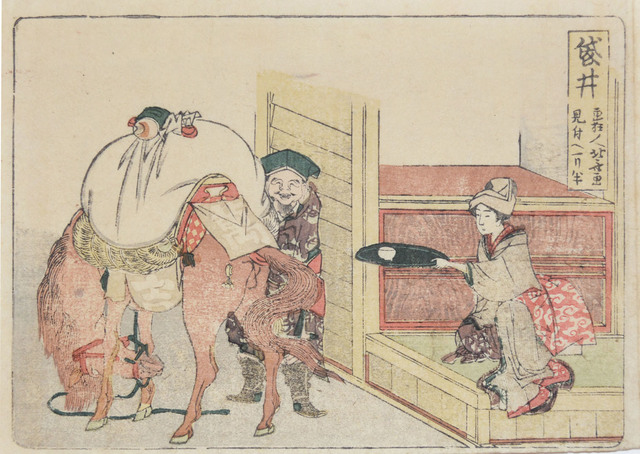
Fukuroi
1804
Japanese woodblock print

The Fishermen of Katase Hauling in Their Nets: The Purple Shell (Murasakigai)
1821
Color woodblock print with metallic pigments; surimono shikishiban

Burdock Root (Kurama gobo), from the series "A Selection of Horses (Uma-zukushi)"
1822
Color woodblock print; shikishiban, surimono
More Birds & Flowers Prints
Featured in Collections
Curated cross-cuts that include this print.
Frequently Asked Questions
Two Birds and Iris was created by Katsushika Hokusai (葛飾北斎) in Early 20th century.
Two Birds and Iris depicts birds & flowers and landscapes.