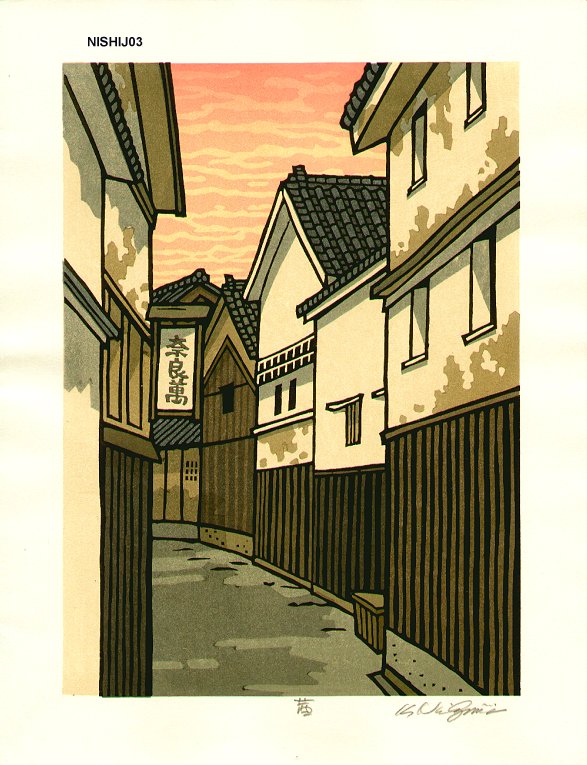
AKANE (Red Dye)
- Medium:
- Woodblock print
- Source:
- Watanabe Print
- Image courtesy of
- Watanabe Print
Description
Akane refers to the madder plant (Rubia argyi), historically cultivated in Japan for its roots, which yield a warm red-orange dye used extensively in textiles and traditional dyeing practice. Nishijima's print likely depicts either the plant itself in a garden or field setting, or more probably a scene evoking the dye's associations — perhaps a cloth merchant's district, a drying yard hung with akane-dyed fabric, or a Kyoto alley where the deep red of textiles contrasts with weathered wooden architecture. The compositional tension between the organic warmth of red-dyed cloth and the cool grays and silvers of wooden facades or stone pavement would be central to the work. Multiple woodblocks would be required to achieve the depth and variation within the red passages, likely with careful registration ensuring the color reads as saturated rather than flat. The subject connects Nishijima's architectural interests to the traditional craft economy of Kyoto's merchant districts.
More Prints by Katsuyuki Nishijima

Frequently Asked Questions
AKANE (Red Dye) was created by Katsuyuki Nishijima (西島勝之).